
What if the key to unlocking your property’s true potential isn’t found in rigid boundaries, but in the elegant balance of a shared vision? While many developers default to standard strata plans, a community title subdivision nsw offers a sophisticated “best of both worlds” approach that pairs individual land ownership with premium communal amenities. You’ve likely felt the weight of confusion when distinguishing between these legal frameworks, or perhaps you’re concerned about the updated 2026 NSW Land Registry Services requirements. It’s a complex path, and your desire for absolute clarity is entirely valid.
We’re here to ensure you master these complexities, transforming uncertainty into a confident strategy for your next project. This guide provides a clear roadmap through the subdivision process, highlighting how the April 2026 legislative reforms impact developer accountability and maintenance schedules. We’ll explore the nuances of community management statements and the precision required for legal mapping, giving you the tools to choose a title framework that reflects the high-quality craftsmanship of your development.
Key Takeaways
- Discover why a community title subdivision nsw represents the pinnacle of land flexibility, blending the permanence of Torrens ownership with the shared luxury of strata-style amenities.
- Gain absolute clarity on the legal distinctions between community, strata, and Torrens titles to select the framework that best protects your investment.
- Master the role of the Management Statement and Association Property to ensure your shared roads and green spaces are managed with care and precision.
- Learn how a meticulous detail and level survey forms the essential foundation for a successful development application and seamless council approval.
- Stay ahead of the 2026 reforms that prioritize developer accountability, ensuring your project remains compliant while maximizing its market value.
What is a Community Title Subdivision in NSW?
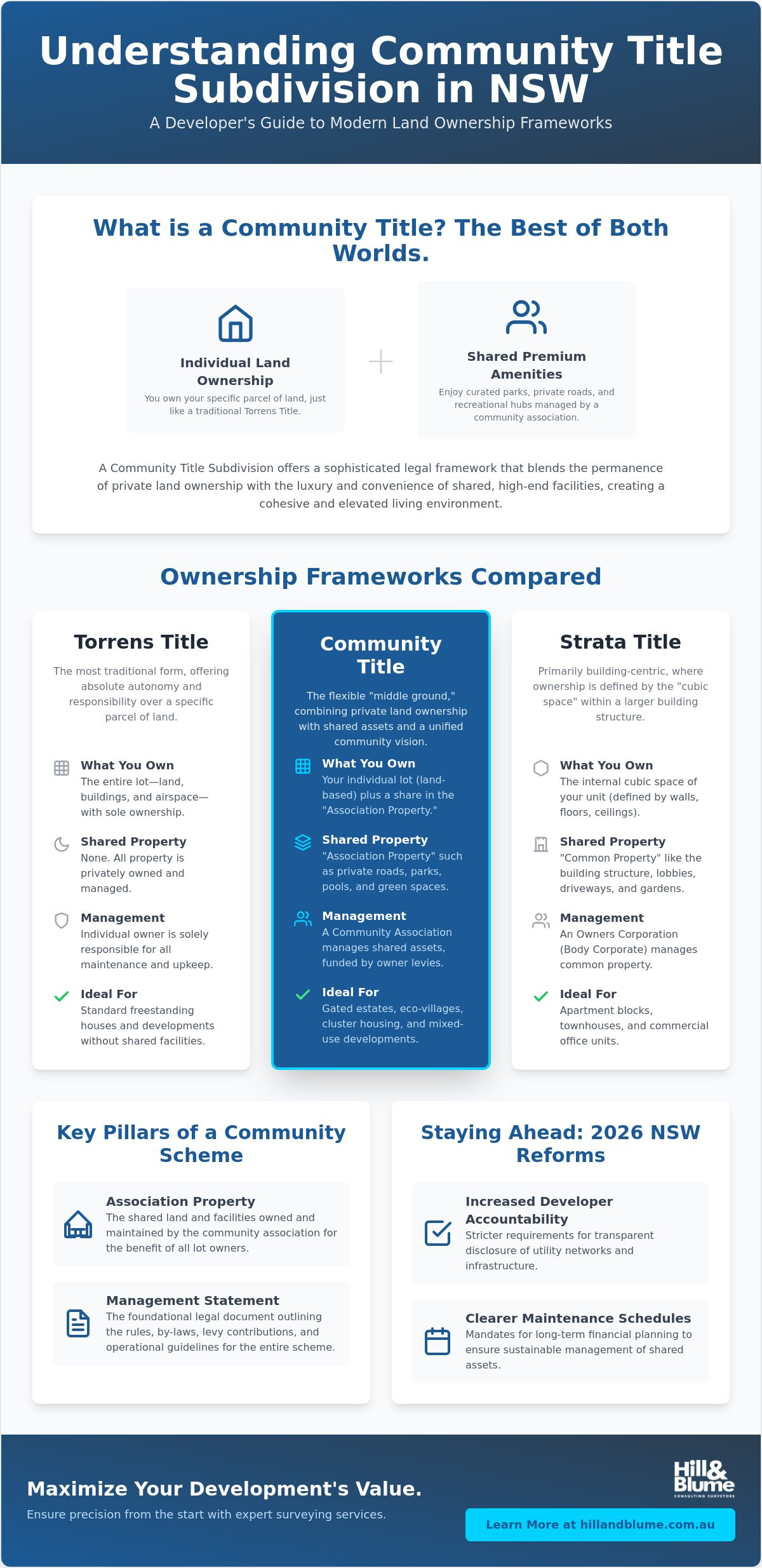
At its heart, a community title subdivision nsw is a sophisticated legal framework that allows you to own a specific parcel of land while enjoying the benefits of shared, high-end facilities. Governed by the Community Land Development Act 2021, this structure creates a harmonious balance between private sanctuary and collective lifestyle. You hold the title to your lot, much like a traditional property, yet you also become a member of an association that manages “Association Property.” This shared land might include private roads, curated parklands, or boutique recreational hubs that elevate the entire development’s appeal.
Australian planners often refer to this model as “Cluster Housing.” The term reflects a deliberate design choice to group dwellings together, which effectively preserves significant natural features or open spaces that would otherwise be lost in a standard subdivision. Within this framework, you’ll encounter three distinct layers: Community, Precinct, and Neighborhood schemes. A Community Scheme serves as the overarching umbrella, while Precinct and Neighborhood schemes allow for more granular management of specific areas within a larger estate. This nesting of titles ensures that complex, multi-stage developments remain organized and maintain their premium standards over time.
The Legal Framework in New South Wales
The Community Land Management Act 2021 provides the essential rules for how these communities operate, ensuring transparency and fairness for every owner. When you embark on this journey, your plans are registered through the NSW Land Registry Services (LRS), a process that requires absolute mathematical precision. As we move through 2026, new regulations have shifted the focus toward sustainable development and increased developer accountability. These updates mandate clearer disclosures regarding utility networks and maintenance schedules, ensuring that the dream you sell to future residents is grounded in long-term financial stability. It’s a modern approach that values the human element of property ownership just as much as the legal boundaries.
The “Middle Ground” Perspective
Choosing a community title is often a strategic decision to find the “middle ground” between different ownership styles. Unlike a standard Torrens Title subdivision, where you’re solely responsible for everything within your boundaries but have no control over the streetscape, community titles allow for a curated environment. When comparing Strata Title vs. Community Title, the difference lies in what you actually own. In strata, the boundaries are usually defined by the structure of a building. In a community scheme, the boundaries are land-based, offering you more freedom to design and build your home while still benefiting from shared infrastructure.
This flexibility makes it the preferred choice for private gated estates, eco-villages, and mixed-use hubs where a specific lifestyle vision is paramount. To ensure your vision is captured accurately from the start, engaging with specialized surveying services is vital. Precision in the early mapping stages prevents the legal friction that can arise from poorly defined association property, allowing you to focus on the craftsmanship and character of your development.
Community Title vs. Strata and Torrens Title: A Comparison
Choosing the right framework for your development is a decision that shapes the property’s future for decades. While Torrens title is the most traditional form of land ownership in NSW, offering absolute autonomy over your lot, it lacks the collaborative spirit found in shared schemes. A community title subdivision nsw bridges this gap. It provides the same land-based ownership as a Torrens title but introduces a shared management layer for communal assets, creating a premium environment that a single lot owner simply couldn’t maintain alone.
Strata title, by contrast, is fundamentally building-centric. It focuses on the internal “cubic space” of a unit or townhouse. In a community scheme, your ownership extends to the soil and the sky above your specific lot. This distinction is vital for those who value architectural freedom while desiring high-end, shared neighborhood features. Financing and insurance also reflect these differences; while strata insurance covers the building structure, community title owners typically insure their own homes individually, contributing only to the insurance of the association’s shared property.
To help you decide which path aligns with your project goals, consider these key operational differences:
- Ownership: Torrens is sole ownership; Strata is unit-based; Community is land-based with shared association property.
- Maintenance: Council handles Torrens streets; the Association manages all internal infrastructure in a community scheme.
- Control: Community titles offer a “best of both worlds” flexibility for building design and shared lifestyle standards.
Boundaries and Surveying Requirements
The precision required for these developments is absolute. Unlike strata plans that rely on structural walls, a community scheme requires a meticulous boundary survey to define the land area of each lot. Our surveyors mark physical pegs in the ground, establishing clear, permanent borders for your private sanctuary. In strata, the surveyor identifies structural lines within a building; in a community title, they map the very earth you stand on. This land-based approach provides a level of certainty and permanence that is highly prized in the Sydney market.
Ongoing Costs and Management
Understanding the financial commitment is essential for long-term success. While strata owners pay levies for building maintenance, community association contributions fund the upkeep of shared infrastructure like private roads, streetlights, and complex drainage systems. Because the council does not maintain these assets, the association must manage them with care. This self-governance often leads to higher property values and better resale potential, as the neighborhood’s aesthetic remains pristine and cohesive. If you’re weighing these options for your next project, you might find it helpful to discuss your vision with a local expert who understands the nuances of the NSW landscape.
Understanding Association Property and the Management Statement
In the delicate architecture of a community scheme, the soul of the project lives within Lot 1. Unlike a standard subdivision where every lot is destined for a private dwelling, a community title subdivision nsw designates Lot 1 as the Association Property. This isn’t merely a leftover parcel of land; it’s the anchor of the entire development. It encompasses the private roads that lead residents home, the curated parklands where neighbors gather, and the complex web of utilities that keep the community running smoothly. By holding this land collectively, you create a sense of place that is both exclusive and enduring.
The Community Management Statement (CMS) acts as the development’s constitution. This document isn’t just a legal necessity; it’s the guardian of your vision. It dictates the “theme” of the neighborhood, ensuring that the high-end aesthetic and lifestyle you’ve promised are preserved for decades. Whether you’re establishing an eco-village with strict sustainability goals or a premium gated estate, the CMS provides the rules of engagement. It ensures that every resident is aligned with the community’s values, protecting property values and fostering long-term harmony among owners.
Drafting the Community Management Statement
Creating a robust CMS requires a blend of legal foresight and architectural sensitivity. It covers mandatory by-laws required by NSW law, but its true power lies in the optional by-laws you choose to include. These might control everything from building materials and landscaping palettes to the management of shared recreational hubs. Following the April 2026 reforms, developers must now engage an independent surveyor to review and certify the initial maintenance schedule. This adds a layer of transparency and trust, ensuring that levy estimates are grounded in reality rather than optimistic projections. A well-crafted CMS prevents the friction that can arise when expectations aren’t clearly defined from the outset.
Defining Shared Infrastructure
The technical precision required to map Association Property is where the surveyor’s craftsmanship truly shines. We must define the exact limits of shared infrastructure, ensuring that every pipe, cable, and pathway is correctly accounted for within the community plan. This involves creating intricate easements and rights of way to manage shared services like water, electricity, and the increasingly complex embedded utility networks. Under the 2026 regulations, disclosure of these networks in contracts for sale is now mandatory. Our specialized surveying services ensure that these boundaries are legally watertight, preventing the costly disputes that often stem from ambiguous mapping of shared assets.
The Step-by-Step Path to a Community Title Subdivision
The journey toward a successful community title subdivision nsw is a deliberate, multi-phase process. It begins with a deep understanding of your land’s physical character. You’ll start with an initial site assessment and a comprehensive contour and detail survey. This isn’t just a map. It’s the essential foundation for your vision. Once the data is secured, you’ll lodge your Development Application (DA) with the local council. This stage requires patience and a clear narrative of how your project enhances the local fabric.
After receiving council approval, you’ll move into the construction phase. This involves obtaining a Subdivision Works Certificate and building the shared infrastructure you’ve envisioned. As the physical work nears completion, the focus shifts back to legal precision. You’ll need final surveying to verify that everything built matches the approved plans, alongside the finalization of your Community Management Statement. The final step is the formal registration with NSW Land Registry Services (LRS). With the 2026 fee schedule now in effect, including the $182.71 fee for plan amendments, having a partner who understands these bureaucratic nuances ensures a smooth transition to the issuing of new Certificates of Title.
Navigating Council and Regulatory Approvals
Councils in Sydney and Newcastle have distinct expectations. You might face unique requirements for stormwater management or heritage preservation that require a nuanced approach. Managing the Subdivision Certificate (SC) application requires a steady hand and meticulous documentation. With over 90 years of collective experience, we’ve learned how to navigate local planning panels with calm confidence. We don’t just submit forms; we advocate for the integrity of your project at every turn.
Final Survey and Plan Registration
The accuracy required at this stage is absolute. A final subdivision survey ensures that the lot boundaries and Association Property are exactly where they should be. Once the LRS registers the plan and the CMS, the original parcel of land is legally transformed into individual titles. This is the moment your vision becomes a tangible reality. If you’re ready to begin this journey with a partner who values quality over volume, reach out to our team today to secure your project’s foundation.
Maximizing Development Value with Professional NSW Surveying
Unlocking the full potential of your land requires more than just a vision; it demands a foundation of absolute certainty. In the intricate process of a community title subdivision nsw, the decisions made during the initial survey ripple through every subsequent phase of the project. A single misplaced boundary or an overlooked easement can lead to years of legal friction and diminished property value. By prioritizing precision from the outset, you aren’t just meeting regulatory requirements; you’re safeguarding the future of your community and the integrity of your investment.
At Hill & Blume, we believe that property development is a deeply personal endeavor. We’ve spent over 90 years refining our craft, moving beyond the clinical nature of corporate surveying to offer a boutique, relationship-driven experience. Our legacy is built on the belief that quality should never be sacrificed for volume. Whether you’re planning a sophisticated gated estate in Sydney, a modern mixed-use hub in Newcastle, or an eco-conscious retreat on the Central Coast, we provide the steady hand and specialized local knowledge your project deserves. We understand the unique charm of these regions and how to navigate the specific council expectations that define them.
The Hill & Blume Difference: Accuracy and Integrity
We utilize advanced measurement technology to capture every nuance of your site’s topography with effortless precision. This technical prowess is paired with a commitment to clear, purposeful communication, ensuring you’re never left wondering about the status of your project. Engaging a registered surveyor is an essential step in securing your title security. Only a registered professional has the legal authority and specialized training to certify the plans that define your property rights, providing the ultimate seal of quality for your investment while ensuring full compliance with 2026 NSW standards.
Partnering for Your Next Project
Our work spans the entire lifecycle of your development, from the first site visit to the final LRS registration. We act as a trusted bridge between your aspirations and the rigorous demands of the NSW Land Registry Services, ensuring every detail is polished and purposeful. We’re proud to support architects, developers, and homeowners alike, offering tailored solutions that respect both your time and your intelligence. If you’re ready to master the complexities of your next development, we invite you to speak with our expert team about your community title goals. Let’s work together to create something exceptional, anchored by traditional integrity and a personal touch.
Your Legacy Begins with a Precise Foundation
Transforming a vision into a lived reality is a journey of meticulous stewardship. You’ve explored how a community title subdivision nsw offers the rare freedom of land ownership alongside the refined benefits of shared amenities. From mastering the nuances of the Management Statement to navigating the latest 2026 regulatory updates, you now possess the clarity needed to lead your project with confidence. Success in these complex schemes isn’t just about lines on a map; it’s about the integrity of the relationships and the precision of the data that support them.
Since 1932, Hill & Blume has stood as a seal of quality for those who value craftsmanship in every detail. With over 90 years of surveying excellence, we are specialists in NSW Land Registry Services compliance, trusted by Sydney’s leading developers and architects to protect their most ambitious visions. We invite you to Contact Hill & Blume for a Comprehensive Subdivision Consultation and discover the peace of mind that comes from a boutique, relationship-driven partnership. Your property’s potential is vast, and with the right expert guidance, its future is perfectly secure.
Frequently Asked Questions
What is the main difference between community title and strata title in NSW?
The primary distinction lies in the physical nature of what you own. In a community scheme, you own a specific parcel of land and everything upon it, whereas strata ownership is defined by the cubic space within a building. This land-based approach offers you greater architectural freedom while still providing access to shared facilities managed by an association.
How much does it cost to set up a community title subdivision in NSW?
The total investment for a community title subdivision nsw typically ranges from $20,000 to over $90,000 depending on the project’s complexity. You’ll need to account for council application fees, which often fall between $2,000 and $5,000, and mandatory developer contributions that can range from $10,000 to $40,000. Professional fees for surveyors and planners generally range from $12,000 to $18,000 for a standard two-lot project.
Can I convert an existing Torrens title lot into a community title?
You certainly can. This process involves lodging a new plan of subdivision with your local council and the NSW Land Registry Services. It’s a strategic way to add value to a large parcel of land by creating multiple lots that share a private driveway or curated green space, effectively transforming a single property into a cohesive lifestyle cluster.
What are the ongoing responsibilities of a Community Association?
The association acts as the steward of your shared environment. They manage the upkeep of “Lot 1,” which includes private roads, streetlights, and complex drainage systems. Under the April 2026 reforms, they must also ensure maintenance schedules are independently certified, protecting the long-term financial health and aesthetic standards of the entire scheme.
How long does the community title subdivision process typically take?
Most projects reach completion within 6 to 18 months. Your timeline is influenced by the speed of council approvals and the time required to construct shared infrastructure. Engaging a partner who understands the rhythm of local planning panels can help ensure your project moves forward with steady, deliberate momentum.
Is a community title subdivision suitable for small developments?
It’s an excellent choice for boutique projects. While often associated with large estates, “Neighborhood Schemes” allow smaller groups of owners to share private access or unique landscaping features. This framework provides a sense of exclusivity and shared pride that standard subdivisions often fail to capture.
What is the role of a registered surveyor in a community title scheme?
A registered surveyor is the guardian of your property’s legal integrity. They define the physical boundaries of your land and the precise limits of the Association Property. Since the 2026 legislative changes, they also play a vital role in reviewing maintenance schedules to ensure developer accountability for new multi-storey schemes.
Are there specific council requirements for community titles in Sydney?
Sydney councils maintain rigorous standards for infrastructure and developer contributions. You’ll need to navigate specific Section 7.11 or 7.12 levies, which vary significantly between local government areas. They often require detailed plans for stormwater management and a cohesive architectural theme that respects the unique character of the local neighborhood.
Disclaimer
The information provided in articles published on this website is for general informational purposes only. While we make every effort to ensure the accuracy, completeness, and timeliness of the content, the material is based on our understanding of the industry at the time of writing and may not reflect the most current developments, regulations, or standards. All opinions expressed in our articles are those of the respective authors and do not necessarily represent the official position of the website or its affiliates. The content should not be considered professional, legal or technical advice, and should not be relied upon as a substitute for consultation with qualified professionals