

What if the key to unlocking an additional 20% of your property’s market value wasn’t a designer renovation, but a shift in how your home is legally defined? For many owners in Sydney’s established neighborhoods, the journey toward a strata title conversion nsw can feel clouded by the restrictive nature of company title lending and the anxiety of navigating complex Land Registry Services requirements. You’ve likely felt the frustration of shareholder disputes or the fear that your property’s true worth is being stifled by an outdated legal structure.
It’s a common hurdle, but one that’s entirely surmountable with a partnership-oriented approach. This guide provides the precise roadmap you need to navigate this transition, ensuring your legal boundaries perfectly align with the physical reality of your home. We’ll walk you through the updated 2026 LRS fee structures, the critical role of professional surveying in securing your title, and the step-by-step process that turns a shared company interest into a secure asset that reflects the true quality and character of your property.
Key Takeaways
- Discover the fundamental shift from owning company shares to holding a fee-simple title, providing you with direct ownership of your individual lot.
- Learn how to navigate the legal prerequisites, including the 75% majority vote required to move forward with your building’s transformation.
- Understand the “strata premium” and how a strata title conversion nsw typically enhances both property valuation and lending flexibility.
- Gain a clear, five-step roadmap from initial feasibility to final registration, ensuring a seamless transition for all shareholders.
- See why precise surveying is the cornerstone of a successful conversion, protecting your investment with decades of local expertise.
Understanding Strata Title Conversion in NSW: Beyond the Basics
At its heart, a strata title conversion nsw represents a sophisticated evolution of your property’s legal identity. It is the deliberate transition from holding shares in a company to possessing individual fee-simple ownership. While company title was once the standard for Sydney’s grandest apartment blocks, today’s market demands a more transparent and flexible form of tenure. Converting your building doesn’t just change a document; it fundamentally redefines what you own. You move from having a right to occupy a space based on a share certificate to holding an absolute title to a specific lot.
In 2026, we are seeing a significant shift as owners of Sydney’s heritage and mid-century buildings recognize that their homes deserve a modern legal framework. As Understanding Strata Title reveals, this system was pioneered in New South Wales to provide a clearer path to ownership. To bridge the gap between your existing corporate structure and a new strata scheme, the expertise of a Registered Surveyor is essential. They translate the physical reality of your walls and boundaries into the precise legal language required for Strata and Community Title Plans, ensuring your new title is as accurate as it is valuable. It’s a process that honors the craftsmanship of the past while embracing the security of the future.
What is Company Title Property Ownership?
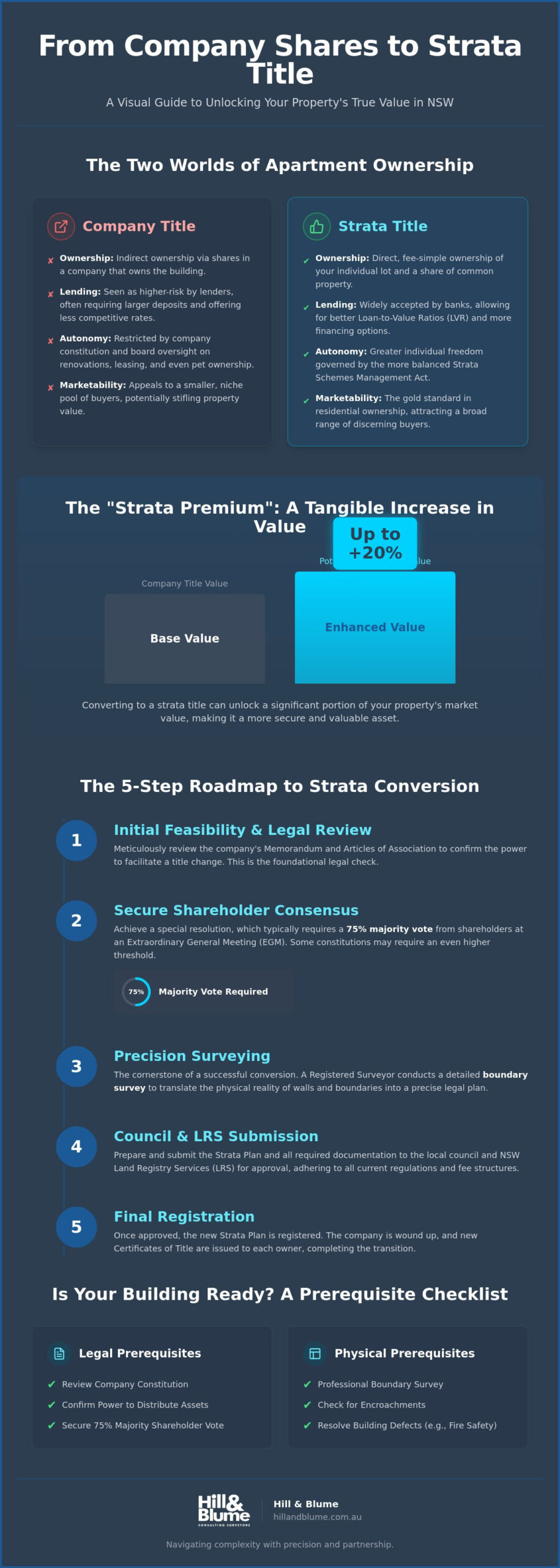
Before the introduction of strata legislation in 1961, Sydney’s apartment landscape relied on the share-block system. In this model, a company owns the entire building and land. When you buy an apartment, you’re actually purchasing a specific class of shares that grants you the exclusive right to live in a particular unit. It’s a collective arrangement governed by a company constitution, which often dictates everything from who can rent your home to whether you can keep a pet. Because this structure is more complex than a standard title, many modern lenders view it as higher-risk collateral, often requiring larger deposits and offering less competitive interest rates.
The Strategic Benefits of Converting to Strata
Choosing to convert is a statement of confidence in your property’s future. Strata title is widely considered the gold standard for residential ownership in Australia, instantly making your home more attractive to a broader pool of discerning buyers. Professionals who specialise in property acquisition, such as Anna O’Neill Buyer’s Agent, often highlight the value of clear titles to their clients when identifying premium investment opportunities. Beyond marketability, the financial advantages are compelling. Owners often find they can access significantly better Loan-to-Value Ratios once the conversion is complete, as banks provide more favorable terms for individual titles than for company shares. You also gain a renewed sense of individual autonomy. The restrictive oversight of a company board is replaced by the more balanced framework of the Strata Schemes Management Act 2015, giving you greater freedom to renovate, lease, and enjoy your home on your own terms. It’s about securing your investment through a refined, partnership-oriented approach to property management.
The Legal and Physical Prerequisites for Conversion
Before you can register a new plan, you must ensure the foundation of your building’s legal and physical structure is sound. This journey begins with a meticulous review of your company’s Memorandum of Association and Articles of Association. You’re looking for the specific power to distribute assets to shareholders or to facilitate a title change. In most cases, achieving a strata title conversion nsw requires a special resolution, which demands a 75% majority vote from shareholders. Some older constitutions may even require a higher threshold, so verifying these numbers early is vital to avoid future roadblocks.
While the legal documents set the stage, a boundary survey is the first physical step in checking your site’s viability. It’s a process of verification that ensures your building actually sits where the records say it does. Councils are often hesitant to approve conversions if there are significant encroachments or unresolved building defects, particularly regarding fire safety standards. You can find more detailed regulatory guidance on these requirements via the NSW Government’s Strata Hub, which serves as a central resource for compliance during this transition.
Securing Shareholder and Board Consensus
The human element of a conversion is just as important as the technical one. Holding an Extraordinary General Meeting (EGM) allows the board to present a unified vision and address the very real concerns of the community. Owners often worry about the immediate costs, potential Capital Gains Tax implications—which can be clarified by financial specialists like KHT Accounting & Wealth—or the disruption of surveyors moving through the building. Addressing these points with transparency fosters a partnership-oriented atmosphere. A unified front doesn’t just make the process smoother; it prevents the kind of costly litigation that can stall a project for years. When everyone understands the long-term value uplift, the path to that 75% majority becomes much clearer.
The Surveyor’s Role in Defining the New Boundaries
A surveyor’s task is to translate the “exclusive use” rights found in your company books into clearly defined, registered strata lots. This involves more than just measuring walls; it’s about identifying exactly where private ownership ends and common property begins. Your balconies, car spaces, and even small storage cages must be precisely accounted for in the new plan to ensure every owner receives exactly what they are entitled to. It’s a high-stakes task that requires absolute precision. A registered surveyor is the only professional authorised to sign off on these plans, providing the legal certainty required by the Land Registry Services. If you’re ready to define your property’s future with this level of detail, we invite you to reach out to our specialist team for a preliminary discussion.
Comparing the Value: Is the Conversion Worth the Investment?
Investing in a transition of this magnitude is about more than just a legal adjustment; it’s a strategic enhancement of your property’s legacy. In Sydney’s most prestigious postcodes, the “strata premium” is a tangible reality that owners can no longer ignore. Properties often see a valuation uplift of 10% to 20% simply by transitioning to a standard title. This isn’t just a speculative figure. It’s a reflection of how the market prizes the transparency and protection offered by the Strata Schemes Management Act 2015. By moving away from the bespoke, often restrictive rules of a company constitution, you’re adopting a robust, modern framework that every buyer and lender understands.
Beyond immediate capital growth, a strata title conversion nsw future-proofs your building for any subsequent ambitions. If you’re considering a rooftop addition, a basement conversion, or perhaps splitting a larger unit, having an established strata plan makes the path forward much clearer. It simplifies the requirements for future subdivision surveys, ensuring that any physical changes to the building are easily reflected in the legal titles. You aren’t just solving today’s financing hurdles; you’re paving a sophisticated way for tomorrow’s possibilities.
Marketability and Financing Advantages
Conservative investors and sophisticated buyers often shy away from company title due to its perceived complexity and the need for board approval. Strata title removes these barriers, opening your home to the widest possible audience. In 2026, bank valuations for strata lots remain significantly more favorable than their company title counterparts. This often allows you to access higher Loan-to-Value Ratios, which facilitates easier refinancing or a smoother sale when the time comes. The entire conveyancing process becomes a standard, polished experience that respects the time and intelligence of all parties involved.
Managing the Conversion Budget and Timeline
While the transition requires a considered investment in legal counsel, surveying expertise, and Council fees, the long-term reward justifies the initial outlay. You’ll need to account for major cost centers including Council Development Application (DA) fees and the annual LRS lodgement fees, which were updated in July 2026. A typical conversion might span six to twelve months, depending on the building’s complexity and the speed of shareholder consensus. Engaging a surveyor to lead the project management can significantly reduce these timelines. They act as the essential bridge between your board, the local Council, and the Land Registry Services, ensuring every detail is purposeful and every lodgement is handled with calm confidence.
The 5-Step Roadmap to Strata Title Registration in NSW
Transitioning your property requires a methodical, considered approach. It isn’t merely a paperwork exercise; it’s a physical and legal re-alignment of your home’s identity. This roadmap ensures that every stakeholder moves in unison toward a shared goal of increased security and value. While the legal framework provides the structure, the physical survey provides the proof. Following these steps carefully will help you navigate the strata title conversion nsw with calm confidence.
- Step 1: Feasibility and Board Approval. Review your company constitution and secure the necessary 75% majority vote. This initial consensus is the bedrock of a successful transition.
- Step 2: Development Application (DA). Submit your proposal to the local Council. This step formalizes the change of title and ensures the building meets modern safety and planning standards.
- Step 3: Physical Survey and Plan Drafting. This is the technical heart of the process. A surveyor meticulously measures the entire building to create the formal Strata Plan.
- Step 4: Final Certification. Once the DA conditions are met, you’ll obtain a Strata Certificate from Council or a private certifier. This verifies that the building is ready for its new legal status.
- Step 5: LRS Lodgement. The final act involves registering your new plans with Land Registry Services. This cancels the old company title and issues individual Certificates of Title for every lot.
Navigating the Council DA Process
Sydney councils approach conversions with a keen eye for compliance. They typically focus on fire safety, parking allocations, and overall building standards. To support your application, a contour and detail survey is often required. This provides Council with an accurate representation of the site’s topography and existing structures. If the Council requests building upgrades, such as improved fire doors or window seals, view these as investments in your community’s safety rather than mere hurdles. Handling these requests with a partnership-oriented mindset often leads to a smoother, faster approval process.
Creating a Compliant Strata Plan
In 2026, the technical standards for Strata Plans are higher than ever. Plans must be delivered in specific digital formats that meet rigorous precision standards. This is where the surveyor’s craftsmanship truly shines. We calculate unit entitlements based on the relative value of each lot, which determines your future levies and voting power. It’s a delicate balance that requires deep local knowledge and an aesthetic for detail. The surveyor’s signature on the final plan is more than just a requirement; it’s a seal of quality that ensures your strata title conversion nsw stands up to legal scrutiny. If you’re ready to begin this meticulous journey, speak with our specialist surveyors today to arrange your initial site assessment.
Why Hill & Blume is Your Trusted Partner for Strata Conversions
Hill & Blume represents a legacy of precision that spans over 90 years. We’ve seen Sydney evolve from a collection of colonial townships into a world-class metropolis. Throughout this growth, our commitment to property integrity hasn’t wavered. When you embark on a strata title conversion nsw, you aren’t just hiring a technical service; you’re engaging a specialized local authority. We understand that these conversions are high-stakes. They require a delicate balance of technical mastery and interpersonal diplomacy. It’s a journey we’ve navigated many times, always with a focus on the human element of real estate.
Our boutique approach ensures that your building isn’t just another file in a cabinet. We prioritize the depth of relationship over high-volume turnover, offering a tailored solution that mirrors the seamless service you expect from a premium agency. Our experts work in close partnership with your legal team, providing the foundational data they need to draft documents with absolute confidence. From complex construction set-out projects to the most intricate strata plans for landmark buildings, our work serves as a seal of quality. We believe every project deserves a hand-crafted feel that distinguishes it from the clinical approach of larger corporate firms.
The Precision of a Boutique Sydney Authority
Regarding permanent property boundaries, “close enough” is a phrase we simply don’t recognize. Defining these limits requires a level of craftsmanship that only comes from nearly a century of specialized experience. We possess a deep, intuitive understanding of local council requirements across Sydney, Newcastle, and the Central Coast. This regional expertise allows us to anticipate potential hurdles before they become delays. Engaging a registered professional from our firm provides the peace of mind that your investment is anchored by traditional integrity and a personal touch. It’s about ensuring your legal titles match the physical reality of your home with effortless accuracy.
Taking the First Step Toward Modern Ownership
The journey toward a more flexible and valuable property structure begins with a considered conversation. We invite you to book a preliminary consultation to assess your building’s unique conversion potential. During this meeting, we’ll review your existing plans and discuss the physical requirements for your specific site. To make our first meeting most productive, it’s helpful to have any existing company title documents or previous surveys ready for review. This initial step is about more than just data; it’s about establishing the trust and clarity needed for a successful partnership. We’re here to guide you through every step of the strata title conversion nsw with calm confidence and expert care.
Contact Hill & Blume today to discuss your strata title conversion needs.
Securing Your Property’s Future with Confidence
Transitioning from company title is a significant milestone that honors the history of your building while embracing the financial and legal clarity of the modern market. You’ve seen how a strata title conversion nsw unlocks untapped market value and provides owners with the autonomy they deserve. By following a clear roadmap from board consensus to final registration, you ensure your investment is protected by the robust framework of current legislation. It’s a journey that turns a shared corporate interest into a definitive, individual asset.
At Hill & Blume, we bring over 90 years of Sydney surveying expertise to every project. As Registered NSW Surveyors, we specialize in the complex strata and community title plans that define our city’s finest residences. We understand that precision is the foundation of trust, and we’re committed to providing the detail-oriented service your property requires. Our boutique approach means your transition is handled with the care and exclusivity it deserves.
Request a Professional Survey Quote for Your Strata Conversion
Let’s work together to turn your property’s potential into a lasting, secure reality.
Frequently Asked Questions
Is it compulsory to convert company title to strata title in NSW?
No, converting from company title is not compulsory in New South Wales. It remains a voluntary decision made by the shareholders of the owning company. While there’s no legal mandate to change, many building communities choose a strata title conversion nsw to align with modern lending standards and to realize the full market value of their individual homes.
How long does the strata title conversion process typically take in Sydney?
A typical conversion in Sydney generally takes between six and twelve months to complete. This timeline encompasses the initial feasibility study, the shareholder voting process, and the local Council’s Development Application assessment. Delays can occur if building upgrades are required; however, engaging an experienced surveyor to manage the technical lodgements can often streamline the path toward final registration.
What is the minimum shareholder majority needed to approve a conversion?
You generally need a special resolution passed by a 75% majority of shareholders to approve the transition. It’s essential to review your specific Memorandum and Articles of Association early. Some older constitutions might require an even higher threshold for distributing assets. Achieving this consensus is the most critical human element of the entire legal and physical journey.
Can a building be “too old” for strata title conversion?
No building is technically too old for conversion, provided it’s structurally sound and can meet essential safety requirements. Sydney is home to many beautiful heritage apartment blocks that have successfully transitioned to strata title. The process honors the architectural craftsmanship of the past while providing owners with a modern legal framework that ensures their property remains a viable, secure asset.
Do we need to upgrade the building to modern fire standards to convert?
Yes, meeting modern fire safety and building standards is almost always a requirement for Council approval. When you submit a Development Application for a strata title conversion nsw, the Council will assess the building’s current compliance. They may issue conditions requiring upgrades to fire doors or smoke alarms. These improvements don’t just facilitate the conversion; they enhance the safety of the entire community.
How is unit entitlement determined in a new strata plan?
Unit entitlement is determined by a professional assessment of the relative market value of each lot within the scheme. This isn’t just about square meterage. It considers factors like views, floor level, and private outdoor space. These entitlements are crucial because they dictate your share of the annual levies and the weight of your vote in owners’ corporation decisions, ensuring a fair balance.
What happens to our existing mortgages during the conversion process?
Your existing mortgages will need to be discharged and replaced with new ones that reflect the individual strata title. This happens simultaneously with the registration of the new strata plan at Land Registry Services. It’s a coordinated effort where your bank or lender releases their interest in the company shares in exchange for a mortgage over the specific lot you now own outright.
How much does a strata plan survey cost for an apartment block?
The cost of a strata plan survey depends entirely on the complexity and scale of your building. Factors like the number of units, the presence of car spaces, and the quality of existing records all influence the final investment. We recommend a preliminary consultation to assess your building’s unique requirements. This allows us to provide an accurate, transparent scope that respects your community’s budget and timeline.
Disclaimer
The information provided in articles published on this website is for general informational purposes only. While we make every effort to ensure the accuracy, completeness, and timeliness of the content, the material is based on our understanding of the industry at the time of writing and may not reflect the most current developments, regulations, or standards. All opinions expressed in our articles are those of the respective authors and do not necessarily represent the official position of the website or its affiliates. The content should not be considered professional, legal or technical advice, and should not be relied upon as a substitute for consultation with qualified professionals