
What if the true value of your Sydney property isn’t found in its current footprint, but in the strategic lines you’ve yet to draw? Securing a specialized subdivision surveyor sydney developers and homeowners trust is often the catalyst that turns a complex parcel of land into a high-yield investment. You’ve likely felt the weight of uncertainty that comes with shifting NSW planning laws, or perhaps you’ve felt the quiet fear that a boundary dispute could stall your progress for months. It’s a common concern in a city where every centimetre counts and the regulatory landscape is constantly in motion.
We understand that you’re looking for more than just technical drawings; you’re seeking a clear path through the technicalities of the 2026 planning reforms. This guide provides the expert clarity you need to master the latest requirements, including the April 1st community land law updates and the new centralized referral systems. We’ll walk through the essential stages of titling and surveying, showing you how to maximize your property’s potential while ensuring a seamless journey from your initial DA to the final registration of your new titles.
Key Takeaways
- Learn why a Registered Surveyor is the only professional legally permitted to define your land’s boundaries and secure your property’s legal standing.
- Gain a clear roadmap from your initial site survey to final title registration with a specialized subdivision surveyor sydney who understands the nuances of local council approvals.
- Explore the distinct advantages of Torrens, Strata, and Community titles to determine which path offers the most sophisticated solution for your project.
- Uncover the variables that shape project timelines and costs, from site complexity to the clarity of historical land records.
- Understand how a legacy of precision and deep local knowledge can resolve complex boundary issues and safeguard your property’s long-term value.
Defining the Role of a Subdivision Surveyor in Sydney
In the intricate tapestry of Sydney’s urban landscape, a subdivision surveyor sydney acts as a custodian of both your property’s heritage and its future potential. While many view surveying as a simple act of measurement, it’s truly a discipline of legal definition. You aren’t just hiring someone to hammer pegs into the ground; you’re engaging a professional who translates physical space into a legally recognized asset. This role is pivotal because every new lot created must be perfectly aligned with the state’s rigorous standards for accuracy and transparency.
Our city’s unique geography, from the rugged sandstone cliffs of the coast to the established enclaves of the inner west, presents a complex puzzle of historical land titles. Some of these records date back to the earliest days of colonial settlement, requiring a meticulous eye to decode. Properly managing a Subdivision (land) project requires a deep intimacy with these cadastral records to ensure your new boundaries are beyond reproach. Choosing a specialized subdivision surveyor sydney means you’re investing in a partner who manages the delicate bridge between your vision and the NSW Land Registry Services (LRS).
The Legal Authority of a Registered Surveyor
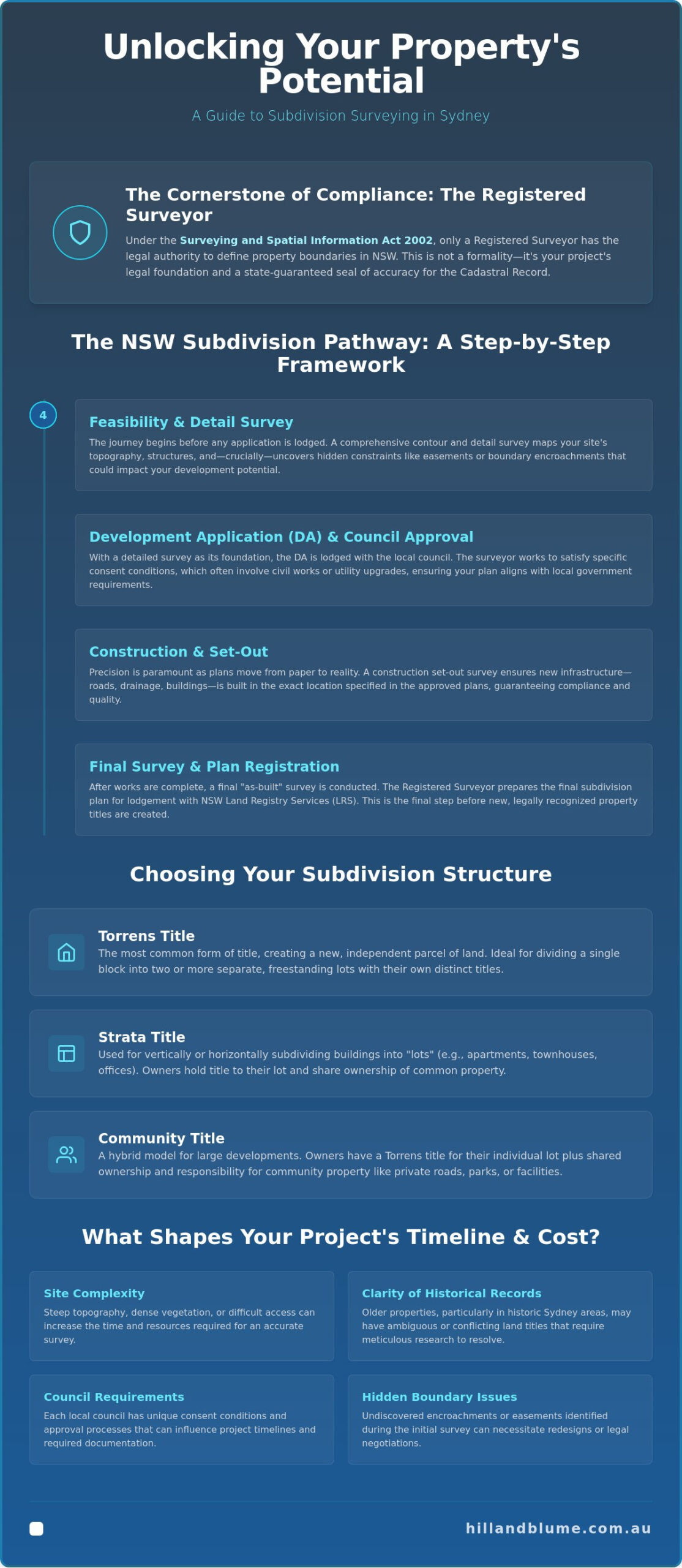
Under the Surveying and Spatial Information Act 2002, only a Registered Surveyor holds the legal authority to determine the position of a property boundary in New South Wales. This isn’t a mere formality. It’s a protection for you and the broader community. When you lodge a plan, the signature of a Registered Surveyor serves as a guarantee of accuracy for the state’s Cadastral Record. Without this status, a plan cannot be registered. It’s the essential difference between an informal sketch and a binding legal deed that secures your investment for generations.
When to Engage a Subdivision Specialist
The most successful projects begin long before the first shovel hits the earth. You should engage a specialist during your feasibility stage to uncover hidden boundary encroachments or easement issues that could derail a Development Application. We often work alongside architects to provide precise subdivision plans and detail surveys, ensuring their designs are grounded in physical reality. With a 90-year legacy in interpreting Sydney’s oldest titles, we provide a level of discernment that transforms uncertainty into a clear, actionable strategy for your land.
Navigating the NSW Subdivision Process: A Step-by-Step Framework
The journey from a single title to a multi-lot development is a sophisticated legal and physical transformation. Unlike the processes found in other states, the NSW framework is uniquely rigorous, requiring a precise sequence of approvals that begins long before any soil is moved. Your success depends on a rhythmic progression through local council requirements and state regulations. By engaging a dedicated subdivision surveyor sydney, you ensure that every technical detail aligns with the professional standards set by the Association of Consulting Surveyors NSW.
Phase 1: Feasibility and Detail Surveys
Before you submit a Development Application (DA), you must understand the hidden constraints of your land. This begins with a comprehensive contour and detail survey to map the site’s topography and existing structures. We look beyond the surface to identify existing easements or drainage rights that could restrict your subdivision potential. The Detail Survey is the foundation of any successful DA. Without this initial clarity, your project risks costly redesigns or council rejection during the early assessment stages.
Phase 2: Council Approval and Construction
Once your DA is lodged, we collaborate with local councils across Sydney, Newcastle, and the Central Coast to satisfy their specific consent conditions. These conditions often involve civil works or utility upgrades that require a precise construction set-out to ensure new infrastructure is built exactly where it’s planned. This phase is about compliance and craftsmanship. After construction is complete, we assist in obtaining the Subdivision Certificate (SC), which serves as the final council green light before moving to the legal registration of your new lots.
The final, and perhaps most critical, step involves the creation of the Section 88B instrument. This legal document defines the easements, restrictions, and covenants that will govern the new lots. It’s a delicate piece of legal drafting that requires the expertise of a subdivision surveyor sydney to ensure your property’s value is protected and clearly defined. Once the plan and the 88B instrument are finalized, they are lodged with the NSW Land Registry Services (LRS) for registration. If you’re ready to begin this journey with a partner who values precision, you might find it helpful to discuss your project’s specific needs with our team.
Choosing Between Torrens, Strata, and Community Title Subdivisions
Selecting the right title structure is a strategic decision that shapes how your property is perceived by the market. It’s not just about drawing lines; it’s about defining the nature of ownership itself. Whether you’re looking at a simple backyard split or a sophisticated multi-dwelling development, your choice will dictate the long-term management and saleability of the lots. Just as professional presentation is vital for market appeal, you can discover Houzpics | Real Estate Photographers in Hilton Head, SC to see how high-quality media can elevate a property’s presence. As your subdivision surveyor sydney, we help you weigh these options against your specific project goals and the unique character of your local area.
Torrens Title: The Sydney Standard
Torrens Title remains the most coveted form of ownership in our local suburbs. It offers absolute ownership of both the land and the structures upon it, without the need for a shared management body. This independence is highly attractive to Sydney buyers who value autonomy and the freedom to manage their property without external oversight. The process involves creating a new Deposited Plan (DP), a precise legal document that we craft to meet the official NSW subdivision process requirements. It’s the traditional “side-by-side” split that remains the gold standard for residential value.
Strata and Community Options
When your vision involves shared spaces, shared walls, or vertical living, Strata and Community titles offer the necessary legal flexibility. Strata Title is the ideal vehicle for dual occupancies, townhouses, or apartment developments where common property must be managed collectively. Engaging a strata plan surveyor in Crows Nest or across Greater Sydney ensures that these shared boundaries and common areas are defined with absolute clarity. You’ll need to establish an owners corporation to handle ongoing maintenance and insurance, which is a standard and well-understood expectation for modern urban living.
For larger estates or boutique developments with shared private infrastructure, such as private roads, gated entries, or recreational facilities, Community Title provides a sophisticated solution. It allows for individual lot ownership while maintaining a community scheme to manage the shared assets. This structure is increasingly popular in master-planned areas where residents value a curated environment and exclusive amenities. Each title type has its own nuances, and the right choice can significantly enhance the premium feel and long-term investment profile of your development. We work as your partners to ensure the titling strategy matches the high-quality experience you intend to create for future residents.
Managing the Costs and Timelines of a Sydney Subdivision Project
Managing a subdivision in a city as historic and dynamic as Sydney requires a clear-eyed approach to both your budget and your calendar. While it’s tempting to focus solely on the initial quote, the true surveyor cost is often measured in the time saved through expert navigation of the system. Several factors influence the investment required, including the physical complexity of your site, its total area, and the clarity of the historical records associated with your land. When records are centuries old, the discerning eye of a subdivision surveyor sydney becomes your greatest asset in avoiding unforeseen hurdles.
You should also prepare for external costs that sit outside of professional consulting fees. Sydney councils often levy developer contributions, commonly referred to as Section 7.11 or 7.12 contributions, to fund local infrastructure. These can vary significantly between local government areas. Additionally, as of July 1, 2026, the NSW Planning Portal has standardized several service fees, including a $47 fee for Subdivision Certificate applications and a $6 registration fee for the certificate itself. Keeping these figures in mind ensures your financial planning remains as precise as your boundary lines; for expert fiscal strategy, you can learn more about Samios Partners and their advisory services for property developers.
The Investment in Accuracy
In the world of property development, the cheapest path is frequently the most expensive. A quote that seems unusually low often lacks the depth of research required to satisfy a discerning council assessor. If a plan is rejected due to technical inaccuracies, the resulting delays can stall your project for months. By choosing a Registered Surveyor, you’re investing in a professional who values quality over volume. Precise boundary surveys are more than just a requirement; they’re a safeguard for your property’s integrity and a shield against future litigation or disputes with neighbors.
Navigating Sydney Council Timelines
The rhythm of a subdivision project is often dictated by the local government’s processing speed. While the NSW Planning Portal has centralized and streamlined the lodgement process, you’ll still find variation in assessment times across the Sydney metro area. In 2026, we’ve seen the Housing Delivery Authority successfully fast-track major residential projects, yet smaller subdivisions still require a steady, deliberate approach. You can streamline the Subdivision Certificate phase by ensuring all DA conditions are met meticulously before submission. A proactive surveyor acts as a bridge, maintaining the momentum of your project from the first measurement to the final registration. If you’re looking to establish a realistic timeline for your specific site, we invite you to reach out for a tailored project assessment.
Why Precision and Legacy Matter: The Hill & Blume Approach
Choosing a subdivision surveyor sydney is a decision that extends far beyond the immediate requirements of a development application. It’s about selecting a custodian for your land’s history and its future potential. At Hill & Blume, we view every project through a lens of craftsmanship and care, ensuring that the lines we draw today withstand the scrutiny of tomorrow. Our approach is grounded in a deep respect for the regional identity of Sydney, Newcastle, and the Central Coast, where every parcel of land tells a unique story.
A Heritage of Excellence Since 1932
Accessing over 90 years of meticulously preserved surveying data gives our clients an advantage that few others can match. This archive is more than just a collection of old maps; it’s a vital tool for resolving the complex boundary issues that often arise in Sydney’s historic suburbs. While newer firms might struggle with ambiguous historical titles, our deep-rooted records provide the clarity needed to navigate even the most challenging cadastral puzzles. This heritage has built a long-standing reputation for integrity, facilitating smoother dealings with local councils who recognize our name as a seal of quality. We don’t just see a lot; we see a legacy that deserves protection.
Your Partners in Property Transformation
Maintaining a boutique service model allows us to prioritize depth of relationship over high-volume turnover. When you engage our team, you gain direct access to a senior subdivision surveyor sydney who remains personally invested in your project’s success. This partnership-oriented narrative ensures that you’re never just another file in a corporate system. Whether you require tailored solutions for a boutique residential split or a complex commercial development, our registered land surveyor sydney team provides the steady, deliberate guidance necessary for a compliant and future-proofed outcome.
Senior surveyors at our firm oversee every detail, from the initial boundary identification to the final registration of strata or community title plans. We understand that your property represents a significant investment, and our role is to ensure that investment is secured with absolute precision. Our communication is steady and inviting, moving smoothly from identifying your aspirations to offering a tailored solution that respects your time and intelligence.
If you’re ready to unlock your property’s potential with a team that values quality over quantity, we invite you to start a conversation with us. Our expertise ensures your journey from DA to title registration is effortless and polished. Contact Hill & Blume today to discover how our specialized local authority can transform your property vision into a reality.
Securing the Future of Your Sydney Property
The lines you draw today define your property’s legacy for generations. We’ve explored how the right titling strategy and a meticulous approach to NSW planning laws can transform a complex parcel into a high-value asset. Whether you’re opting for the independence of a Torrens Title or the shared sophistication of a Strata scheme, success relies on absolute precision from the very first measurement. Partnering with an experienced subdivision surveyor sydney ensures that your project is grounded in accuracy and protected by a deep understanding of local cadastral history.
At Hill & Blume, we bring over 90 years of Sydney surveying expertise to every partnership. Our Registered Surveyors provide a boutique, partner-led service that prioritizes the integrity of your land and the clarity of your vision. We don’t just process plans; we craft the legal foundations for your success. It’s time to move forward with the calm confidence that comes from expert guidance. Request a Consultation with a Registered Sydney Surveyor today and begin the journey of unlocking your property’s true potential.
Frequently Asked Questions
How long does a subdivision survey take in Sydney?
Fieldwork for a subdivision survey in Sydney typically requires one to three days on-site, depending on the terrain and vegetation. However, the comprehensive process of research, data analysis, and plan drafting usually spans several weeks. Your timeline will also be influenced by the complexity of historical records and the responsiveness of local authorities during the final lodgement phases.
Do I need a new survey if I already have a title plan?
Yes, you almost always require a fresh survey to ensure the accuracy of your current boundaries. While your existing title plan provides a historical record, it doesn’t account for physical shifts, new structures, or potential encroachments that have occurred over time. A new survey provides the precise, up-to-date data required by the NSW Land Registry Services to register your new lots with confidence.
What is the difference between a Registered Surveyor and a land surveyor?
A Registered Surveyor is the only professional in New South Wales legally authorized to define and sign off on property boundaries under the Surveying and Spatial Information Act 2002. While a land surveyor may assist with measurements or topographical data, they cannot provide the certified plans required for subdivision. Engaging a registered subdivision surveyor sydney ensures your project meets the highest legal standards for plan registration.
Can I subdivide my Sydney property if there is an existing easement?
You can certainly subdivide a property with an existing easement, though its location will dictate how you design your new lots. Easements for services like drainage or electricity must remain accessible and generally cannot be built upon. We carefully map these restrictions during our initial site analysis to ensure your proposed subdivision plan remains compliant while maximizing your land’s usable area.
How much does a subdivision surveyor cost in NSW?
The investment required for a subdivision surveyor in NSW is determined by the size of your land, the complexity of its topography, and the clarity of existing title records. Each project is unique, requiring a tailored approach to research and fieldwork. We recommend a consultation to establish a clear scope of work that reflects the specific requirements and heritage of your particular parcel.
What is a Section 88B instrument and why do I need one?
A Section 88B instrument is a legal document that accompanies your subdivision plan to define the easements, restrictions, and covenants affecting the new lots. It’s essential because it establishes the rights and responsibilities of future owners, such as shared access ways or building height limits. This document ensures that the intended character and functionality of your development are legally protected for the long term.
Do I need council approval before hiring a subdivision surveyor?
You don’t need council approval before engaging a surveyor; in fact, we recommend involving us during the feasibility stage. A detail and level survey is the essential foundation for your Development Application (DA), providing the precise data your architect needs to design a compliant scheme. Involving a subdivision surveyor sydney early helps you identify potential hurdles before you commit to the formal council approval process.
What happens if my neighbour disputes the new boundary line?
If a boundary dispute arises, a Registered Surveyor acts as an impartial expert to resolve the issue using historical cadastral records and physical evidence. Our role is to define the boundary with absolute legal precision, which often prevents disputes from escalating into costly litigation. Having a professionally certified plan provides the definitive proof needed to reassure all parties and secure your property’s integrity.
Disclaimer
The information provided in articles published on this website is for general informational purposes only. While we make every effort to ensure the accuracy, completeness, and timeliness of the content, the material is based on our understanding of the industry at the time of writing and may not reflect the most current developments, regulations, or standards. All opinions expressed in our articles are those of the respective authors and do not necessarily represent the official position of the website or its affiliates. The content should not be considered professional, legal or technical advice, and should not be relied upon as a substitute for consultation with qualified professionals