

Strata registration is not a bureaucratic hurdle but a precision-led transition that transforms physical space into legal legacy. The moment your vision stands in steel and glass, the true transformation begins. It’s a delicate phase where even a minor administrative oversight can lead to costly delays at the Land Registry Services (LRS). You’ve likely felt the weight of the new digital mandates or the complexity of the Strata Hub reporting requirements that came into effect this year. Understanding the strata plan registration process nsw is no longer just about paperwork. It’s about mastering a sophisticated digital landscape where precision is the only currency that matters.
We understand that you want a seamless transition without the frustration of repeated requisitions or uncertain timelines. This guide provides a clear path through the 2026 regulatory environment, from initial digital lodgement to the creation of legal titles. We’ll explore how to meet the latest Digital Survey Plans (DSP) requirements and exactly when to engage a registered surveyor to ensure your project’s integrity remains unshakeable. By the end, you’ll have the confidence to move forward with a registration process that feels as polished and professional as the development itself.
Key Takeaways
- Understand how a single parcel of land is legally transformed into individual strata lots, marking the official birth of your property titles.
- Master the nuances of the strata plan registration process nsw to navigate the 2026 digital mandates and LRS standards with absolute precision.
- Learn why the registered surveyor is the essential architect of your legal boundaries, bridging the gap between physical construction and title integrity.
- Prepare for the mandatory activation of the Strata Hub, ensuring your development meets the latest reporting requirements immediately after registration.
- Discover how a legacy of surveying expertise can protect your project from costly requisitions while fostering a seamless transition to market.
Understanding Strata Plan Registration in NSW
Registration is the definitive moment a physical building becomes a collection of tradable assets. It’s the legal birth of individual property titles. Before this point, your development exists as a single parcel of land. Once the strata plan registration process nsw is complete, that single title dissolves, replaced by a suite of individual certificates of title. This transition is governed by the Strata Schemes Development Act 2015 and the recent legislative refinements of 2026. These frameworks ensure every square centimeter is accounted for with absolute legal certainty. If documentation falters now, the repercussions ripple through future sales, stalling settlements and eroding buyer confidence. Precision isn’t just a requirement; it’s the foundation of your project’s financial success.
The Purpose of a Strata Plan
A strata plan is a visual and legal map that delineates where your private sanctuary ends and the shared community begins. By understanding strata title, you can see how the plan clearly separates individual lots from common property areas like hallways, gardens, and structural walls. It’s this document that empowers the Owners Corporation, defining their specific rights and responsibilities for maintenance and insurance. The plan also establishes unit entitlement. This isn’t just a number; it’s a weighted value that determines a lot owner’s voting power and their share of levies, ensuring a fair and transparent community structure.
When to Start the Registration Journey
Timing is everything when you’re moving from construction to occupation. The optimal window for the strata plan registration process nsw usually opens as the building reaches physical completion, but the groundwork starts much earlier. You’ll need to secure a subdivision certificate from your local council, a step that confirms the development aligns with the original planning approvals. Delays here are often the result of administrative misalignment or late-stage measurement discrepancies. Engaging a registered surveyor during the final stages of construction allows for a proactive approach. They can begin the precise measurements and plan drafting while the final finishes are being applied, ensuring the process moves forward without unnecessary pauses. This early coordination transforms a complex legal requirement into a smooth, predictable milestone for your development.
The Surveyor’s Role: Preparation and Plan Drafting
The surveyor’s role is the point where architectural imagination meets the uncompromising reality of the Earth. It begins with a meticulous site visit, a process that is far more than a simple check of dimensions. We measure the physical existence of the building to ensure every millimetre aligns with the legal requirements of the land. This data forms the technical backbone of the strata plan registration process nsw. Drafting the plan requires an intimate understanding of NSW Land Registry Services (LRS) standards, which have become increasingly sophisticated with the 2026 digital mandates. Every structural feature, from the primary load-bearing walls to the subtle placement of a window, must be represented with absolute fidelity relative to the property boundaries. When a registered surveyor provides their certification, they are offering a seal of mathematical and legal accuracy. This isn’t just paperwork; it’s a promise of quality that protects the developer, the future owners, and the integrity of the property itself.
Defining Boundaries with Precision
True precision is found in the technical details of how a boundary is defined. In the world of strata, a wall is rarely just a wall. We must determine whether a boundary lies at the internal face of a wall or follows the centre-line, a distinction that significantly impacts property rights. We apply this same level of care when defining balconies, car spaces, and storage cages, ensuring each area is clearly and legally accounted for. The Plan of Survey is the definitive legal record of the scheme. By resolving these nuances during the drafting phase, we eliminate the ambiguity that often leads to future disputes within an Owners Corporation. It’s about creating a clear, peaceful transition for everyone involved.
Collaboration with Architects and Developers
A seamless registration relies on a thread of continuity that runs through the entire project lifecycle. We work closely with your team to align the final strata plan with the original contour and detail survey, ensuring the legal boundaries reflect the initial site analysis. It’s common to discover slight discrepancies between the architect’s design intent and the “as-built” reality of the construction. Our role is to identify and resolve these differences through clear, professional communication. If you are looking for a partner who values depth of relationship over high-volume turnover, we invite you to speak with our team. This collaborative spirit ensures that the documents lodged at the LRS are flawless, providing a smooth path to title issuance.
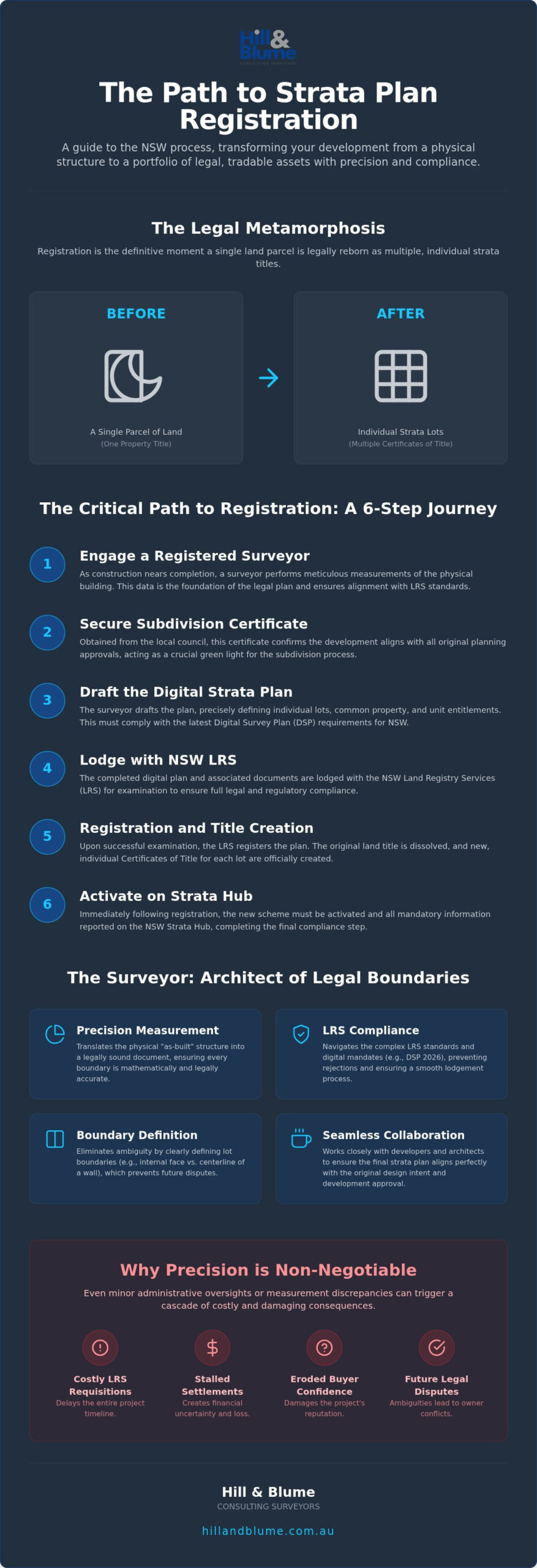
Navigating the NSW Land Registry Services (LRS) Process
Moving from a completed survey to a registered title is a structured journey through the state’s official records. It’s a phase where administrative precision meets legal finality. The strata plan registration process nsw involves several critical touchpoints that require a steady, expert hand to ensure your project doesn’t stall at the final hurdle. This sequence begins at the local level and culminates in the secure digital vaults of the NSW Land Registry Services.
The first step involves obtaining the Subdivision Certificate from your local council. This document acts as the gatekeeper, confirming that the physical building aligns perfectly with the approved development plans. Once secured, we move to Step 2: a comprehensive final review and signing by all stakeholders, including owners and mortgagees. Step 3 is the electronic lodgement via the LRS portal, a task performed by your registered surveyor. During Step 4, we manage any LRS requisitions; these are technical queries or corrections requested by the registry that require a rapid response to maintain momentum. Finally, Step 5 is the successful registration and the issuance of new Certificates of Title, signaling that your lots are ready for settlement.
Electronic Lodgement (ePlan) in 2026
The digital landscape has shifted significantly this year. As of July 1, 2026, the Digital Forms mandate has fully integrated into the Digital Survey Plans (DSP) Program. This shift has streamlined the NSW registration timeline, replacing legacy paper systems with a secure, efficient electronic workflow. Your surveyor acts as the guardian of this digital file security, ensuring that sensitive data is transmitted accurately through the LRS portal. This transition away from paper reduces manual handling errors and accelerates the journey from project completion to market readiness.
Avoiding Common Requisitions
A requisition is more than just a minor correction; it’s a formal rejection that can halt your project’s progress. The most frequent errors include mathematical inconsistencies, missing signatures from mortgagees, or slight misalignments with council requirements. In a high-interest environment, every day of delay adds to your holding costs and can threaten the settlement of pre-sold lots. Hill & Blume’s 90-year experience provides a unique advantage here. Since 1932, we’ve refined our internal review processes to catch these technical nuances before they ever reach the LRS. Our boutique approach means we treat your registration with the care it deserves, minimizing the risk of technical queries and ensuring a swift, successful outcome.
Compliance and the Strata Hub: 2026 Requirements
The moment the LRS issues those new titles, the clock starts on your digital obligations. The strata plan registration process nsw doesn’t end at the registry; it transitions immediately into the activation of the building’s profile on the Strata Hub. Under the Strata Schemes Legislation Amendment Act 2025, which saw its final phase take effect on April 1, 2026, developers must now navigate a more transparent and structured digital landscape. This platform ensures that every one of the 87,000 schemes in NSW maintains a clear, updated record of its management and physical state. It’s a shift from static paperwork to a living digital record that demands accuracy from day one.
Mandatory reporting requirements for developers have become more stringent post-registration. You’re responsible for the initial upload of essential documents and contact information. This isn’t just a compliance task; it’s the first step in establishing the scheme’s governance. By providing the Owners Corporation with seamless access to all registered survey data, you set the stage for a successful first Annual General Meeting (AGM). This ensures that the new committee isn’t left searching for the “source of truth” regarding their boundaries and assets.
The Developer’s Handover
Accuracy in the initial setup of the Strata Hub profile is vital. You aren’t just handing over keys; you’re transferring a digital legacy. The registered strata plan and all associated survey records must be handed to the new committee to provide a clear legal framework for the building. This data is particularly critical for the new standardized 10-year capital works fund plans. Since April 1, 2026, these plans must use a prescribed form. The precision of your initial survey ensures that future maintenance costs and sustainability upgrades, such as EV charging stations, are calculated on a foundation of fact rather than estimation.
Maintaining the Digital Legacy
High-quality survey records are the building’s permanent source of truth. As residents move in and the community begins to grow, the Strata Hub becomes their central window into the scheme’s financial and physical health. By ensuring your development is anchored by high-quality digital survey records from the start, you future-proof the project against administrative confusion. This transparency builds lasting trust and protects the long-term value of the lots you’ve worked so hard to create. If you’re ready to ensure your project’s digital transition is as flawless as its construction, reach out to our specialist team today for a partnership-oriented approach to your next development.
Partnering with Hill & Blume for Seamless Registration
Choosing a partner for your development is a decision that defines the project’s legal legacy. At Hill & Blume, we believe that the strata plan registration process nsw should be a journey of calm confidence rather than a race against administrative hurdles. Since 1932, our registered surveyors have been the quiet architects of property boundaries across Sydney, providing a level of craftsmanship that only comes with nine decades of experience. We don’t view your project as a mere volume of data. Instead, we see it as a curated experience where precision is our primary promise to you. By prioritizing property integrity and deep client relationships, we ensure that the transition from a physical structure to a legal title is as seamless as the architecture itself.
The Hill & Blume Experience
Working with our team is a rhythmic and deliberate process designed to mirror the high-end lifestyle of the properties we survey. You’ll have direct access to registered surveyors who possess an intimate understanding of the local Sydney landscape, from the historic nuances of the city center to the emerging developments of the suburbs. We’ve found that a boutique, hand-crafted approach is the only way to truly honor the quality of your vision. We merge the traditional integrity of a firm with a 90-year history with the sophisticated precision of modern digital surveying technology. This balance allows us to provide a service that feels premium yet inclusive, ensuring every measurement is an unshakeable foundation for your Owners Corporation.
Our expertise extends beyond simple drafting. We bring a specialized perspective to subdivision surveys, navigating the intricate overlap between local council requirements and state registry standards. This depth of knowledge is what allows us to anticipate potential requisitions before they occur, protecting your project from the financial weight of unnecessary delays. We treat every line on a plan as a commitment to the future owners of the lots we help create.
Starting Your Strata Journey
Engaging our team for your next multi-unit project is a straightforward, professional conversation. Whether you are developing a boutique residential complex, a sophisticated commercial space, or a complex mixed-use strata scheme, we offer tailored solutions that respect your timeline and your intelligence. We invite you to experience a partnership where quality is never sacrificed for quantity and where your project is treated with the individual care it deserves. To begin your journey toward a flawless title issuance, Consult with our experts for your strata plan today and discover the peace of mind that comes with a legacy of excellence.
Building a Legacy Beyond the Blueprint
The transition from an architectural vision to a registered property title is the most critical phase in your development’s lifecycle. We’ve navigated the complexities of the 2026 digital landscape, from the initial survey to the final activation of the Strata Hub. By mastering the strata plan registration process nsw, you ensure that every lot is anchored by mathematical and legal certainty. This journey is about more than just paperwork; it’s about creating an enduring community and a tradable asset that stands the test of time. Every measurement matters.
At Hill & Blume, we bring over 90 years of Sydney surveying expertise to every partnership. Our registered NSW surveyors offer a boutique, high-end professional service that honors the craftsmanship of your build. We’re here to provide the steady, expert hand required to navigate the LRS with ease. When you’re ready to transform your physical structure into a legal masterpiece, secure your property legacy with Hill & Blume’s expert strata surveying. Your project is a testament to quality, and we’re committed to ensuring its registration reflects that same standard of excellence.
Frequently Asked Questions
How long does the strata plan registration process take in NSW?
The timeline for the strata plan registration process nsw typically spans two to four weeks once lodged with the LRS. However, this doesn’t account for the preliminary stages, such as obtaining the Subdivision Certificate from your local council. Council processing times vary significantly across Sydney. To ensure a polished result, we recommend starting the measurement phase as soon as the building’s structural boundaries are defined, allowing for a seamless transition to lodgement.
Can I register a strata plan before construction is fully complete?
You can’t register a strata plan until the building is physically complete enough for a surveyor to measure the structural boundaries. The LRS requires the plan to reflect the as-built reality of the structure. Measuring before walls are in their final positions leads to inaccuracies and requisitions. We coordinate our final site visits with your construction schedule to capture the precise dimensions required for a successful registration that feels effortless and professional.
What is the difference between a strata plan and a subdivision plan?
A strata plan divides a building and its associated land into lots and common property, while a subdivision plan typically refers to Torrens Title subdivisions that divide a single parcel of land into separate lots. Strata schemes are unique because they involve shared infrastructure and an Owners Corporation. These distinctions are vital for developers who want to maximize the potential of their specific property type in the NSW market and ensure legal clarity.
What documents are required for LRS strata plan lodgement?
Successful lodgement requires a suite of precise documents, including the strata plan itself and the formal administration sheets. You’ll also need a valid Subdivision Certificate from the local council and written consent from any mortgagees or parties with an interest in the land. Since the 2026 digital mandates, these must be submitted as high-quality electronic files through the LRS portal, ensuring every technical detail meets the latest registry standards and avoids delays.
Who is responsible for lodging the strata plan with the LRS?
Your registered surveyor is responsible for the electronic lodgement of the strata plan. Under the current Digital Survey Plans (DSP) Program, the surveyor manages the secure transmission of the ePlan files directly to the LRS. This professional oversight ensures that the technical data is formatted correctly for the registry’s systems. It’s a specialized task within the strata plan registration process nsw that bridges the gap between the physical site and digital records.
What happens if there is a mistake on the registered strata plan?
If an error is discovered after registration, you’ll need to lodge a formal amendment with the LRS. This often involves a Plan of Amendment prepared by a registered surveyor to correct the boundary or unit entitlement discrepancy. It’s a complex legal process that can stall property settlements or cause disputes. Our boutique approach focuses on extreme precision during the drafting phase to prevent these costly post-registration corrections and protect your project’s long-term integrity.
How much does it cost to register a strata plan in 2026?
LRS registration fees are updated annually on July 1. For the 2026 financial year, these fees include the standard lodgement rate plus a Torrens Assurance Fund levy of $5.35. While we don’t provide a total cost for our professional surveying services here, we recommend consulting the official NSW LRS fee schedule for the most current government charges. Accurate budgeting for these administrative costs is essential for the financial health of your development.
Is a strata plan the same as a survey plan?
A strata plan is a specialized type of survey plan, but they aren’t identical. While all strata plans are based on a precise survey of the land and buildings, a general survey plan might only define land boundaries or site features. A strata plan goes further by defining the three-dimensional airspace of individual lots and the shared common property. It acts as the definitive legal map for the life of the strata scheme.
Disclaimer
The information provided in articles published on this website is for general informational purposes only. While we make every effort to ensure the accuracy, completeness, and timeliness of the content, the material is based on our understanding of the industry at the time of writing and may not reflect the most current developments, regulations, or standards. All opinions expressed in our articles are those of the respective authors and do not necessarily represent the official position of the website or its affiliates. The content should not be considered professional, legal or technical advice, and should not be relied upon as a substitute for consultation with qualified professionals