
A single misplaced fence post can feel like a direct challenge to your peace of mind. The most effective way to protect your sanctuary isn’t found in a courtroom, but at the tip of a surveyor’s prism. You’ve likely felt that rising knot of anxiety when a neighbour questions a property line or a renovation stalls because of a few disputed centimetres. It’s exhausting to watch a relationship fray over a line on a map, especially when you’re worried about escalating legal fees and the long-term value of your home.
We believe that your property is more than just an asset; it’s a legacy that deserves clarity and protection. This guide will show you exactly how to resolve a boundary dispute nsw by leveraging professional surveying expertise to find a definitive, legally defensible solution. You’ll learn how to move from uncertainty to a position of calm confidence. We will walk through the technical precision of identification surveys, the specific requirements of the Dividing Fences Act 1991, and the 2026 NCAT protocols that help you secure your property’s future without the need for aggressive litigation.
Key Takeaways
- Understand why your physical fence line is often distinct from your legal title and how the Torrens Title system defines your property’s true footprint.
- Discover how to resolve a boundary dispute nsw by securing a formal Identification Survey from a Registered Surveyor, providing you with a definitive legal foundation.
- Explore the 2026 NCAT and Land Registry Services pathways to navigate disagreements with technical precision and a focus on maintaining neighbourly harmony.
- Follow a structured, step-by-step resolution process designed to minimise legal costs while securing your home’s long-term market value and peace of mind.
Understanding Boundary Disputes in NSW: Why Fences Aren’t the Law
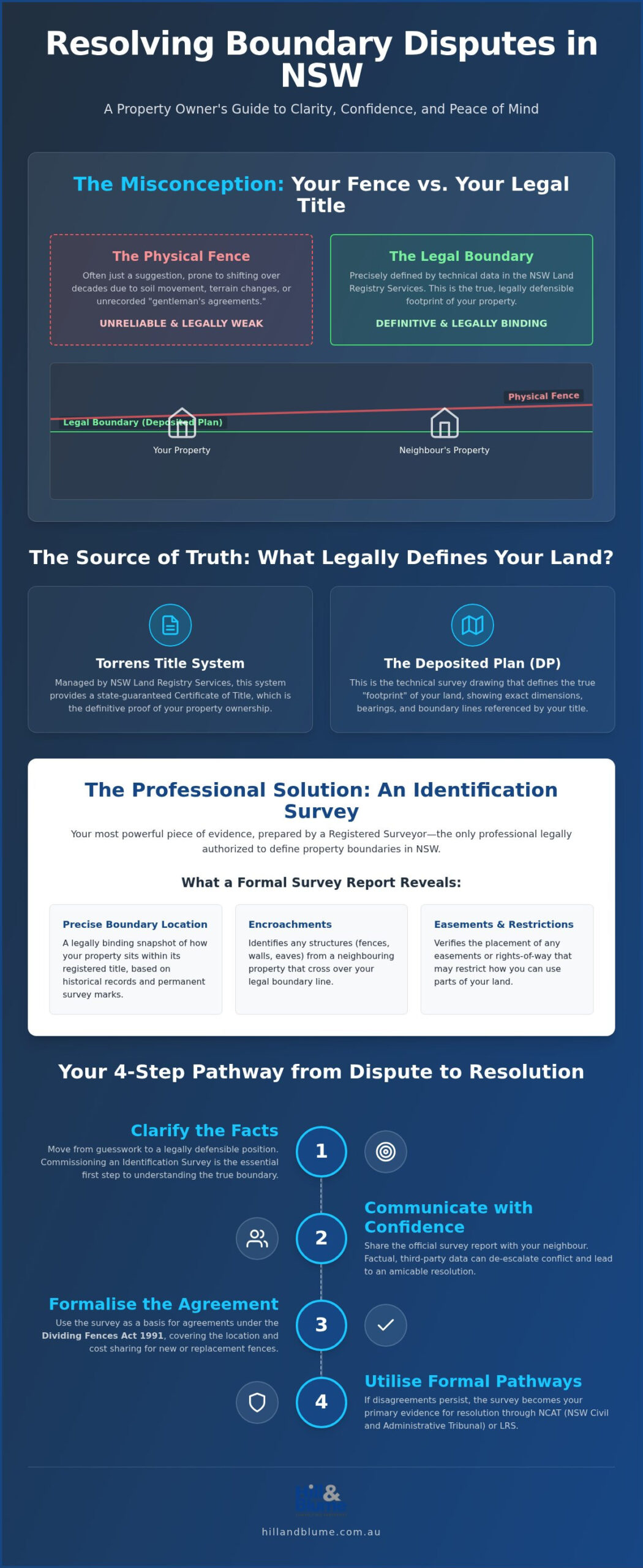
It is a common sight across Sydney: a weathered timber fence that every neighbour assumes marks the edge of their world. However, in the eyes of the law, that fence is often little more than a suggestion. When you are faced with a disagreement over a property line, understanding how to resolve a boundary dispute nsw starts with looking past the physical structures. In New South Wales, the legal definition of your land isn’t found in the placement of a post or a sandstone wall; it’s recorded within the Torrens Title system. This system ensures that your “Certificate of Title” is the definitive proof of ownership, but even that document relies on a deeper layer of technical data: the Deposited Plan.
Disputes often flare up during moments of change. You might be planning a new retaining wall, installing overhanging eaves, or simply replacing an old fence. These projects act as a catalyst for hidden uncertainties to surface. You may find that a fence has “drifted” over decades due to shifting soil or past “gentleman’s agreements” between previous owners that were never formally recorded. These informal arrangements don’t bind you today. To protect your property’s value, you must lean on the precision of a registered professional rather than local folklore or visual guesswork.
The Unreliability of Physical Markers
Physical markers are surprisingly fluid. Over many decades, fences in older suburbs like Paddington or Balmain can move significantly as soil settles or terrain shifts. Relying on nineteenth-century landmarks or rusted iron pegs found in the garden is a risky strategy for any homeowner. Even if a previous owner agreed to a specific fence placement, that verbal contract rarely holds weight against a registered title. When you explore our professional surveying services, you’ll find that precision is the only path to certainty. We look past the vegetation and the timber to find the original intent of the land’s division.
Torrens Title vs. Old System Title
Most modern property in NSW falls under the Torrens Title system, managed by the NSW Land Registry Services (LRS). This central registry provides a state-guaranteed title, making ownership clear and secure. However, the true “footprint” of your land is defined by the Deposited Plan (DP), a technical drawing that shows the exact dimensions and bearings of your boundaries. While some might hope to claim land through long-term use, the legal doctrine of adverse possession in Australia is notoriously difficult to prove within the modern Torrens system. This technical foundation is the first step in learning how to resolve a boundary dispute nsw without the emotional toll of a long legal battle.
The Role of a Registered Surveyor in Dispute Resolution
While a lawyer interprets the law, a Registered Surveyor interprets the land. In New South Wales, the legal authority to define a property boundary is strictly reserved for surveyors licensed by the Board of Surveying and Spatial Information (BOSSI). This isn’t merely a matter of technical skill; it’s a statutory requirement. When you are navigating how to resolve a boundary dispute nsw, your first priority is often commissioning an Identification Survey. This document acts as your most powerful piece of evidence, providing a precise, legally binding snapshot of how your property sits within its registered title.
Our surveyors don’t simply measure from the nearest fence post. They perform a complex reconstruction of your property lines by analyzing historical records and locating permanent survey marks often hidden beneath pavements or soil. This deep dive into the archives is where a legacy of accuracy proves its worth. It’s also vital to distinguish between a “peg-out,” which physically marks the boundary on the ground for construction, and a formal Identification Report. The report is a written narrative that stands up in a legal setting, detailing exactly where your land begins and ends.
What an Identification Survey Reveals
An Identification Survey reveals the subtle details that a simple visual inspection will always miss. It identifies specific encroachments, such as a neighbour’s garage wall sitting 100mm over your line, and verifies the placement of easements or rights-of-way that might restrict your land use. These details are critical for maintaining the integrity of your title. For a deeper look at these technical processes, you can read our guide on Boundary Surveys in Sydney: A Homeowner’s Guide to Property Integrity.
The Surveyor as an Independent Expert
A professional surveyor serves as an objective third party. By providing a “source of truth” based on mathematics and historical data, we help de-escalate the high emotions that often accompany property disagreements. This factual foundation often prevents the need for a formal Registrar General boundary determination, saving you significant time and legal expense. If you’re feeling overwhelmed by a disagreement, you might find that a professional consultation is the quickest way to restore clarity to your home life and protect your investment for the future.
Negotiation vs. Legal Action: NCAT and LRS Pathways
The most elegant path to clarity is often a quiet conversation over a cup of coffee. When you are considering how to resolve a boundary dispute nsw, we always recommend a “Talk First” approach. Presenting a professional survey report to your neighbour shouldn’t feel like a confrontation; instead, it’s an invitation to look at the same set of facts together. By sharing the technical data early, you often dissolve the friction that stems from simple misunderstanding. This collaborative spirit preserves the harmony of your street while ensuring your property’s footprint is respected by all parties.
Sometimes, however, a shared understanding remains out of reach. If the disagreement involves an encroachment, such as a structure crossing the line, or a breach of your “quiet enjoyment” of the land, it may be time to involve a solicitor. A legal professional can help you navigate the complexities of property law while we provide the mathematical evidence they need to build a robust case. This partnership between legal and technical experts ensures your interests are protected with both precision and authority.
NCAT and the Dividing Fences Act 1991
When a dispute focuses specifically on the placement or cost of a fence, the NSW Civil and Administrative Tribunal (NCAT) is the primary venue for resolution. Under the Dividing Fences Act 1991, you must serve a formal Fencing Notice on your neighbour before seeking tribunal intervention. You’re required to wait at least one month after serving this notice before you can apply to NCAT. For claims filed after July 1, 2026, the application fees in the Consumer and Commercial Division are structured as follows:
- A$64.00 for claims not exceeding A$10,000.
- A$133.00 for claims between A$10,000 and A$30,000.
- A$344.00 for claims exceeding A$30,000.
The tribunal relies heavily on the technical clarity of a survey report to issue orders regarding fence location and cost-sharing. You can find more detail on this process through the official portal for NCAT dividing fence disputes.
Formal Boundary Determinations (Part 14A)
In rare instances, two independent registered surveyors may disagree on the location of a boundary. This technical stalemate is resolved through a formal Boundary Determination by the Registrar General under Part 14A of the Real Property Act 1900. This is a specialized pathway where the NSW Land Registry Services (LRS) reviews the evidence and makes a final, binding decision. Once a determination is made, it’s lodged on the land title, providing a permanent resolution that binds all current and future owners. While this process involves specific LRS fees, such as A$182.71 for plan amendments, it offers a level of finality that protects your property value for generations.
Step-by-Step Resolution Process for NSW Property Owners
Resolving a property disagreement is a journey that rewards the methodical. You’ll find that clarity is your most effective tool for restoring peace and protecting your investment. The process begins not with a shovel or a hammer, but with the right paperwork. Your first step is to obtain a current copy of your Certificate of Title and the original Deposited Plan (DP) from the NSW Land Registry Services (LRS). These documents are the legal blueprint of your land’s identity within the Torrens Title system. Without this foundation, any discussion about property lines remains a matter of mere opinion.
Once you have the documents, the next phase is professional verification. Learning how to resolve a boundary dispute nsw effectively means moving from visual guesswork to mathematical certainty. By commissioning an Identification Survey, you secure a definitive map of your property’s legal footprint. With this evidence in hand, you can initiate a formal conversation with your neighbour. If the issue involves a fence, this often takes the form of a “Fencing Notice” under the Dividing Fences Act 1991. This notice is a structured invitation to share costs and agree on a location, providing a clear path toward mediation or, if necessary, a formal determination by the Registrar General.
Commissioning Your Survey
To receive a tailored and accurate quote, you should provide your surveyor with your Lot and Plan numbers. Sydney’s unique landscape, filled with heritage titles and complex terrain, requires deep archival research. We often spend as much time in the LRS records as we do on your property to ensure every centimetre is accounted for. For a detailed look at selecting the right partner for this task, explore our guide on Choosing a Surveyor in Sydney: The 2026 Professional Buying Guide. Understanding these lead times helps you plan your renovations or sales with confidence.
Handling Encroachments Legally
If the survey reveals a permanent structure is over the boundary line, you must act with deliberate speed. Encroachments can range from a minor gutter overhang to a significant garage wall. You have several pathways: negotiating the structure’s removal, seeking financial compensation, or creating a formal easement to regularise the situation. It’s vital to avoid “laches,” a legal principle where an unreasonable delay in asserting your rights can prejudice your claim. Acting promptly ensures you maintain the full integrity of your title. If you’re ready to define your boundaries with 90 years of expertise, reach out to our team for a professional consultation.
Why Hill & Blume is the Trusted Choice for Boundary Integrity
Hill & Blume has been an essential part of the Sydney fabric since 1932. We bring over 90 years of industry experience to every project, providing a level of historical insight that few can match. When you’re navigating how to resolve a boundary dispute nsw, you aren’t just looking for a technician; you’re seeking a partner who understands the deep, often complex records of the Sydney Basin. Our boutique approach ensures that you work directly with Registered Surveyors who prioritize the depth of your relationship over high-volume turnover. We specialize in those intricate “Old System” or heritage titles where precision is a necessity for legal integrity.
Our expertise extends far beyond the field. We ensure your documentation is meticulously prepared and compliant for local Councils, financial institutions, and the NSW Land Registry Services. This level of care provides you with the peace of mind that comes from a near-century legacy of accuracy. Whether it’s an identification survey for a terrace in Paddington or a subdivision plan in Newcastle, we treat every boundary as a handcrafted piece of your property’s story. We believe in providing a seamless, polished service that mirrors the high-end lifestyle you’ve worked hard to build.
A Legacy of Precision Since 1932
Our long-standing presence in the region allows us to resolve boundaries that others might find impossible. We have access to deep archival records that help us reconstruct property lines in areas where modern markers have long since vanished. To understand the specific legal requirements and the rigorous standards we maintain, you can explore our guide on What is a Registered Surveyor in NSW? The Essential 2026 Property Guide. This specialized knowledge ensures that your project remains compliant with all local council requirements, effectively avoiding the stress of costly delays or rework.
Secure Your Property’s Future
An accurate survey is much more than a technical requirement; it’s a vital investment in your property’s saleability and future value. By clarifying your boundaries today, you remove obstacles for future buyers and secure your equity against potential claims. We invite you to experience a service that values quality over quantity and provides a sense of calm confidence. You can secure your property boundaries with a professional quote from Hill & Blume today. Let us help you find the clarity you need to move forward with your next renovation or sale.
Secure Your Property’s Legacy with Certainty
Your home is more than a structure; it’s a sanctuary and a significant investment. Understanding how to resolve a boundary dispute nsw requires moving beyond visual assumptions and embracing the precision of the Torrens Title system. We’ve explored how a physical fence is rarely the final word in law and why a professional Identification Survey serves as your most powerful tool for de-escalating tension. By following a methodical approach, you can navigate the technical pathways of NCAT or the Registrar General with absolute clarity. This process doesn’t just settle a disagreement; it restores your peace of mind and secures your property’s future saleability.
Since 1932, Hill & Blume has provided the Sydney community with the sophisticated expertise needed to navigate these complex challenges. As Registered NSW Surveyors compliant with BOSSI requirements, we specialize in both residential and commercial boundary identification. We invite you to request a professional boundary consultation from Hill & Blume to benefit from our 90-year legacy of accuracy. You deserve the confidence that comes from working with a boutique authority that values your property’s integrity as much as you do. Let’s define your boundaries together.
Frequently Asked Questions
How much does it cost to resolve a boundary dispute in NSW?
Total costs vary based on the complexity of your land and the path you take. NCAT application fees as of July 1, 2026, range from A$64.00 for small claims to A$344.00 for claims exceeding A$30,000. You should also consider the professional fees for a registered surveyor and potential legal representation. Investing in a precise survey early often prevents the much higher costs associated with prolonged litigation or court-ordered mediation.
Can I remove a fence if I think it is on my land?
You shouldn’t remove a fence without your neighbour’s consent or a tribunal order, even if you’re certain it’s on your land. Doing so could expose you to claims of trespass or property damage. Under the Dividing Fences Act 1991, there’s a specific process for replacing or moving a fence. It’s always safer to verify the boundary with a survey first and then serve a formal Fencing Notice to your neighbour.
What is a Fencing Notice and when do I need one?
A Fencing Notice is a formal legal document served under the Dividing Fences Act 1991. You need one if you want your neighbour to contribute to the cost of a new or repaired fence. It must outline the proposed fence type, the boundary line location, and the estimated costs. You must wait at least one month after serving this notice before you can apply to NCAT for a resolution.
Does a boundary survey expire in NSW?
A boundary survey doesn’t have a statutory expiry date, but its reliability fades as the landscape changes. New construction, shifting terrain, or updates to the NSW Land Registry Services database can make an older plan less accurate. If you’re learning how to resolve a boundary dispute nsw in 2026, relying on a survey from decades ago is risky. A current Identification Survey ensures you’re working with the most accurate data.
What happens if my neighbour refuses to pay for a survey?
If a neighbour refuses to contribute to a survey, you may need to pay the initial cost yourself to gather evidence. However, if the dispute goes to NCAT, the tribunal can order the neighbour to pay a portion of the survey costs if it was necessary to resolve the fencing issue. Having a professional report often helps convince a reluctant neighbour that your claim is backed by mathematical fact rather than opinion.
Can NCAT decide where the boundary is?
NCAT doesn’t have the legal power to make a final boundary determination that changes your land title. Instead, the tribunal makes orders regarding the placement and cost of a dividing fence. If you need a definitive ruling on the property line itself, you must apply to the Registrar General under the Real Property Act 1900. NCAT will typically use a registered surveyor’s report as the primary evidence for its fencing orders.
Is a “peg-out” the same as a boundary determination?
These are two very different services. A “peg-out” is a physical marking on the ground, usually performed for construction purposes to show builders where to work. A boundary determination is a formal legal process through the NSW Land Registry Services. It resolves conflicting survey evidence and results in a permanent, legally binding record on your land title. A peg-out is a physical guide; a determination is a final legal ruling.
What is the “Encroachment of Buildings Act 1922”?
This legislation provides specific remedies when a permanent building or structure crosses a property line. It acknowledges that moving a brick wall isn’t always practical. The Act allows the court to order various solutions, such as the payment of compensation to the affected owner or the creation of a formal easement. It’s the primary legal framework for managing encroachments that involve more than just a simple timber fence or garden bed.
Disclaimer
The information provided in articles published on this website is for general informational purposes only. While we make every effort to ensure the accuracy, completeness, and timeliness of the content, the material is based on our understanding of the industry at the time of writing and may not reflect the most current developments, regulations, or standards. All opinions expressed in our articles are those of the respective authors and do not necessarily represent the official position of the website or its affiliates. The content should not be considered professional, legal or technical advice, and should not be relied upon as a substitute for consultation with qualified professionals