
If you are investing in a Sydney property where the median house price is now approaching $2 million, can you really afford to guess where your land ends and your neighbour’s begins? You likely understand that absolute precision is the foundation of any successful property project. Yet, the nuanced terminology surrounding a boundary survey vs identification survey often creates more questions than it answers. It’s natural to feel a sense of hesitation when faced with technical requirements that carry significant legal weight and impact your long-term peace of mind.
We’re here to provide the clarity you deserve. Drawing on a 90-year legacy of local stewardship, we’ll help you distinguish between these two vital documents to ensure your project aligns with the Surveying and Spatial Information Regulation 2024. Whether you’re seeking to resolve a quiet concern with a neighbour or preparing for a sophisticated new build, we’ll outline which report offers the protection you need. We’ll examine how each survey type serves your specific goals, from securing a smooth settlement to establishing the definitive markers for your home’s future.
Key Takeaways
- Distinguish between the physical re-establishment of land limits and the formal certification of how structures sit within those boundaries.
- Identify whether your specific project requires a boundary survey vs identification survey to ensure compliance with NSW property law and financial requirements.
- Learn why Sydney banks and solicitors require an Identification Survey report to secure mortgages and verify land ownership during a purchase.
- Understand the critical role of a Registered Surveyor in providing legally binding documentation that adheres to the Surveying and Spatial Information Regulation 2024.
- Leverage a 90-year legacy of local surveying records to prevent boundary disputes and protect the long-term value of your property investment.
Understanding the Difference: Boundary Survey vs Identification Survey
In the nuanced world of Sydney real estate, clarity is a premium commodity. When you’re managing a property project, you’ll likely encounter terms that sound deceptively similar, yet carry distinct legal implications. The confusion between a boundary survey vs identification survey is one of the most common hurdles for homeowners. While real estate agents or neighbours might use these phrases loosely, the distinction is vital for your legal and financial protection.
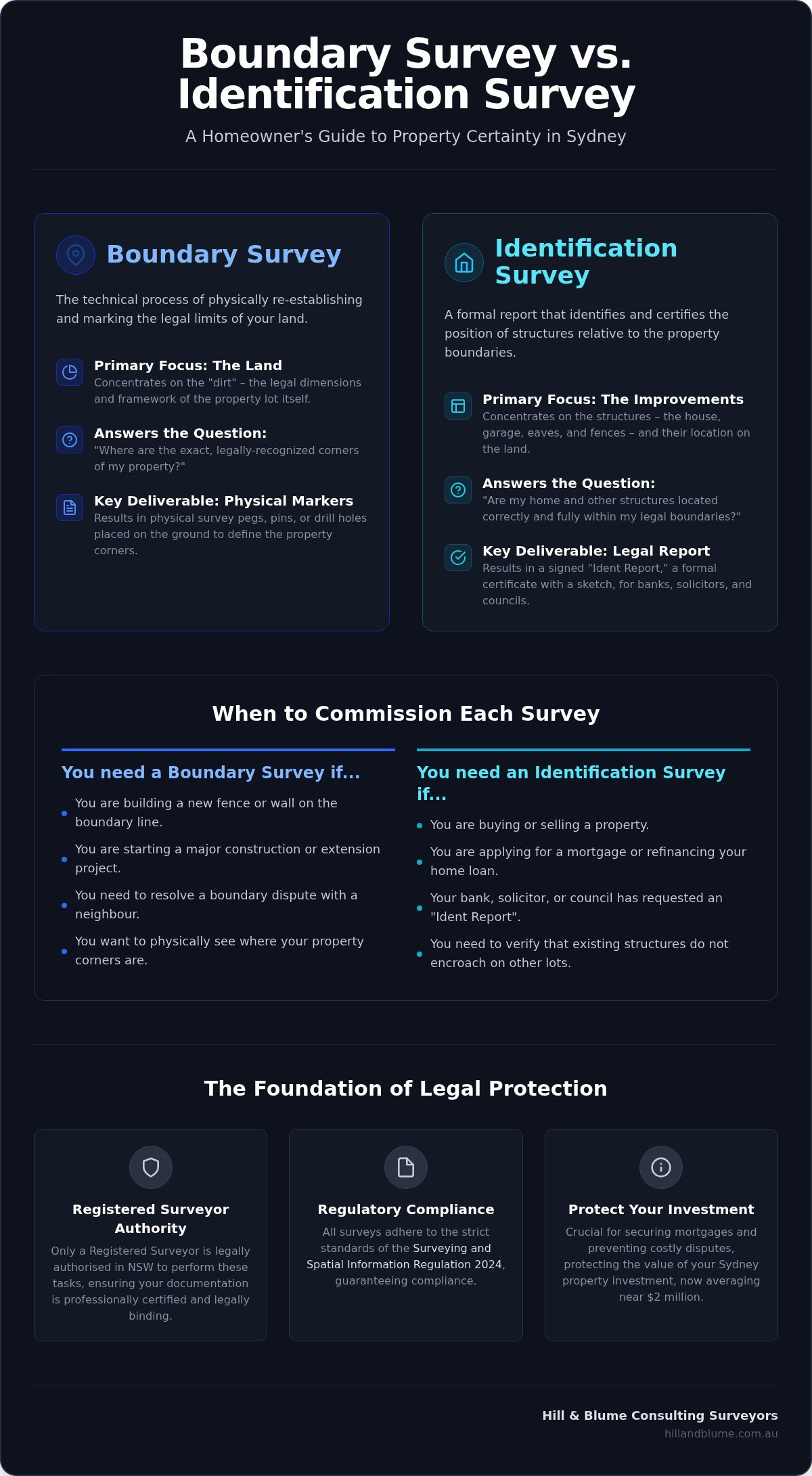
A Boundary Survey is the technical process of re-establishing the legal limits of your land. It involves a Registered Surveyor physically locating or replacing the survey marks that define your lot’s corners. Conversely, an Identification Survey is a formal report that identifies the position of structures, such as your home, garage, or eaves, in relation to those established boundaries. Under NSW law, only a Registered Surveyor is authorised to perform these tasks, ensuring every measurement is backed by professional liability and statutory authority. Understanding what is surveying in a legal sense helps you appreciate why these documents aren’t interchangeable.
The Core Technical Distinction
To simplify the choice, think of a Boundary Survey as being about the “dirt” and the legal framework of the lot itself. Its primary output is often physical; you’ll see white pegs or drill holes marking the exact corners of your property. This is the foundational work required before any physical construction or fencing begins. It’s about establishing the “where” of your land ownership.
An Identification Survey, often called an “Ident” report, focuses on the “improvements.” It doesn’t necessarily result in new pegs in the ground. Instead, it provides a signed certificate and a sketch that confirms your house doesn’t encroach on the neighbour’s land, and vice versa. While a Boundary Survey often informs the Identification report, the two serve different purposes. One defines the land’s edge, while the other certifies your structures’ relationship to that edge.
Why Sydney Property Owners Face This Choice
Sydney’s unique geography, from the coastal cliffs of the Eastern Suburbs to the leafy, undulating hills of the North Shore, presents specific challenges. Our city’s complex topography and aging survey records mean that “near enough” is never good enough. You’ll likely face this choice when purchasing a new home, where a lender requires an Ident report, or when resolving a minor disagreement over a fence line.
Choosing the right service at the start prevents the anxiety of project delays. If you’re planning a significant change to your property’s footprint, exploring our guide on Boundary Surveys in Sydney can provide deeper context on maintaining your property’s integrity. At Hill & Blume, we’ve spent over 90 years navigating these local complexities, ensuring our clients move forward with a sense of calm confidence and certain ownership.
The Technical Precision of a Boundary Survey (Re-marking Your Land)
When you stand on your lawn, the line where your property ends is often invisible, yet it’s one of the most significant legal demarcations you own. While the choice between a boundary survey vs identification survey often starts in a solicitor’s office, the boundary survey is where that legal theory meets the physical earth. This process, often referred to as ‘pegging’, involves the physical placement of markers to show exactly where your land starts and stops. It’s a task that demands both historical detective work and modern scientific rigour.
You might notice old timber pegs or rusted metal pins in the corners of your garden, but these relics aren’t always reliable. Over decades, Sydney’s soil shifts, fences are replaced, and markers are accidentally moved during landscaping. Relying on an unverified peg can lead to costly errors. A professional survey ensures that your property’s physical markers align perfectly with the official cadastral records held by NSW Land Registry Services.
The Process of Re-establishing Boundaries
Our work begins long before we arrive at your gate. We start by researching historical survey plans, sometimes dating back to the early 20th century, to understand the intent of the original subdivision. This historical depth is where our 90 years of experience becomes your greatest asset. Once on-site, we combine this archival data with modern GPS and Total Station technology to achieve millimetre precision. This rigorous approach is a core part of the BOSSI surveyor guidelines, ensuring that the plan signed by your Registered Surveyor is a definitive legal document. It’s this level of detail that transforms a simple piece of land into a secure investment.
Boundary Surveys for Fencing and Retaining Walls
If you’re planning a new perimeter fence or a substantial retaining wall, a boundary survey is your primary safeguard against future disputes. There’s a persistent myth in Sydney that a fence line is the ‘de facto’ boundary, but this is rarely the case. Building even a few centimetres onto a neighbour’s land can result in an encroachment claim, forcing the removal of expensive structures. The Dividing Fences Act 1991 (NSW) provides a framework for sharing costs, but it relies entirely on the fence being positioned on the true legal boundary. By establishing the correct line first, you foster a sense of community with your neighbours rather than conflict. If you’re ready to secure your property’s perimeter, our team can help you start the conversation today.
The Role of an Identification Survey Report in Property Transactions
While a boundary survey re-marks the physical earth, an Identification Survey serves as a definitive legal snapshot of how your property’s structures sit within those limits. It’s a nuanced report, comprising a detailed sketch and a signed certificate, that acts as a vital safeguard during a property exchange. When you’re evaluating a boundary survey vs identification survey, it’s helpful to remember that the latter is often the document your lender or solicitor will insist upon. It ensures that the home you’re buying doesn’t have a neighbour’s gutter hanging over the fence line or a garage built squarely over a Sydney Water easement. These subtle encroachments, if left undiscovered, can lead to years of quiet friction or expensive legal disputes. We pride ourselves on a boutique approach that identifies these fine details before they become your burden.
What Your Solicitor Is Looking For
Your solicitor uses this report to verify that the property is exactly what’s described in the contract of sale. They’re searching for peace of mind, ensuring there are no unauthorised structures that might trigger a council order later. When comparing a boundary survey vs identification survey for a purchase, the identification report is superior for checking easements for electricity providers or water authorities that could restrict your future plans. This process relies on the NSW Registrar General’s Guidelines on boundary definition, which dictate the technical precision required to certify these relationships. It’s about creating a transparent narrative for the land’s history and its current state. By confirming the property’s compliance with local council setbacks, the report provides a layer of protection that a simple physical inspection cannot offer.
Identification Surveys for New Builds
For those embarking on a new build or a significant renovation in Sydney, the Identification Survey becomes a milestone of compliance. It’s often required at the Final Survey stage to secure an Occupation Certificate (OC), proving to the council that the new slab and walls sit exactly where the DA or CDC specified. This level of oversight prevents the heartache of discovered errors once the project is finished. It’s the final seal of quality on your investment, confirming that your craftsmanship respects the legal limits of your lot. You can explore our full range of Hill & Blume Services to see how we support every stage of the construction journey, from initial set-out to final certification. We bring a discerning eye to every detail, ensuring your vision remains anchored in legal certainty and community harmony.
Decision Guide: When to Commission a Boundary vs Identification Survey
Selecting the appropriate survey type is a matter of aligning technical precision with your specific property milestone. While the terms are often used interchangeably in casual conversation, the choice between a boundary survey vs identification survey is a strategic decision that affects your legal standing and project timeline. It’s about choosing the right tool for the specific challenge your property presents.
If you’re purchasing an established home in Sydney, an Identification Survey is your essential companion. It provides the written assurance your bank requires and the peace of mind you deserve during a high-stakes transaction. However, if your vision involves physical changes to the land, such as a new boundary fence or a masonry retaining wall, a Boundary Survey is the only way to secure physical pegs in the ground. For those planning a sophisticated extension or a second storey, a combination of a Boundary Survey and a Detail Survey is often necessary to meet rigorous council requirements. In the unfortunate event of a disagreement with a neighbour over an existing structure, an Identification Survey serves as the definitive legal document to resolve the matter with calm authority.
The Homeowner’s Checklist
Before you engage a firm, consider these simple triggers for your project. If you’re settling on a property, you need an Ident report. If you’re digging or building near the line, you need boundary pegs. Most importantly, you should verify what is a registered surveyor nsw to ensure your documentation carries the necessary legal weight for Sydney councils and financial institutions. Our boutique firm prioritises these details, ensuring your paperwork is as meticulous as your property deserves.
The Developer’s Perspective
For those managing property development in high-density Sydney suburbs like Crows Nest, risk management is paramount. In these tight urban environments, every millimetre counts. We often recommend a Detail and Level survey as the foundational first step. This provides the topographical context that informs both your boundary re-establishment and your architectural design. You can learn more in our Contour and Detail Survey Guide, which explains how this data prevents costly design revisions. Whether you’re a seasoned developer or a first-time renovator, we invite you to reach out for a tailored consultation to discuss your project’s unique requirements.
Navigating NSW Property Law with Hill & Blume’s Expertise
The legal framework of New South Wales property law is designed to protect your most significant asset, but it requires an expert hand to interpret. Determining whether your project requires a boundary survey vs identification survey is more than a technical hurdle; it’s a critical step in complying with the Conveyancing Act 1919 and current NSW Land Registry Services (LRS) standards. At Hill & Blume, we believe that professional surveying is an art of precision that serves the human element of real estate. We don’t just provide data; we provide the calm confidence that comes from knowing your property’s legal standing is beyond reproach.
In Sydney’s premium market, a minor misunderstanding of a boundary can lead to what we call the “hundred-thousand-dollar mistake.” This often occurs when a new build or extension is positioned incorrectly, leading to forced demolitions or expensive, permanent easements. Under the Surveying and Spatial Information Act 2002, only a Registered Surveyor in NSW is legally authorised to define land boundaries. This status is non-negotiable for boundary work. It acts as a seal of quality, ensuring that your documentation is legally binding and respected by councils, banks, and the courts. We offer a bespoke, hand-crafted feel that distinguishes our work from larger, more clinical corporate agencies, treating every lot as a unique piece of Sydney’s fabric.
90 Years of Sydney Surveying Heritage
Our firm was founded in 1932, and that 90-year legacy provides us with access to historical surveying records that newer firms simply cannot replicate. This archival depth is often the key to resolving complex boundary re-establishments in Sydney’s oldest suburbs, where modern marks may have vanished. While our roots are deep in Sydney, our expertise extends beyond the harbour, supporting architects and developers with the same boutique precision across Newcastle and the Central Coast. We are not merely collectors of data. We are stewards of your property’s future, ensuring every measurement reflects our passion for the regional lifestyle we all share.
Your Next Steps for Property Peace of Mind
Securing your property’s integrity begins with a clear understanding of your goals. To help us provide a tailored solution, we recommend gathering your current title documents or any previous plans you may have before our team arrives on-site. This preparation allows us to move smoothly from identifying your aspirations to offering a precise technical solution. Whether you are settling on a new home or planning a landmark renovation, we invite you to explore our professional consultation services to discover how we can protect your investment. While the choice between a boundary survey vs identification survey might seem complex, our role is to translate that complexity into a clear path forward, anchored by traditional integrity and modern expertise.
Securing Your Property’s Legacy with Certainty
Understanding the distinction between the physical markers of the land and the legal certification of your structures is the first step toward property peace of mind. Whether you require physical pegs for a new fence or a signed certificate for a bank settlement, choosing the correct report ensures your project remains compliant and your relationships with neighbours stay harmonious. Navigating the choice between a boundary survey vs identification survey doesn’t have to be a source of anxiety. By partnering with experts who understand the unique fabric of Sydney’s landscape, you protect the long-term value of your investment.
At Hill & Blume, we bring 90+ years of Sydney surveying expertise to every lot. As Registered NSW Surveyors, we offer fixed-fee professional consulting that combines archival depth with modern precision. We invite you to secure your property’s future with a Hill & Blume professional survey and move forward with the calm confidence your project deserves. Your vision for your home is an investment in your lifestyle; we’re here to ensure its foundation is legally and technically sound.
Frequently Asked Questions
Is a boundary survey the same as a title survey?
No, they are not strictly the same. While “title survey” is a term often used in other countries or states, in New South Wales we focus on specific legal documents. A boundary survey is the technical act of marking land limits, whereas an identification survey certifies structures on that land. For your Sydney property, understanding the choice between a boundary survey vs identification survey is essential for meeting the requirements of the NSW Land Registry Services.
How much does a boundary survey cost in NSW in 2026?
The cost of professional surveying depends on the unique characteristics of your lot. Factors such as the size of the land, the steepness of the terrain, and the availability of historical records all influence the final fee. Boutique firms provide tailored quotes that reflect the specific level of detail required for your project. We recommend requesting a consultation to receive a fixed-fee quote that ensures your property’s legal integrity is professionally managed.
Can a non-registered surveyor perform an identification survey?
No, they cannot. Under the Surveying and Spatial Information Act 2002, only a Registered Surveyor in NSW is legally authorised to define and certify land boundaries. An identification survey performed by an unregistered individual will not be accepted by banks, solicitors, or local councils. This regulation exists to protect property owners, ensuring that the professional responsible for your land’s data holds the necessary qualifications and mandatory professional indemnity insurance.
Do I need a survey if my neighbour already has one?
In most cases, you should still commission your own survey. A neighbour’s survey was prepared for their specific needs and may not address the details required for your purchase or construction project. Crucially, you cannot legally rely on a survey addressed to another party if a dispute or error arises later. Having your own report provides you with direct professional protection and ensures the data is current and tailored to your goals.
How long does it take to get an identification survey report in Sydney?
The process generally takes between one and two weeks to complete. This period allows our team to conduct deep archival research into Sydney’s historical records before performing the precise on-site measurements. If your property is located in an older suburb with complex title history, the research phase may take slightly longer. We prioritise accuracy over speed to ensure that the final signed certificate and sketch provide you with absolute legal certainty.
What happens if a survey reveals an encroachment on my property?
Discovering an encroachment is the first step toward a calm resolution. Once the surveyor documents the exact extent of the structure crossing the boundary, you have the factual evidence needed for a conversation with your neighbour. You should then consult your solicitor to explore options under the Encroachment of Buildings Act 1922. Resolutions can include a formal boundary adjustment, a small compensation payment, or the creation of an easement to legally permit the structure’s position.
Will a boundary survey resolve a dispute with my neighbour automatically?
A survey provides the definitive legal facts, but it is not a court order. The primary benefit of comparing a boundary survey vs identification survey is that it removes the ambiguity that often causes conflict. Once the “true line” is professionally marked with physical pegs or certified in a report, most disputes are resolved through clear evidence. It serves as the essential foundation for any legal or personal agreement regarding your property’s perimeter.
Disclaimer
The information provided in articles published on this website is for general informational purposes only. While we make every effort to ensure the accuracy, completeness, and timeliness of the content, the material is based on our understanding of the industry at the time of writing and may not reflect the most current developments, regulations, or standards. All opinions expressed in our articles are those of the respective authors and do not necessarily represent the official position of the website or its affiliates. The content should not be considered professional, legal or technical advice, and should not be relied upon as a substitute for consultation with qualified professionals