
Imagine standing on your sun-drenched terrace, only to receive a formal notice suggesting your new extension encroaches on your neighbor’s land by a mere ten centimeters. It’s a small distance that creates a significant, costly headache. You’ve likely felt that nagging uncertainty when looking at an old timber fence, wondering if it truly marks the edge of your investment. In New South Wales, relying on visual cues or “handshake” agreements is a risk that few property owners can afford to take. Understanding exactly when do you need a boundary survey in nsw is the first step toward protecting your property’s physical and financial integrity.
This 2026 guide reveals the critical legal and practical scenarios where a survey by a Registered Surveyor is mandatory to protect your investment. We’ll explore the triggers that require professional intervention, from complex local council requirements to the rigorous standards of the Surveying and Spatial Information Regulation 2024. You’ll gain the clarity needed to navigate construction projects, resolve disputes, and move forward with the calm confidence that only absolute precision can provide. It’s about more than just lines on a map; it’s about securing your peace of mind through expert craftsmanship and a deep respect for local land records.
Key Takeaways
- Understand the legal weight of a cadastral survey and why only a BOSSI-regulated Registered Surveyor can provide the certainty your property deserves.
- Identify the specific lifestyle and legal triggers, such as fencing, extensions, or DA submissions, that determine exactly when do you need a boundary survey in nsw to protect your equity.
- Mitigate the high-stakes risks of encroachment and avoid the emotional and financial strain of neighborhood disputes or local council orders.
- Distinguish between an Identification Survey for property settlement and physical boundary pegging to ensure your next construction project is built on solid ground.
- Leverage nine decades of local expertise to navigate NSW land records with the grace and precision of a specialized boutique firm.
What is a Boundary Survey in NSW and Who Can Perform It?
Ownership of land in New South Wales is a privilege defined by precision. While many homeowners rely on existing fence lines or visual markers to identify their property limits, these physical cues often deviate from the legal reality held in state records. A boundary survey is the formal bridge between your physical land and its legal title. It is a technical discipline that requires a deep understanding of surveying principles, mathematics, and property law. Identifying exactly when do you need a boundary survey in nsw begins with recognizing that land limits are not just physical; they are legal definitions protected by the Crown.
In New South Wales, the Board of Surveying and Spatial Information (BOSSI) regulates the profession to ensure every land measurement meets rigorous accuracy standards. Only a Registered Surveyor has the legal authority to perform and certify a boundary survey. This professional doesn’t just measure distance; they interpret the complex interplay between historical evidence and modern technology. A Cadastral Survey is the legally binding process of establishing land ownership limits. Without the certification of a Registered Surveyor, any measurement of a property line lacks the legal standing required for construction, subdivisions, or dispute resolution.
The Legal Mandate for Registered Surveyors
You might wonder why a builder or an unlicensed consultant cannot simply “check the marks.” The answer lies in liability and legal weight. Measurements performed by anyone other than a Registered Surveyor are considered unofficial and cannot be used to settle boundary disputes or satisfy local council requirements. When you engage a professional, they access the NSW Land Registry Services (LRS) database to retrieve original deposited plans, some dating back over a century. This research ensures that the marks placed on your property are backed by the full weight of the law. Hiring a professional from Hill & Blume provides you with the security of professional indemnity insurance and the calm confidence that your project is built on a foundation of absolute legal certainty. You can explore our specialized services to see how this expertise supports your property goals.
Why Historical Context Matters in Sydney Property
Sydney’s landscape is a patchwork of history, featuring a mix of Old System title and the more modern Torrens title. This complexity means that knowing when do you need a boundary survey in nsw is often tied to the age and location of your land. In older suburbs, original survey marks may have shifted or disappeared entirely, leading to inconsistencies that only an expert can resolve. Since our founding in 1932, Hill & Blume has cultivated an unmatched knowledge of local land records. We don’t just see a plot of land; we see 90 years of evolving records and community growth. This depth of relationship with the local fabric allows us to navigate inconsistent historical data with a level of care and craftsmanship that larger, clinical agencies simply cannot replicate.
Critical Scenarios: When Do You Need a Boundary Survey?
Every property journey has moments where precision becomes paramount. These “Trigger Events” are the specific windows when do you need a boundary survey in nsw to safeguard your assets. Whether you’re navigating the complexities of a local council Development Application (DA) or seeking the peace of mind that your sanctuary is secure, professional data is your strongest shield. It’s a considered step that transforms uncertainty into legal certainty, ensuring your property remains a source of joy rather than a site of dispute.
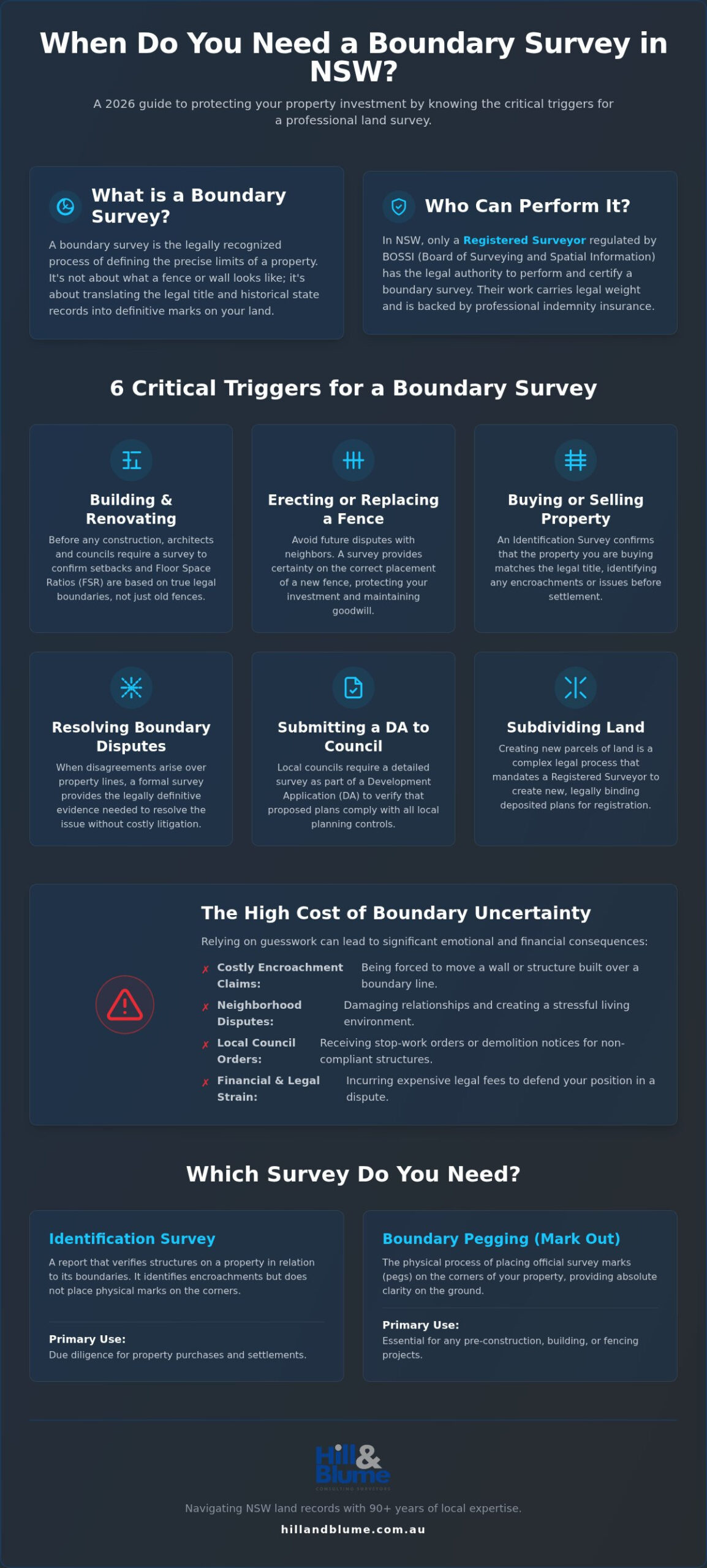
1. Building and Renovating (Pre-Construction)
Architects and builders rarely work without absolute clarity. Before the first architectural sketch is finalized, your design team will insist on a boundary survey to define the canvas. This isn’t just about length and width; it’s about ensuring setbacks and Floor Space Ratios (FSR) are calculated from the true legal boundary rather than a weathered fence line. Building even ten centimeters over the line can trigger an “Encroachment Nightmare.” The cost of moving a structural wall or settling a legal claim far outweighs the initial investment in accuracy. We provide the meticulous data that allows your vision to take shape without the shadow of future litigation.
2. Buying or Selling Property (Due Diligence)
The contract of sale is a legal promise, but it doesn’t always reflect the physical reality of the land. An Identification Survey serves as essential due diligence for any discerning buyer. It uncovers unapproved structures or encroachments that might complicate your mortgage security or future resale value. By verifying that the physical property matches the legal title before you sign, you’re protecting the long-term integrity of your investment. It’s about knowing exactly what you own, from the edge of the driveway to the back of the garden shed, ensuring your lifestyle is built on a foundation of truth.
3. Fencing and Retaining Walls
Shared boundaries are often the source of unexpected friction. Under the Dividing Fences Act 1991 (NSW), property owners share the responsibility of fencing, yet disputes frequently arise when the “true” line is in question. If a neighbor serves you a Boundary Notice, or if you’re planning a new retaining wall, “pegging” the line provides an indisputable reference point. For those facing more complex disagreements, the NSW Registrar General offers a path for official boundary dispute resolution. Having a Registered Surveyor establish these markers early prevents conflict from escalating. If you’re preparing for a new project, our team is here to provide the expert guidance your property requires.
The Risks of Boundary Uncertainty: Encroachments and Legal Liability
In the dense residential tapestry of Sydney and the Central Coast, land is a precious commodity. An encroachment occurs when a structure from one property extends onto the land of another, effectively intruding on legal rights. This isn’t always a deliberate act; often, it’s the result of historical guesswork or relying on a fence that was never correctly placed. Understanding exactly when do you need a boundary survey in nsw becomes critical when these subtle overlaps threaten your property’s value and your peace of mind.
The financial consequences of boundary errors are often severe. Beyond the immediate legal fees of a dispute, property owners may face court-ordered demolition or the substantial cost of structural relocation. These errors can diminish your resale value, as savvy buyers will often shy away from titles clouded by encroachment issues. In NSW, the principle of “Adverse Possession” adds another layer of urgency. While complex under Torrens title, failing to defend your boundaries can lead to long-term legal complications regarding land use. A professional survey acts as a neutral resolution, replacing emotional arguments with indisputable data.
Common Encroachment Issues in NSW
In our 90 years of experience, we’ve seen how easily minor structures can cross the legal line. Common issues include overhanging eaves, gutters, and garden sheds that subtly migrate over decades. Shared retaining walls and drainage easements present even greater complexities, as they involve shared maintenance responsibilities and legal access rights. Our team identifies these nuances during our boundary surveys, catching small discrepancies before they evolve into high-stakes legal battles. It’s about protecting the unique charm of your specific area from the friction of uncertainty.
The Land and Environment Court Process
When mediation between neighbors fails, the matter often moves to the Land and Environment Court. In these instances, a Registered Surveyor serves as an essential expert witness, providing the court with a definitive, legally admissible record of the property lines. While the court provides a path to resolution, the process is inherently stressful and expensive. Investing in a proactive survey is a far more elegant and cost-effective solution than a reactive legal defense. It allows you to maintain the calm confidence that comes from knowing your property’s integrity is fully protected by professional craftsmanship and a deep respect for local land records. Knowing when do you need a boundary survey in nsw allows you to act before the court dictates the outcome.
Identification Surveys vs. Boundary Pegging: Which Do You Need?
Choosing the right survey is a matter of matching the solution to your specific aspiration. In our experience, clients often find themselves at a crossroads between needing a legal document for a transaction and needing physical guidance for a construction crew. While both services are provided by a Registered Surveyor, they offer different forms of protection for your property investment. Understanding the nuances of each helps you decide exactly when do you need a boundary survey in nsw to meet your current goals.
The Identification Survey Report
The Identification Survey is the “gold standard” for real estate transactions in Sydney and the surrounding regions. Rather than placing marks on the ground, this service results in a detailed legal document designed for lawyers, banks, and discerning buyers. It includes a precise sketch of the land, a description of all improvements, and a clear identification of any encroachments. This report acts as a comprehensive health check for your property’s title, ensuring that what you see on the ground aligns perfectly with the legal records. You can explore our Hill & Blume Services to see how these reports provide the ultimate due diligence for your next purchase or sale.
Physical Boundary Marking (Pegging)
When the time comes to break ground on a new extension or install a premium fence, you require physical certainty. Boundary pegging involves the placement of markers, such as timber pegs, metal nails, or drill holes, directly on the site. These marks are more than just timber and paint; they are the physical manifestation of your legal rights. It’s a delicate process that requires the technical mastery of a Registered Surveyor to ensure every mark is placed with millimeter precision. Once these markers are in place, they should never be moved or removed, as they serve as the definitive guide for your builders and fencers. If a peg is disturbed during the frantic pace of construction, it’s vital to have it professionally re-established to maintain the project’s integrity.
In many sophisticated residential projects, you may find that you need both services combined. A comprehensive renovation often requires the physical pegs to guide the construction team and an Identification Survey Report to satisfy local council requirements or secure final bank valuations. This dual approach ensures that your project remains compliant from the first shovel in the ground to the final settlement. Knowing when do you need a boundary survey in nsw allows you to plan for these requirements early, avoiding the stress of last-minute compliance hurdles. To ensure your project begins with this level of clarity, reach out to our boutique team for a tailored consultation.
Securing Your Property Integrity with Hill & Blume
Choosing a surveyor is about selecting a partner who values your property as much as you do. While the technical requirements of NSW land law are rigid, the service you receive should feel personal, refined, and deeply rooted in your local community. Hill & Blume provides that essential bridge between complex spatial data and the clear, actionable advice you need to move forward with your project. Deciding exactly when do you need a boundary survey in nsw is a significant moment for any property owner, and it’s a decision that deserves the support of a firm that prioritizes quality over quantity.
Our boutique approach ensures that your property receives the meticulous, detail-oriented care it deserves. We don’t believe in high-volume turnover; instead, we focus on the depth of our relationships and the precision of our data. This calm confidence allows us to support homeowners, architects, and developers through every stage of the property lifecycle. By engaging a Registered Surveyor who understands the human element of real estate, you’re not just buying a measurement. You’re investing in a curated experience that treats your land as the unique asset it is.
A Legacy of Precision Since 1932
Precision is a legacy we’ve cultivated for generations. Since our founding in 1932, we’ve maintained a deep commitment to the local fabric of Sydney, Newcastle, and the Central Coast. This long history has allowed us to build a vast archive of local survey records, providing a distinct advantage in complex areas where historical marks might be inconsistent or missing. We take immense pride in supporting our region’s unique architectural heritage, from heritage terraces to modern coastal retreats. The Hill & Blume Promise is our commitment to professional integrity and transparent communication, ensuring you always have a clear path forward. We position ourselves as the calm authority in your property journey, anchoring our modern service in traditional values.
Get Started with Your Boundary Survey
Ready to secure your property’s physical and legal future? To provide you with an accurate, tailored quote, we simply require your property address, the Deposited Plan (DP) number, and the specific purpose of your survey. Whether you’re navigating a DA in Crows Nest or planning a lifestyle renovation on the Northern Beaches, our team understands the local council requirements and the nuances of your specific area. We offer typical lead times of two to five business days for residential surveys, ensuring your project maintains its momentum without sacrificing accuracy. For those seeking financial clarity, we provide fixed-fee consulting options for residential projects to ensure there are no surprises. Knowing when do you need a boundary survey in nsw is the first step; the next is ensuring that survey is a seal of quality for your home. Contact Hill & Blume for a Professional Boundary Survey Quote and let us provide the expert craftsmanship your property deserves.
Protecting Your Property Legacy with Precision
Navigating the complexities of land ownership in New South Wales requires more than just a keen eye; it demands a deep respect for historical truth and legal accuracy. You’ve seen how a Registered Surveyor acts as a guardian of your property’s integrity, transforming technical data into a shield against future disputes. Whether you’re breaking ground on a coastal renovation or finalizing a significant property purchase, the physical certainty of your boundaries is the foundation of your peace of mind. By identifying exactly when do you need a boundary survey in nsw, you’ve taken the first step toward securing an asset that reflects your lifestyle and your legacy.
Since 1932, Hill & Blume has provided a sophisticated, boutique approach to land measurement, anchoring our modern expertise in 90 years of local history. Our team of BOSSI regulated Registered Surveyors specializes in Sydney’s unique residential and commercial landscape, ensuring that every mark we place is a seal of quality. Don’t leave your investment to chance or outdated fence lines. We invite you to secure your property boundaries with Hill & Blume’s expert surveyors. It’s time to move forward with the calm confidence that your property’s future is built on absolute precision.
Frequently Asked Questions
Is a boundary survey legally required when selling a house in NSW?
While not a mandatory requirement for the inclusion of a contract of sale, an Identification Survey is almost always requested by the buyer’s solicitor or lender. It provides the legal certainty that all structures on the property are within the boundaries and don’t encroach on neighboring land. Providing this document early can prevent delays during settlement, ensuring the transaction remains a smooth and elegant experience for both parties.
Can I use a previous owner’s survey from 20 years ago?
Relying on an outdated survey is a significant risk that could cloud your property’s integrity. Land features shift, fence lines move, and the Surveying and Spatial Information Regulation 2024 has introduced stricter accuracy standards that older documents may not meet. Additionally, a surveyor’s professional indemnity typically only protects the person who commissioned the work. A fresh survey ensures your current project complies with the latest NSW digital lodgement requirements.
How much does a boundary survey cost in NSW in 2026?
The investment required for a survey depends entirely on the complexity of your land and the specific purpose of the report. Factors such as the age of the original subdivision, the terrain’s slope, and the density of local vegetation all influence the time required for a Registered Surveyor to achieve absolute precision. We offer fixed-fee consulting for residential projects to provide you with financial clarity and peace of mind before any work begins on your site.
What happens if my neighbor refuses to accept the survey results?
A survey performed by a Registered Surveyor carries significant legal weight and is the only authoritative determination of property lines in NSW. If a neighbor disputes the findings, the first step is usually a calm conversation facilitated by the technical data in the report. If disagreement persists, the matter can be referred for official boundary dispute resolution through the NSW Registrar General or, in more complex cases, the Land and Environment Court.
Can a fence be used as a legal boundary in NSW?
A fence is merely a physical structure and rarely represents the true legal boundary of a property. Many fences in Sydney and the Central Coast were built based on visual estimates rather than precise measurements, leading to common encroachment issues. Only a plan prepared by a Registered Surveyor and lodged with the Land Registry Services defines the legal limits of your ownership. Relying on a fence line is never a substitute for professional data.
How long does it take for a Registered Surveyor to complete a boundary survey?
Most residential boundary surveys are completed within two to five business days from the initial booking. This timeframe allows our team to conduct thorough research into historical land records and perform the necessary site work with meticulous care. Complex properties or those requiring extensive historical re-establishment may take slightly longer. We prioritize a steady, deliberate pace to ensure that every measurement meets our boutique firm’s high standards of craftsmanship.
What is the difference between a detail survey and a boundary survey?
A Detail and Level Survey focuses on the topography and physical features of the land to assist architects with design, whereas a boundary survey defines legal ownership limits. While a detail survey captures trees, structures, and utility services, it doesn’t necessarily involve the legal re-establishment of property lines. Understanding exactly when do you need a boundary survey in nsw is vital, as construction projects typically require both services to ensure design accuracy and legal compliance.
Does a boundary survey include checking for easements or covenants?
Yes, an Identification Survey specifically investigates the relationship between the property’s physical structures and any legal encumbrances like easements or covenants. This process verifies that you aren’t building over a vital drainage easement or violating a restrictive covenant that could lead to council orders. It’s an essential component of protecting your property investment, providing a comprehensive overview of the rights and restrictions that define your land’s unique character.
Disclaimer
The information provided in articles published on this website is for general informational purposes only. While we make every effort to ensure the accuracy, completeness, and timeliness of the content, the material is based on our understanding of the industry at the time of writing and may not reflect the most current developments, regulations, or standards. All opinions expressed in our articles are those of the respective authors and do not necessarily represent the official position of the website or its affiliates. The content should not be considered professional, legal or technical advice, and should not be relied upon as a substitute for consultation with qualified professionals