The most valuable way to divide your land isn’t always through a traditional Torrens or strata title. For developers who prioritize both architectural freedom and shared lifestyle amenities, a community title subdivision nsw offers a unique middle ground that balances private ownership with curated communal spaces. You’ve likely felt the weight of this choice, perhaps worrying about the legalities of the NSW Land Registry Services or the long-term maintenance of shared private roads. It’s a sophisticated path that requires a nuanced understanding of the 2021 legislation and the significant reforms that took effect on April 1, 2026.
We understand that you’re looking for more than just a survey; you’re seeking a partnership that respects the unique character of your project. This guide will help you navigate the updated 10-year capital works requirements and the independent review processes now required for multi-storey schemes. You’ll discover how to choose the right subdivision path with confidence, ensuring your development reflects the craftsmanship and care your future residents expect. We’ll walk through the current NSW LRS framework and show you how a specialized surveyor can transform a complex plan into a seamless reality.
Key Takeaways
- Understand why this model is considered the “architectural freedom” subdivision, offering individual land ownership alongside shared interest in premium communal amenities.
- Learn to navigate the hierarchy of community, precinct, and neighbourhood schemes to find the most efficient structure for your specific project.
- Identify the critical legal and insurance distinctions of a community title subdivision nsw, particularly how land-based boundaries differ from traditional strata structures.
- Master the surveying roadmap from initial feasibility to the final preparation of your Community Plan and Management Statement.
- Discover how a partnership anchored in 90 years of precision ensures your development meets the sophisticated standards of the NSW Land Registry Services.
Understanding Community Title Subdivision in NSW
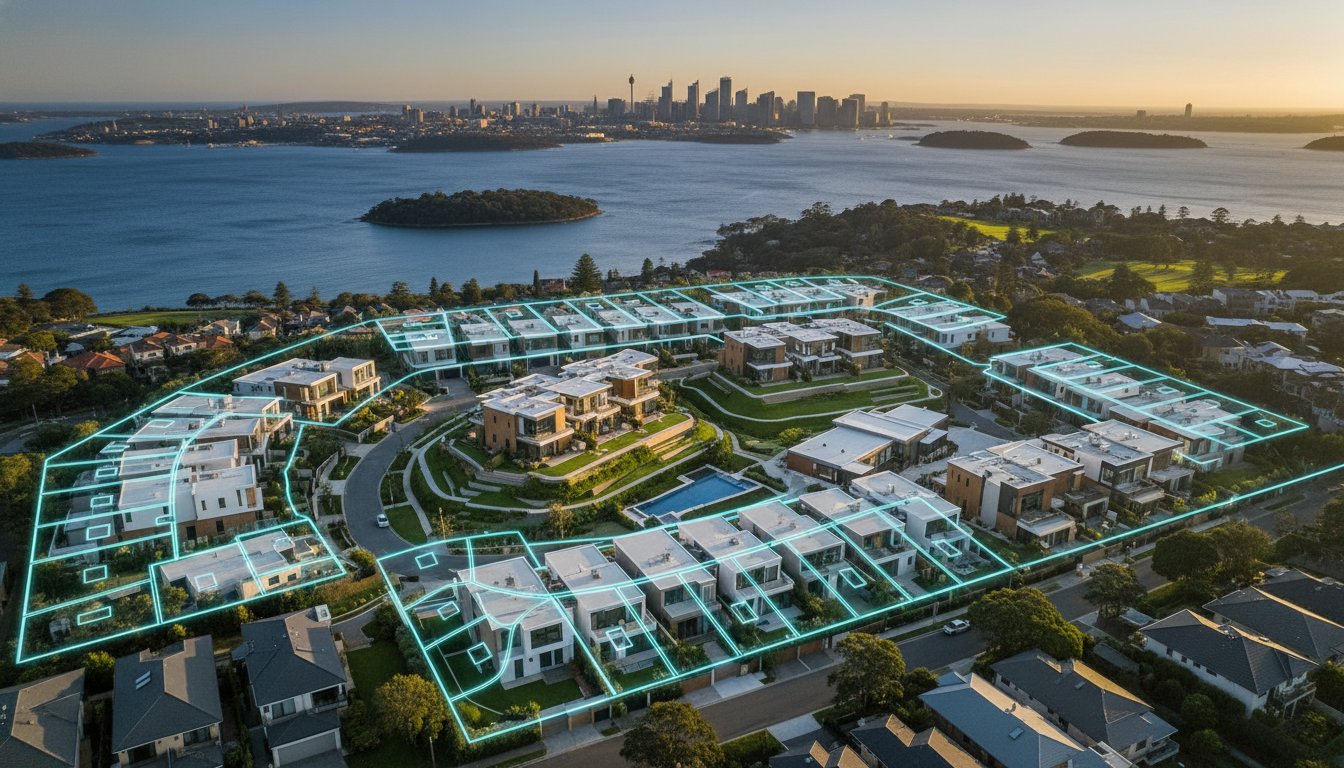
Choosing the right structure for your development is a decision that defines its legacy. In the evolving property market of 2026, a community title subdivision nsw represents a sophisticated evolution of land ownership. Governed by the Community Land Development Act 2021, this format offers a refined alternative to traditional subdivisions. It’s designed for those who seek the autonomy of owning their own land while enjoying the curated benefits of shared infrastructure. Whether you’re envisioning a boutique gated estate in Sydney or a rural cluster on the Central Coast, this structure provides the legal framework to manage common assets with precision and elegance.
This model is often referred to as a “middle ground” in property law. While the global concept of shared ownership is often categorized under Community Title Schemes in Australia, the NSW application is particularly robust. It allows for a harmonious blend of private sanctuary and communal connection. You aren’t just buying a lot; you’re investing in a lifestyle managed by a cohesive legal entity known as the Scheme. This surge in popularity across our region’s premium developments stems from a desire for more than just a house. It’s about creating a sense of place where private roads, landscaped parklands, and exclusive facilities are maintained to an exacting standard.
Defining the “Middle Ground” of Property Ownership
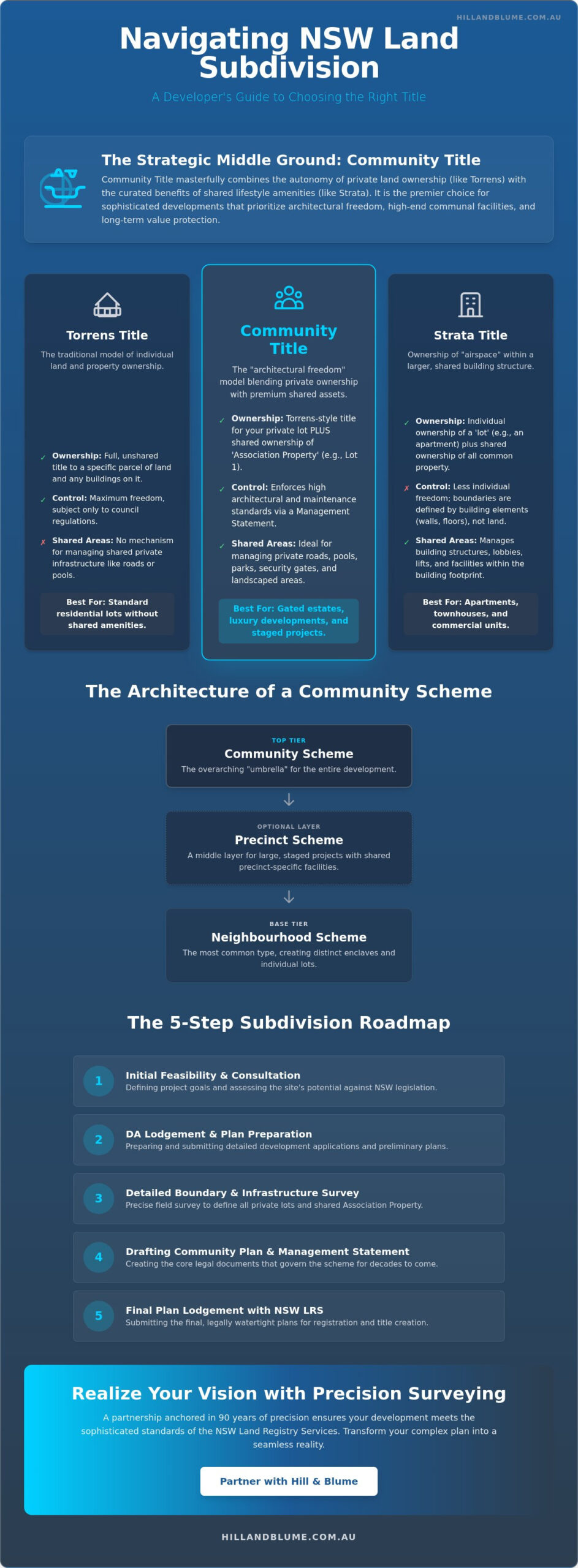
In a community scheme, your ownership of the land is Torrens-style. This means you hold the title to the ground itself, much like a traditional house and land package. However, you also hold a shared interest in “Association Property,” which mirrors the collaborative nature of a strata scheme. Visually, these developments stand apart. They often feature uniform fencing, manicured common verges, and a level of architectural consistency that standard subdivisions lack. The Scheme acts as the governing heartbeat, ensuring that the collective vision for the neighborhood remains untarnished by time.
When to Choose Community Title Over Torrens
A standard Torrens subdivision often hits a ceiling when it comes to shared luxury. If your project includes private roads, community pools, or complex water management systems, a Torrens title can’t effectively manage the ongoing maintenance. Community title fills this gap perfectly. It grants you, as the developer, immense control over development standards through a tailored Management Statement. This document acts as a promise of quality. It protects property values by mandating specific architectural guidelines; it ensures that every home built within the scheme contributes to a balanced, high-end aesthetic that resonates with discerning buyers. Understanding the full land subdivision process nsw is essential before committing to any title structure, as the legal and technical steps differ significantly between Torrens, strata, and community schemes.
The Architecture of a Community Scheme: Lot 1 and Beyond
The structure of a community title subdivision nsw is elegantly tiered, allowing for a level of design complexity that traditional subdivisions simply cannot match. At the heart of this architecture lies a hierarchy of schemes. A Community Scheme serves as the overarching umbrella, which can be further refined into Precinct Schemes and eventually Neighbourhood Schemes. This modular approach allows you to create distinct enclaves within a larger development, each with its own character while remaining part of a cohesive whole. Understanding these NSW community scheme laws is essential for developers who wish to master the art of staged delivery without compromising on long-term management.
Association Property, almost universally designated as Lot 1 on your plan, is the soul of the development. It isn’t just “leftover” land; it’s the shared canvas that hosts your project’s most prestigious assets. From private arterial roads to bespoke community centres, Lot 1 represents the collective investment of every lot owner. Because this land is shared, surveying precision is paramount. Any ambiguity in the boundaries of Lot 1 can lead to significant legal friction or maintenance disputes years down the line. We ensure these boundaries are legally watertight from the outset, providing a foundation of certainty for your future residents.
Association Property: Managing Shared Infrastructure
Association Property typically encompasses the vital organs of your subdivision. This includes private roads, gated entries, community gardens, and shared utility networks. Each individual lot is assigned a “unit entitlement,” a numerical value that reflects its share of the total scheme. This value isn’t just a number; it dictates the pulse of the community’s finances, determining both voting power and the proportion of maintenance levies each owner contributes. Identifying these vital boundaries requires a meticulous cadastral survey to ensure that every square metre of shared infrastructure is accounted for and correctly attributed to the Association.
The Community Management Statement (CMS)
If the survey plan is the body of the subdivision, the Community Management Statement (CMS) is its mind. This document acts as a living constitution, governing everything from the types of building materials allowed to pet ownership and noise levels. It’s a powerful tool for maintaining the “boutique” feel of a development long after the final lot is sold. Our role as surveyors extends into this administrative space, as we ensure the CMS aligns perfectly with the physical reality of the registered plan. Once finalized, the CMS is registered with the NSW Land Registry Services, creating a binding agreement that protects the aesthetic integrity and property value of the entire scheme. If you’re ready to define the vision for your next project, it’s often helpful to discuss your site’s potential with an expert who understands these nuances.
Community Title vs. Strata Title: A Strategic Comparison
Deciding between strata and community title is a pivotal moment in any development’s journey. While they share a spirit of collective management, their legal DNA is fundamentally different. In a strata scheme, the boundaries are defined by the physical structure of the building; you’re essentially owning a “box of air” bounded by walls and floors. Conversely, a community title subdivision nsw is a land-based model. Here, the boundaries are defined by the earth itself, surveyed with mathematical precision to create distinct parcels of land. This distinction isn’t just a legal curiosity. It fundamentally alters how residents perceive their ownership and how you, as a developer, can market the sense of autonomy your project provides.
Choosing community title offers a strategic advantage for those developing luxury estates or rural clusters. It provides a sense of “true” ownership that resonates with buyers who might be wary of the perceived restrictions of strata living. By establishing a community title subdivision nsw, you’re offering a lifestyle that combines the privacy of a detached home with the curated security of a managed precinct. It’s a nuanced balance that requires a surveyor who understands the long-term implications of these boundary definitions on property value and resident harmony.
Boundary Definitions: Surveyed Land vs. Built Structures
In a community scheme, you own the land beneath your home and the sky above it. This ownership style mirrors a traditional Torrens title, providing a sense of permanence that strata sometimes lacks. Because the boundaries aren’t tied to the walls of a building, boundary surveys become the most critical tool in your design phase. They define exactly where a private sanctuary ends and the communal landscape begins. In contrast, strata boundaries often rely on the “inner surface” of walls or the “centre” of a structural slab; this can limit an owner’s ability to modify their home without impacting the entire scheme’s structural integrity.
Insurance and Maintenance Responsibilities
This structural independence carries over into insurance and maintenance. In a community title subdivision nsw, the Association is only responsible for insuring and maintaining the shared Lot 1 infrastructure, such as private roads or community centres. Individual lot owners are responsible for their own homes, gardens, and building insurance. This often results in lower monthly levies, which is a compelling selling point for buyers who want the perks of a managed estate without the high overheads of a full-service strata building. It also grants owners far greater freedom for future renovations. As long as the changes align with the Community Management Statement, an owner can extend their living space or update their facade without the complex structural approvals required in a strata environment.
The Surveying Roadmap for a Successful Subdivision
A successful project begins long before the first shovel hits the ground. It starts with a considered site assessment that identifies the unique constraints and opportunities of your land. Engaging a registered surveyor during this feasibility phase is a strategic investment in the project’s future. We help you draft the initial Community Plan and Management Statement, ensuring the vision you’ve crafted is legally viable. This early collaboration prevents costly design misalignments that can stall a community title subdivision nsw during the crucial approval stages. It’s about building a foundation of technical certainty.
From Preliminary Plan to Final Registration
Precision is the hallmark of a boutique development. During the construction phase, our team marks the precise boundaries of your private lots and the shared Lot 1 infrastructure. This physical layout must mirror the registered plans to the millimetre to avoid delays at the final certification stage. The Plan of Subdivision stands as the final legal document that defines your development’s legacy at the NSW Land Registry Services. Once registered, it transforms your physical construction into a collection of individual titles, ready for settlement and the first residents to call them home.
Navigating NSW LRS Requirements and Council Approval
The journey through Council DA and SC processes requires a partner who understands the local landscape. Councils in Sydney and the Central Coast have specific expectations for a community title subdivision nsw, particularly regarding the Subdivision Works Certificate (SWC). This certificate is the green light for your physical works to commence. Hill & Blume manages the intricate technical liaison with these government bodies, streamlining the path toward your Subdivision Certificate. We ensure that every detail, from the utility networks to the private roads, meets the stringent requirements of the NSW LRS. To ensure your project stays on track, you can request a tailored project roadmap from our experienced team.
Expert Surveying for Sophisticated NSW Developments
Choosing a partner for your community title subdivision nsw is a decision that defines the long-term legacy of your project. It’s about finding a team that values the same level of craftsmanship you’ve poured into your architectural vision. At Hill & Blume, we’ve built our reputation on a foundation of trust and meticulous detail. We don’t just provide data. We offer a partnership that respects the unique character of the local landscape and the people who will eventually call it home. Whether you’re developing a refined coastal enclave or a sophisticated urban retreat, our approach remains anchored by a commitment to quality over volume.
The Hill & Blume Legacy in Complex Subdivisions
Our firm’s history is woven into the fabric of the region. With a 90-year legacy of precision, we’ve guided countless developers through the evolution of property law across Sydney and the Central Coast. This deep-rooted experience allows us to handle both intricate strata plans and expansive community schemes with equal poise. We balance traditional integrity with the latest surveying technology. Every document we produce carries the Hill & Blume seal of quality. It’s a standard of excellence that provides peace of mind for you and a clear, undisputed path for future lot owners.
Bespoke Consulting for Your Next Project
Unlocking the full potential of your land requires a strategy tailored to its specific geography and your long-term goals. Engaging with us at the subdivision survey stage provides you with more than just boundaries; it gives you access to an authoritative boutique perspective. We prioritize the human element of real estate. We understand that behind every technical requirement is a future resident’s lifestyle. Our team is discerning and detail-oriented, ensuring that your community title subdivision nsw is not only legally compliant but also optimized for value and community harmony. We invite you to experience a more personal, hand-crafted level of service that distinguishes your project from the clinical output of corporate agencies.
Your vision deserves a standard of surveying that matches its ambition. We’re ready to help you navigate the 2026 regulatory landscape with calm confidence and local expertise. Consult with our registered surveyors today to discuss how we can bring precision and elegance to your next development project.
Defining the Future of Your Development
Navigating the nuances of a community title subdivision nsw requires more than technical skill; it demands a vision for how people will live and connect within the landscape you’ve created. We’ve explored how this land-based model offers the architectural freedom of Torrens title alongside the curated amenities of a managed scheme. By mastering the hierarchy of Lot 1 and the specific 2026 Management Statement requirements, you aren’t just dividing land. You’re crafting a community that protects property values and fosters a refined regional lifestyle for years to come.
Your project deserves the certainty that comes from nearly a century of local expertise. Hill & Blume stands as a boutique authority, with registered surveyors serving Sydney, Newcastle, and the Central Coast. We specialize in high-end residential and commercial subdivisions, bringing 90+ years of NSW surveying expertise to every boundary and plan we produce. We invite you to partner with Hill & Blume for your community title subdivision and transform your development aspirations into a registered reality. Let’s build a legacy of quality together.
Frequently Asked Questions
What is the difference between community title and strata title in NSW?
Community title is defined by surveyed land boundaries, whereas strata title is defined by the physical building structure. In a community title subdivision nsw, you own the land and the air above it, giving you the freedom to build or renovate your home with fewer structural constraints. Strata owners typically own the internal space of their unit, with the building itself managed as common property.
How much does a community title subdivision cost to set up in Sydney?
The investment required depends on the complexity of your site and the specific requirements of your local council. While we don’t provide fixed pricing without a site assessment, you’ll need to account for professional surveying fees, legal costs for the management statement, and NSW Land Registry Services lodgment fees. Each project is unique, and we recommend a tailored consultation to understand the specific scope of your development.
Can a community title subdivision have its own private roads?
Absolutely, private roads are one of the primary reasons developers choose this structure. These roads are situated on Association Property, often Lot 1, and are managed and maintained by the community scheme rather than the local council. This allows for gated entries, bespoke landscaping, and a higher standard of maintenance that reflects the premium nature of your estate.
Who is responsible for maintenance in a community title scheme?
Responsibility is split between the individual lot owner and the community association. You’re responsible for the maintenance and insurance of your own home and garden, while the association manages the shared infrastructure on Lot 1. This includes private roads, community centres, and common parklands, ensuring the entire precinct remains pristine through collective contributions.
Do I need council approval for a community title subdivision in NSW?
Yes, council approval is a fundamental requirement for establishing any community scheme. You’ll need to navigate the Development Application (DA) process and obtain a Subdivision Certificate (SC) before the plan can be registered. Our team often assists by managing the technical surveying requirements and providing the necessary plans to ensure your application meets council’s exacting standards.
How long does the community title subdivision process take from start to finish?
The timeline for a community title subdivision nsw varies significantly based on council processing times and the scale of construction. Generally, the journey from initial site assessment to final registration with the NSW Land Registry Services can span from several months to over a year. Early engagement with a registered surveyor helps streamline this process by preventing technical errors that could lead to delays. For a detailed overview of each sequential stage, our guide to the land subdivision process nsw outlines the full professional roadmap from feasibility through to final registration.
What is a Community Management Statement (CMS)?
The Community Management Statement (CMS) is the legal constitution that governs the lifestyle and aesthetic of the subdivision. It outlines the rules for everything from architectural guidelines and building materials to pet ownership and noise levels. It’s a powerful document that protects the long-term value of the development by ensuring all residents adhere to a shared vision of quality and conduct.
Can I convert a Torrens title lot into a community title lot?
Yes, it’s possible to convert a Torrens title lot into a community title lot through a new plan of subdivision. This process requires council consent and the creation of a management statement to define the shared association property. It’s an effective way to unlock property value by integrating individual lots into a managed precinct with superior communal facilities and shared infrastructure.
Disclaimer
The information provided in articles published on this website is for general informational purposes only. While we make every effort to ensure the accuracy, completeness, and timeliness of the content, the material is based on our understanding of the industry at the time of writing and may not reflect the most current developments, regulations, or standards. All opinions expressed in our articles are those of the respective authors and do not necessarily represent the official position of the website or its affiliates. The content should not be considered professional, legal or technical advice, and should not be relied upon as a substitute for consultation with qualified professionals