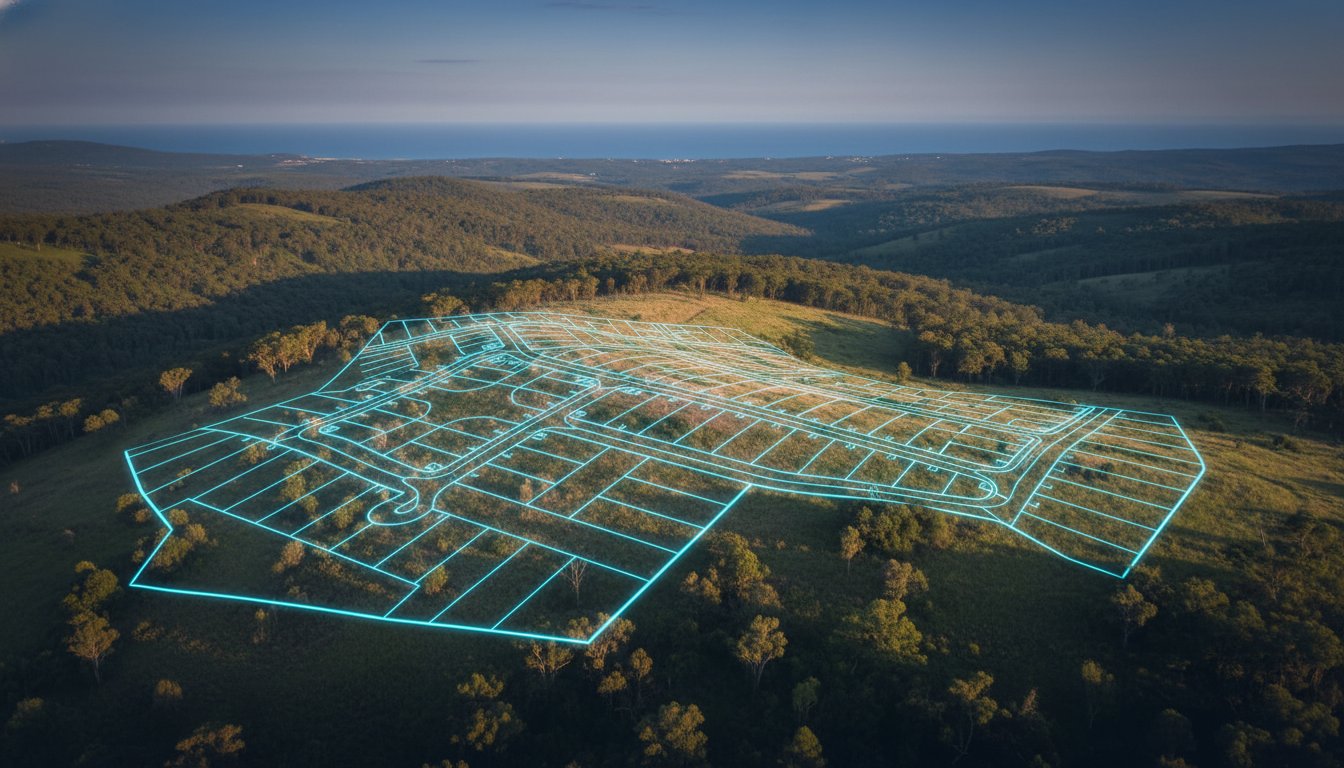
Most property owners view subdivision as a construction project, but the most successful developers know it’s actually a delicate legal and technical transformation. You likely recognize the immense potential sitting within your boundaries, yet the fear of a rejected Development Application or a sudden infrastructure levy can feel like a significant hurdle. It’s a complex landscape, especially with the second stage of the Environmental Planning and Assessment reforms that commenced on March 21, 2026. Managing the land subdivision process nsw requires more than just a plan; it requires a partnership rooted in precision and local expertise.
This guide offers the professional roadmap you need to move forward with a sense of calm confidence. We’ll show you how to protect your investment through meticulous surveying and clear decision-making between Torrens and Strata titles. You’ll discover a sequential path that demystifies council expectations and highlights how to avoid the hidden costs that often catch others off guard. From the initial detail and level surveys to the final lodgement of subdivision plans, we’re here to ensure your journey is as seamless and rewarding as the lifestyle you’re looking to create.
Key Takeaways
- Identify your property’s true potential by understanding how Local Environmental Plans and minimum lot sizes dictate your feasibility from the start.
- Distinguish between Torrens, Strata, and Community titles to choose the legal framework that best aligns with your long-term investment strategy.
- Master the five essential stages of the land subdivision process nsw to move confidently from your initial concept through to the final lodgement of new titles.
- Protect your project from costly delays and legal disputes by prioritizing precise boundary identification and professional identification surveys.
- Discover how partnering with local experts who value craftsmanship and detail can turn a complex regulatory journey into a seamless, boutique experience.
Feasibility and Due Diligence: The Foundation of Subdivision
Every successful property transformation begins with a quiet, thorough investigation. Before you envision the physical split of your property, you must understand the legal DNA of your land. In the land subdivision process nsw, your first port of call isn’t a designer; it is the Local Environmental Plan (LEP). This document serves as the essential rulebook your local council uses to manage the growth and character of your specific area. It dictates exactly what’s possible on your site, from the minimum lot size required for a new title to the specific zoning permissions that govern your land’s use.
When you embark on real estate development, the most expensive mistake you can make is assuming your property is a blank canvas. Physical constraints often hide in plain sight. Heritage listings, existing easements for drainage, and the natural topography of your block can all dictate where a new boundary line can realistically fall. This is why a Detail and Level Survey is non-negotiable at this stage. It provides the precise topographical data and structural details that form the skeleton of your project, ensuring your feasibility study is grounded in reality rather than guesswork.
Consulting the Local Environmental Plan (LEP)
Your council’s LEP dictates density through the Floor Space Ratio (FSR), which is a calculation of how much building area you’re allowed relative to the land size. You’ll need to look closely at how your specific council manages these ratios to ensure your strategy remains profitable. Beyond FSR, you must identify environmental overlays. These include bushfire or flood zones, which can require specialized reports and significantly impact your land subdivision process nsw. Identifying these factors early allows you to adjust your expectations before you’ve committed significant capital.
The Critical Role of the Preliminary Survey
Precision is your best protection against risk. A preliminary survey does more than mark land; it establishes the financial baseline for your project. By identifying unseen boundaries or encroachments by neighboring structures early, you avoid the frustration of redesigning your project mid-way through the DA process. Accurate data ensures your vision is actually buildable. It gives you the confidence to move forward, knowing that your project’s foundation is built on verified measurements rather than historical assumptions.
Understanding NSW Title Types: Torrens, Strata, and Community
Selecting the appropriate legal framework is a defining moment in the land subdivision process nsw. This choice influences everything from your initial investment to the eventual market appeal of your finished lots. In New South Wales, three primary titles exist, each offering a distinct way to define ownership and shared responsibility. Whether you’re envisioning a simple dual-occupancy or a sophisticated multi-level development, your title structure must align with your property’s unique character and the lifestyle you intend to create.
Torrens Title remains the gold standard for traditional land splits. It offers the most straightforward form of ownership, where the title holder owns the land and the building entirely, without the need for an owners corporation. For many, this autonomy is the ultimate goal of property development. It provides a sense of permanence and independence that resonates deeply with buyers seeking a legacy home. However, the requirements for creating new Torrens lots are often more stringent, requiring careful adherence to minimum lot sizes and setback rules dictated by your local council.
Strata and Community titles offer alternative paths for projects that involve shared spaces or higher density. Strata is the natural choice for vertical developments, while Community title is ideal for horizontal estates that share private infrastructure. If you’re unsure which path best suits your vision, reaching out for a professional conversation can clarify the best way forward for your specific site.
Torrens Title vs. Strata Title: A Strategic Choice
The decision between Torrens and Strata title often hinges on your target market and the density you hope to achieve. While Torrens lots are generally more valuable due to their lack of ongoing levies, Strata allows you to unlock value in smaller urban footprints. The surveying requirements for a Strata Plan are exceptionally detailed. We precisely define the boundaries of each lot and the common property, ensuring that every owner understands exactly what they own. This technical clarity is the foundation of a harmonious community and a secure investment.
Community Title for Modern Gated Estates
When a project involves shared amenities like private roads, parks, or community centers, a Community Title Subdivision provides the necessary structure. This framework establishes an Association, which acts similarly to an owners corporation but for a broader estate. Our role as surveyors in this process is to meticulously map the common property boundaries. We ensure that shared services are clearly defined and legally robust, allowing the Association to manage these assets effectively for years to come. This sophisticated approach to the land subdivision process nsw allows for the creation of exclusive, high-end environments that feel both private and connected.
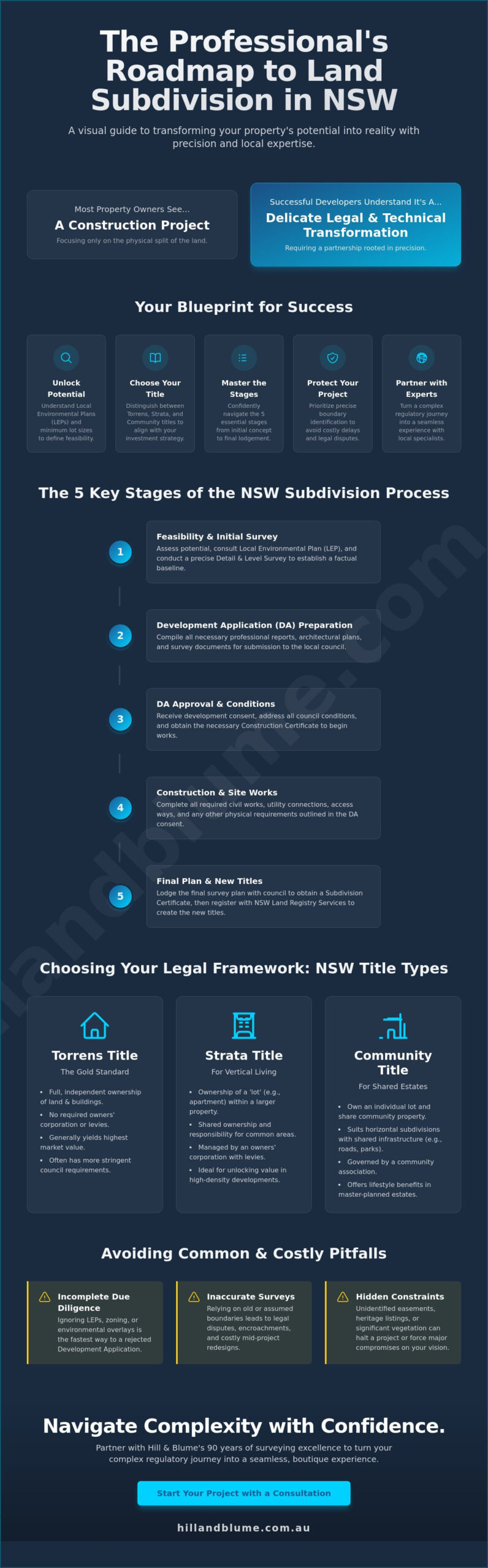
The 5 Key Stages of the Land Subdivision Process in NSW
The land subdivision process nsw is a journey of meticulous steps, moving from a single vision to a collection of separate assets. It is a path that requires patience, precision, and a deep understanding of how local government and state registries interact. While the physical transformation of the land is visible, the most critical work often happens behind the scenes. Success isn’t just about moving soil; it’s about moving through a series of legal and technical gateways with confidence.
Stage 1 & 2: DA Preparation and Council Consent
Your journey begins by assembling a boutique team of experts. Surveyors, town planners, and engineers must work in concert to prepare a Development Application (DA) that speaks the language of your local council. It’s common to receive a Request for Further Information (RFI) during this phase. We view these not as roadblocks, but as opportunities to provide the technical clarity council needs to move forward. You might also encounter a “Deferred Commencement” consent. This means your approval is granted, but specific conditions must be met before the consent becomes active. It’s a nuanced stage that benefits from a calm, professional approach to ensure every box is ticked correctly.
Stage 3 & 4: Construction and Certification
Once you have your consent, the focus shifts to the physical works required to support your new lots. This involves managing civil construction, such as installing sewer, water, and electrical connections. As these works reach completion, our role becomes one of verification. We conduct Work-as-Executed (WAE) Surveys to prove to council and service providers that the infrastructure matches the approved plans. This data is essential for obtaining your Subdivision Certificate. This certificate is the final “green light” from the council, confirming that all conditions of the DA have been satisfied and your land is ready to be legally split.
Stage 5: Final Lodgement and Title Issue
The final stage is the most rewarding. We perform a Cadastral Survey, which serves as the definitive legal basis for your new boundaries. This survey is the core of the plan we lodge with the NSW Land Registry Services (LRS). Once the LRS registers the plan, your original title is cancelled, and new titles are issued for each lot. This is the precise moment of value creation. Your single property has officially become multiple assets, each ready for sale or further development. It’s a sophisticated conclusion to the land subdivision process nsw, marking the successful unlocking of your property’s true potential.
Mitigating Risk: Common Pitfalls in NSW Subdivisions
“Why is my subdivision taking so long?” It’s a question we hear often, and it usually points to the intricate web of approvals required in the land subdivision process nsw. This journey isn’t a simple linear race; it is a series of interlocking technical and legal gateways. Delays frequently occur when property owners underestimate the “invisible” requirements of utility providers. Sydney Water, for instance, often requires a Section 73 Compliance Certificate. This involves specific infrastructure works that must be completed and verified before any new titles can be issued. If these hidden steps aren’t anticipated during your initial feasibility phase, they can add months to your timeline and unexpected figures to your balance sheet.
The Cost of Inaccuracy: Boundary Disputes
Relying on the placement of a weathered fence or a neighbor’s long-held assumption is a significant gamble that rarely pays off. Many property owners don’t realize that a physical fence line is seldom a reliable indicator of a legal boundary. Engaging a professional for a Boundary Survey is the only way to ensure your new lots are legally sound from the outset. A Registered Surveyor acts as a guardian of your property integrity, using historical records and modern precision to define your land’s exact footprint. In New South Wales, the boundaries shown on a registered plan of subdivision constitute the final and definitive legal record of your land ownership.
Navigating Developer Contributions and Fees
Budgeting for a successful subdivision requires looking far beyond the visible construction costs. Local councils levy developer contributions under Sections 7.11 and 7.12 to fund the essential community infrastructure your new lots will utilize. These rates vary significantly across the state and are subject to regular updates. For example, as of April 30, 2026, the Inner West Council applies a Section 7.12 levy of 1% on development costs exceeding $200,000. Meanwhile, the Shoalhaven Contributions Plan 2026 has introduced caps of $20,000 or $30,000 per lot in specific regions to balance growth with local affordability. With other councils like the Central Coast updating their rates as recently as May 1, 2026, staying informed on these shifting figures is vital. To ensure your project budget accounts for every detail, contact our team for a professional consultation regarding your site’s specific requirements.
Partnering with Hill & Blume: 90 Years of Surveying Excellence
Selecting a partner for your development is a significant decision that reaches far beyond simple technical measurement. It’s about finding a team that values the heritage of your land as much as its future potential. At Hill & Blume, we’ve spent 90 years refining our craft within the unique landscape of Sydney and New South Wales. This deep-rooted history allows us to guide you through the land subdivision process nsw with a level of foresight that only comes from nearly a century of local immersion. We don’t just mark boundaries; we act as your strategic partner, ensuring every technical detail aligns with your broader investment goals.
Our commitment to your project is anchored in precision. From the moment we conduct your initial detail and level survey to the final lodgement of your subdivision plans, we provide a steady, deliberate pace that respects your time and intelligence. We understand that a successful subdivision is a legal transformation. We treat every step with the care it deserves, ensuring your journey is as seamless as the lifestyle you’re looking to create. You aren’t just another file in our system; you’re a partner in a shared pursuit of quality.
A Legacy of Precision in Sydney
Our boutique identity is a conscious choice to prioritize quality over quantity. We believe that your property deserves more than the clinical service offered by larger corporate firms. By maintaining an intimate, hand-crafted approach, we ensure that every detail is scrutinized by experts who truly understand the local culture. Our extensive historical archives offer a unique advantage, allowing us to cross-reference modern data with decades of local records. This specialized authority provides a seal of quality that reassures our clients they’re in the most capable hands. It’s this blend of traditional integrity and forward-thinking expertise that makes Hill & Blume the trusted choice for the region’s most discerning developers.
Your Next Steps Toward Subdivision Success
The path to unlocking your property’s true potential is best traveled with a specialist by your side. You can initiate your journey today by engaging our registered team for a comprehensive feasibility study. This initial step provides the technical foundation you need to move forward with absolute confidence. We promise clarity, integrity, and a result that reflects the high standards of your vision. Our team is ready to move smoothly from identifying your aspirations to offering a tailored solution that protects your investment throughout the land subdivision process nsw. Begin your subdivision journey with a professional consultation to ensure your project is built on a foundation of excellence.
Unlocking Your Property’s True Potential with Confidence
Navigating the land subdivision process nsw is a sophisticated journey that rewards those who prioritize precision from the very first peg. You’ve discovered how a meticulous feasibility study and the right choice of title can transform a complex regulatory path into a rewarding investment. By understanding the five key stages of development and identifying potential risks early, you protect both your capital and your peace of mind. Success in property development isn’t just about the physical split; it’s about the technical integrity and expert partnerships you establish along the way.
Since 1932, Hill & Blume has provided a boutique, high-touch service for discerning property owners across Sydney, Newcastle, and the Central Coast. With over 90 years of local expertise, we offer more than just measurements. We provide the calm confidence that comes from deep-rooted authority and a genuine passion for our regional lifestyle. We invite you to partner with Hill & Blume for your NSW subdivision project and experience a hand-crafted approach to surveying that values quality above all else. Your property’s next chapter begins with a conversation grounded in trust and excellence.
Frequently Asked Questions
How long does the land subdivision process take in NSW in 2026?
A standard subdivision typically requires between 9 and 18 months to move from the initial feasibility stage to the issuance of new titles. This timeline accounts for the preparation of your Development Application, the statutory assessment periods, and the completion of necessary physical works. The land subdivision process nsw has seen some streamlining due to the 2026 planning reforms, particularly for minor modifications, but the overall duration remains dependent on your local council’s specific requirements and the complexity of your site’s infrastructure needs.
Can I subdivide my land if I have an existing mortgage?
You can certainly subdivide a mortgaged property, but you must obtain formal consent from your financial institution before the new titles are registered. Your bank will need to review the proposed subdivision to ensure their security remains protected across the new lots. Once the plan is ready for lodgement, the bank will facilitate the discharge of the original mortgage and the creation of new mortgage documents for the resulting titles. It’s a standard procedure that benefits from early communication with your lender’s property titles department.
What is the difference between a DA and a Complying Development Certificate (CDC) for subdivision?
A Development Application (DA) is a merit-based assessment performed by your local council, whereas a Complying Development Certificate (CDC) is a faster approval pathway for projects that strictly meet pre-determined state standards. CDCs are often used for straightforward residential splits that don’t require variations to local rules. If your project falls outside these rigid criteria or involves heritage and environmental overlays, a DA is the necessary route. We often help clients determine which path offers the most certainty for their specific property goals.
How much are the typical Council contribution fees for a two-lot subdivision?
Council contribution fees vary significantly across the state and are dictated by local infrastructure needs. For example, under the Shoalhaven Contributions Plan 2026, some areas are capped at $20,000 or $30,000 per new lot. In contrast, the Inner West Council applies a Section 7.12 levy of 1% of the development cost for projects exceeding $200,000. These figures are updated regularly, such as the quarterly adjustments seen in the Central Coast Council, so it’s vital to check the current rates for your specific local government area during the feasibility phase.
Do I need a lawyer or a surveyor first when starting a subdivision?
You should engage a registered surveyor first to establish the technical and legal feasibility of your project. Before a lawyer can draft contracts or shared property agreements, you need the precise data provided by a Detail and Level Survey to know what is physically and legally possible on the land. Our team provides the foundational measurements and subdivision plans that your legal and design teams will rely upon. Starting with a surveyor ensures that your project is grounded in geographical reality from day one.
Can I subdivide a property that has an easement running through it?
Subdivision is possible with an existing easement, provided the new lot boundaries and building envelopes respect the legal rights associated with that easement. An easement for drainage or electricity may restrict where you can build or how you provide services to the new lots. During the land subdivision process nsw, we meticulously map these encumbrances to ensure your proposed plan complies with all legal restrictions. Identifying these early prevents costly redesigns and ensures that each new lot remains functional and marketable.
What happens if my neighbor disputes the new boundary line?
If a boundary dispute arises, the registered plan of subdivision held by the NSW Land Registry Services serves as the final legal authority. We can perform an Identification Survey to physically mark the legal boundary and provide a report that clarifies the position of fences or structures relative to that line. This professional verification often resolves disputes quickly by providing an objective, legal baseline. Our 90 years of experience in boundary definition provides the technical weight needed to protect your property interests and maintain neighborhood harmony.
Is a registered surveyor mandatory for all subdivisions in NSW?
Yes, engaging a Registered Land Surveyor is a mandatory legal requirement for all subdivisions in New South Wales. Only a surveyor registered with the Board of Surveying and Spatial Information (BOSSI) has the legal authority to sign off on the plans that create new land titles. This regulation ensures that every new boundary in the state is defined with absolute precision and legal integrity. Our team handles the complex cadastral calculations and lodgement requirements, providing the seal of quality necessary for the NSW Land Registry Services to issue your new titles.
Disclaimer
The information provided in articles published on this website is for general informational purposes only. While we make every effort to ensure the accuracy, completeness, and timeliness of the content, the material is based on our understanding of the industry at the time of writing and may not reflect the most current developments, regulations, or standards. All opinions expressed in our articles are those of the respective authors and do not necessarily represent the official position of the website or its affiliates. The content should not be considered professional, legal or technical advice, and should not be relied upon as a substitute for consultation with qualified professionals