
What if the boundary between a seamless property investment and a costly legal dispute was defined by a single professional credential? In the refined world of NSW real estate, it’s common to feel a sense of anxiety over the technicalities of the Surveying and Spatial Information Act 2002. You likely seek the quiet confidence that comes with knowing your land boundaries are legally indisputable and your project is fully compliant. This 2026 guide explains why engaging a registered surveyor is the only legal path to protecting your assets across Sydney, Newcastle, and the Central Coast.
We’ll demystify the essential differences between land and registered surveyors, ensuring your next subdivision or strata plan moves forward with absolute integrity and grace. You’ll learn how to avoid the common pitfalls of DA rejections and boundary overlaps that often stall local projects for months. From managing complex Council requirements to securing your property’s legacy, discover how a bespoke partnership with a local expert provides the clarity and certainty your vision deserves.
Key Takeaways
- Understand the legal necessity of hiring a registered surveyor, the only professional licensed to define property boundaries and protect your NSW land title.
- Ensure your development application proceeds without delay by meeting the exacting standards required by Councils across Sydney and the Central Coast.
- Guard your project against encroachment disputes and legal complications by distinguishing between licensed experts and general survey technicians.
- Learn the essential steps to verify a professional’s credentials and local expertise before committing to a partnership.
- Discover how a legacy of precision since 1932 can provide the seamless, high-end service your property development requires.
What is a Registered Surveyor in NSW?
In the context of NSW property law, a registered surveyor is much more than a technical expert; they’re a statutory officer entrusted with the legal integrity of your land. While many professionals can operate surveying equipment, only those licensed by the Board of Surveying and Spatial Information (BOSSI) possess the legal authority to define the boundaries of your estate. This distinction is enshrined in the Surveying and Spatial Information Act 2002, which serves as the legislative bedrock for all land measurements and boundary determinations across the state. When you explore our professional surveying services, you’re engaging with a team that respects this historical and legal weight.
Understanding the hierarchy within the profession is vital for your project’s success. A survey technician or a graduate surveyor may perform the physical measurements on-site; however, they cannot legally certify a boundary. Only a licensed professional who has met the stringent requirements of the Board can sign the documents that protect your title. This ensures that every line drawn on a plan is backed by professional indemnity and legal accountability, offering you a sense of calm confidence as you move through the development process.
The Role of BOSSI in NSW Surveying
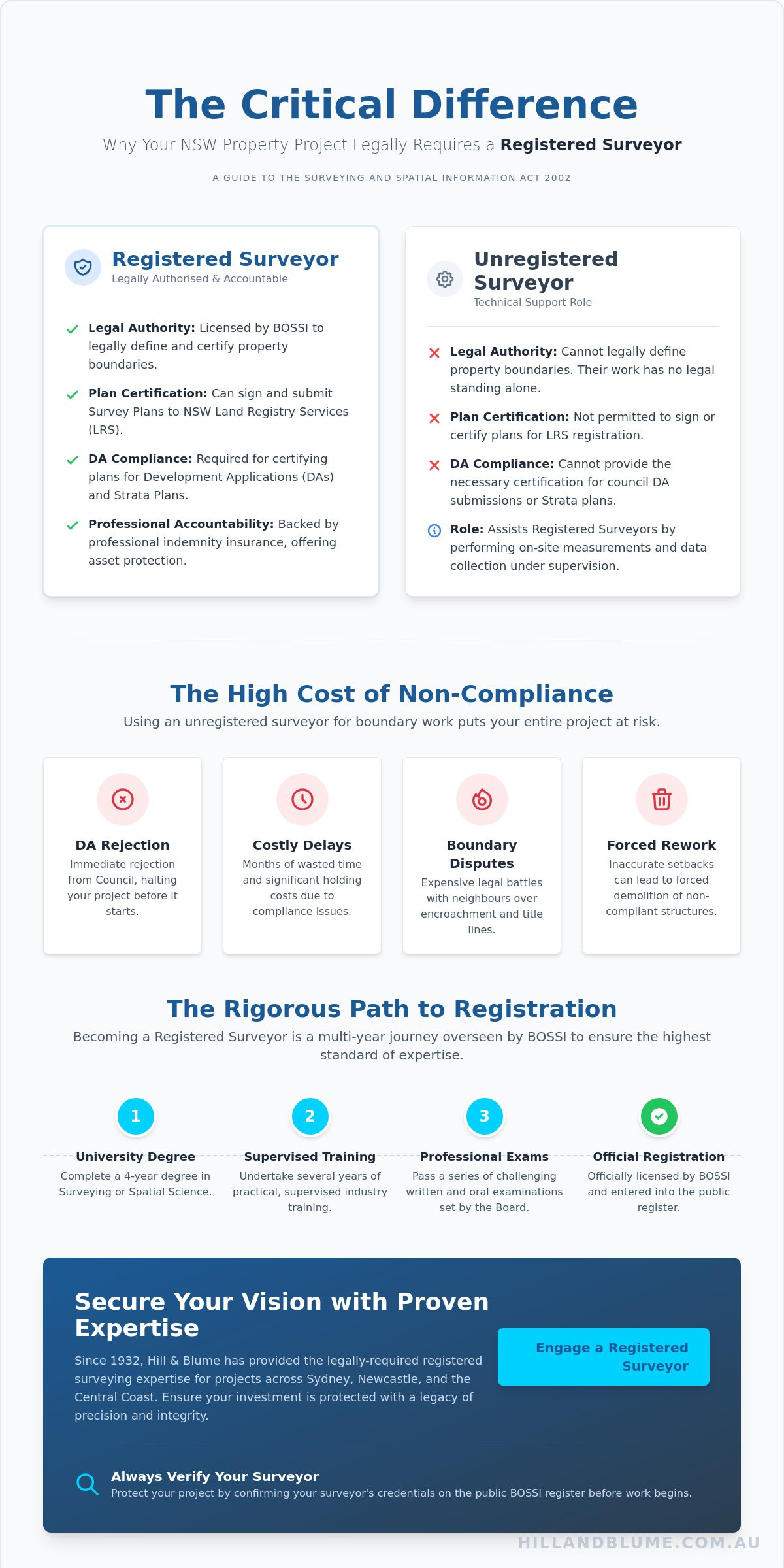
BOSSI acts as the guardian of the NSW cadastre, ensuring that every professional who identifies as a registered surveyor has undergone a rigorous assessment process. This journey typically involves a four year university degree followed by several years of supervised training and a series of challenging professional projects. Candidates must eventually pass a set of oral examinations before the Board to prove their mastery of both spatial science and land law. For any Sydney or Newcastle property project, verifying a professional’s status on the BOSSI register is a critical first step to ensure your investment remains secure and your vision is protected by genuine expertise.
Legal Authority and the NSW Cadastre
The “Cadastre” is the official public record of land ownership, a complex map that defines the spatial extent of every property in New South Wales. When you require a Plan of Survey for the Land Registry Services (LRS), you’re engaging with a system that underpins the multi-billion dollar NSW property market. Because the cadastre relies on absolute precision to prevent social and economic friction, the law mandates that only a licensed expert can certify these records. By choosing a professional with this specific legal authority, you aren’t just hiring a consultant; you’re securing a bespoke partnership that guarantees the long term viability of your property vision through impeccable integrity.
Why Registration is Critical for Your Property Project
Your vision for a property development rests on the precision of its foundation. In the competitive landscapes of Sydney and Newcastle, a Development Application (DA) is more than a formality; it’s a rigorous test of compliance. Councils in these regions require that site plans and boundary definitions be certified by a registered surveyor to ensure every measurement aligns with the Local Environmental Plan (LEP). Without this professional seal, your project risks immediate rejection, leading to months of avoidable delays and mounting holding costs.
Precision in the early stages prevents the heartbreak of construction rework. We’ve seen instances where inaccurate setbacks resulted in structures encroaching onto neighbouring land by as little as 150mm, yet this was enough to trigger expensive legal disputes or forced demolitions. A registered professional provides the legal certainty required for complex subdivision and strata title conversions. In NSW, 100% of these new land titles must be certified by a licensed professional to be accepted by the Land Registry Services, ensuring your investment is protected for generations.
Boundary Integrity and Dispute Prevention
Distinguishing between “occupational” boundaries, such as an old timber fence, and the true “title” boundary is a nuanced art. A registered surveyor in Sydney uses historical records and physical evidence to resolve these discrepancies with absolute integrity. This Identification Survey is often a non-negotiable requirement for mortgage approvals, providing the bank and the buyer with peace of mind regarding the land’s true dimensions. It’s about creating a seamless transition from a vision on paper to a secure asset on the ground.
Compliance with Local Government Requirements
Local governments in Newcastle and the Central Coast are increasingly focused on Floor Space Ratio (FSR) and building height limits. An inaccurate contour and detail survey can lead to miscalculations in your building’s footprint, potentially violating setback regulations. By ensuring your data is legally robust from the outset, you maintain the integrity of your design and foster a smoother relationship with planning authorities. If you’re preparing for a new development, we invite you to discuss your project requirements with our team to ensure every detail is curated for success.
Registered vs. Unregistered Surveyors: Knowing the Difference
Choosing the right professional for your property development is a decision that requires discernment. While the term “surveyor” is often used broadly, the legal distinction between a registered surveyor and a general technician is profound. In New South Wales, the Land Registry Services (LRS) will only accept a Plan of Survey that bears the signature and seal of a licensed professional. This signature isn’t just a formality; it represents a legal guarantee that the boundaries of your asset have been determined with absolute integrity and precision.
You might wonder when it’s appropriate to engage a general survey technician. These professionals are highly skilled in capturing data for internal floor plans, basic topographic mapping, or 3D laser scanning where legal boundaries aren’t the primary focus. However, the moment your project involves identifying, re-establishing, or creating a new property boundary, the law mandates the oversight of a registered professional. Hiring based on a lower price point rather than legal qualification often leads to a “false economy” where plans are rejected by Council, requiring a complete and costly redo. You can explore our curated surveying services to see how we balance technical skill with legal authority.
The Limits of General Surveying Services
A general surveyor cannot legally re-establish a boundary peg or certify the position of a structure relative to a boundary line. This limitation is a common pitfall for developers who assume all surveying services carry the same weight. Without the proper registration, a technician lacks the statutory authority to defend their work in a court of law or before the Land and Environment Court. This lack of accountability introduces a layer of risk that can compromise the seamless progress of your development, particularly in high-stakes markets like Sydney or Newcastle. Modern technology, such as drone surveying for property development in Sydney, can enhance the data collection process, but it still requires the oversight of a registered professional to carry legal weight.
Professional Indemnity and Consumer Protection
Your protection as a property owner is deeply tied to the registration status of your lead registered surveyor. Licensed professionals are required by BOSSI to maintain mandatory Continuing Professional Development (CPD), ensuring they stay abreast of the latest changes in land law and spatial technology. Most professional indemnity insurance policies for surveying firms specify that boundary work must be supervised or performed by a registered professional to remain valid. This oversight provides a curated layer of security for your investment, ensuring that in the rare event of an error, you have a clear path to resolution through a regulated professional body.
How to Hire a Registered Surveyor in Sydney and Newcastle
Finding the right partner for your property journey requires a balance of due diligence and intuition. While the technical requirements are non-negotiable, the relationship you build with your registered surveyor will define the ease of your development. The first step is always verification. You should consult the official BOSSI database to ensure your chosen professional holds a current license. This simple check confirms they’re legally empowered to certify your boundaries and protect your title under NSW law.
Beyond registration, local experience is the quiet engine of a successful project. A firm that’s operated in Sydney’s historic suburbs since 1932 understands the nuances of plans dating back to the mid-1800s that a less experienced provider might overlook. You should also look for specialized expertise tailored to your specific needs, whether that’s a complex Strata conversion, a large-scale subdivision, or a PCA Lease for commercial space. When you request a detailed quote for professional surveying services, ensure it reflects this depth of local and technical understanding.
Evaluating Local Expertise and Legacy
The value of legacy can’t be overstated in the surveying profession. A firm with deep roots in the region possesses an archive of historical data that can be instrumental in resolving complex boundary discrepancies. This is particularly vital in Sydney’s older neighborhoods, where original markers may have shifted over the last century. For a more detailed guide on selecting the right firm, we recommend reviewing our checklist for choosing survey companies. This resource helps you move beyond price comparisons to focus on long-term value and project integrity.
Understanding the Scope of Work
A comprehensive quote shouldn’t leave room for ambiguity. It must include all necessary lodgement fees for the NSW Land Registry Services (LRS) to avoid unexpected costs during the final stages of your project. Timelines are equally critical; a professional firm will provide a clear schedule for both field observations and office-based analysis. For complex urban infill projects in Sydney, a bespoke approach is essential to navigate the proximity of neighboring structures and shared infrastructure. Before committing to a partnership, reviewing a dedicated professional buying guide for choosing a surveyor in Sydney can help you ask the right questions and evaluate proposals with greater confidence. If you’re ready to secure your property’s future, contact our expert team to discuss a tailored solution for your next development.
Hill & Blume: 90 Years of Registered Surveying Excellence
Precision is our heritage. Since 1932, Hill & Blume has served as a cornerstone of the NSW property market, providing the technical mastery required to transform ambitious visions into enduring assets. When you engage a registered surveyor from our firm, you aren’t just hiring a consultant; you’re entering into a partnership defined by integrity and a shared passion for excellence. We understand that your property is likely your most significant investment, and we treat it with the curated care it deserves.
Our commitment to high-end standards is reflected in every plan we produce. From the initial identification of boundaries to the final Work-As-Executed reports, we provide comprehensive support that ensures your project remains compliant and stress-free. As your chosen registered surveyor, we act as the bridge between your architectural vision and the strict legalities of the NSW cadastre. This seamless service is designed for discerning clients in Sydney and Newcastle who value quality over turnover. We move with a deliberate pace, ensuring that every detail is polished and every legal requirement is met before your plans reach the Land Registry Services.
Our Regional Focus: From Sydney Harbour to the Hunter
Our expertise extends across the most sought-after landscapes in the state. As experienced Land Surveyors on the Northern Beaches and the coastal stretches of Newcastle, we possess a deep understanding of the unique challenges posed by coastal hazard zones and complex terrain. This local knowledge is a vital asset for your project, often translating to faster approvals and smoother interactions with local Councils. We provide a sense of calm confidence, knowing that our deep roots in these communities allow us to navigate local regulations with ease and grace.
Partnering for Your Property’s Future
Choosing Hill & Blume means choosing a legacy of craftsmanship. Our 90 year history provides a depth of perspective that modern, high volume agencies simply can’t match. We prioritize the human element of every development, focusing on the relationships that build communities rather than just the lines on a map. Our focus remains on technical mastery and traditional integrity, ensuring that your property’s future is as secure as its past. We invite you to reach out for a professional consultation to discuss how our bespoke approach can bring clarity to your next NSW project.
Securing the Future of Your NSW Property Vision
Your property development deserves a foundation built on absolute legal certainty and local mastery. The distinction between a technician and a licensed professional is the difference between a project vulnerable to boundary disputes and one protected by the full weight of NSW land law. By choosing a partner who understands the nuances of the 2002 Act and the coastal hazards of the Central Coast, you ensure your vision moves forward without the friction of Council rejections or construction delays.
At Hill & Blume, our legacy began in 1932. With over 90 years of private surveying records and a team of BOSSI accredited specialists, we offer a level of discernment and technical precision that is rare in today’s market. We specialize in the property laws of Sydney, Newcastle, and the Central Coast, providing a bespoke service that prioritizes the integrity of your land title and the long term success of your development.
Take the first step toward a seamless project by choosing a partner who values quality as much as you do. We invite you to partner with a registered surveyor for your next Sydney project and experience the calm confidence that comes with true expertise. Your property’s legacy starts with a single, precise line.
Frequently Asked Questions
How do I know if a surveyor is registered in NSW?
You can verify a professional’s status by searching the official register maintained by the Board of Surveying and Spatial Information (BOSSI). This public database is the only authoritative source for confirming that an individual holds a current license under the Surveying and Spatial Information Act 2002. It’s a simple, essential step that ensures your property project is handled with the integrity and legal authority required in New South Wales.
Can an architect perform a boundary survey?
No, an architect cannot legally perform a boundary survey or define land limits in NSW. While architects are masters of design and spatial planning, the law restricts the determination of property boundaries exclusively to a registered surveyor. This ensures the state’s cadastre remains accurate and that your property rights are protected by a specialist with specific statutory authority.
How much does a registered surveyor cost in Sydney in 2026?
The investment for professional surveying services depends on the complexity of your site and the specific requirements of your local Council. Factors such as the age of the original subdivision, the terrain, and the level of detail required for a Development Application will influence the final fee. We recommend requesting a bespoke quote that outlines all professional fees and NSW Land Registry Services lodgement costs to ensure full transparency.
What is the difference between a licensed and a registered surveyor?
In the context of NSW land law, these terms are effectively the same and describe a professional authorized by BOSSI. While “licensed” is a common term in other states, “registered” is the formal designation used within the governing 2002 legislation. Both titles signify that the individual has met the rigorous competency standards and oral examinations required to legally define land boundaries and sign off on survey plans.
Do I need a registered surveyor for a new fence?
While you aren’t always legally mandated to hire a professional for every fence, doing so is the only way to prevent encroachment disputes with your neighbours. A boundary staking survey provides a clear, indisputable line for your new structure, ensuring it sits entirely within your land. This small investment offers a sense of calm confidence and protects the long term harmony of your local community.
What happens if I use an unregistered surveyor for my subdivision?
Using an unregistered individual for a subdivision will result in the immediate rejection of your plans by the NSW Land Registry Services. Only a registered surveyor has the legal power to sign the certificates required for the creation of new land titles. Attempting to use an unlicensed person often leads to significant delays and the added expense of hiring a professional to redo the entire survey from scratch.
How long does a registered survey take to complete?
A standard boundary or identification survey typically requires 10 to 15 business days for field observations and the subsequent drafting of plans. More complex urban projects in Sydney or large subdivisions in Newcastle may take longer depending on the availability of historical records and the specific requirements of the project. We prioritize a seamless process, ensuring every detail is curated for accuracy before final delivery.
Is a registered surveyor needed for a granny flat in Newcastle?
Yes, Newcastle City Council generally requires a site plan prepared by a registered professional for any secondary dwelling or granny flat application. This ensures that setbacks, floor space ratios, and building height limits are calculated with absolute precision relative to your boundaries. Having a legally robust survey from the start facilitates a smoother approval process and prevents complications during the final building certification stage.
Disclaimer
The information provided in articles published on this website is for general informational purposes only. While we make every effort to ensure the accuracy, completeness, and timeliness of the content, the material is based on our understanding of the industry at the time of writing and may not reflect the most current developments, regulations, or standards. All opinions expressed in our articles are those of the respective authors and do not necessarily represent the official position of the website or its affiliates. The content should not be considered professional, legal or technical advice, and should not be relied upon as a substitute for consultation with qualified professionals