
Your property’s true value often remains hidden until you define the invisible lines of its future. While the subdivision process nsw landowners navigate in 2026 is famously intricate, it remains the most powerful tool for unlocking significant equity and creating a legacy of land. You likely understand that the path through council regulations and Local Environmental Plans is rarely a straight line. The fear of hidden compliance costs or the frustration of extended timelines at Land Registry Services can make even the most seasoned investor feel hesitant.
We believe that property development should feel like a refined partnership rather than a bureaucratic battle. This guide provides a professional roadmap to help you navigate these legal complexities with the calm confidence of a specialized local authority. You will gain a clear understanding of feasibility, learn to avoid the pitfalls of the latest planning portal updates, and discover the seamless path to legal title creation. By the end, you’ll have the clarity required to transform a single plot into a curated collection of opportunities with the steady hand of Hill & Blume guiding your vision.
Key Takeaways
- Understand how your local council’s Local Environmental Plan (LEP) and Minimum Lot Size requirements act as the ultimate gatekeepers to your property’s potential.
- Navigate the four critical stages of the subdivision process nsw requires to move seamlessly from your initial application to final title registration.
- Evaluate the unique advantages of Torrens, Strata, and Community titles to ensure your project’s ownership structure aligns with your long-term financial goals.
- Learn why partnering with a Registered Surveyor is essential for securing legally binding plans and managing the sophisticated requirements of the NSW Planning Portal.
What is the Subdivision Process in NSW? Defining Your Property Potential
At its most fundamental level, the subdivision process nsw property owners undertake is the legal act of dividing a single parcel of land into two or more separate titles. It’s a sophisticated evolution of the land’s identity, a moment where a singular vision becomes a tangible reality. While you might see a new fence or a shared driveway, the true change happens within the state’s digital and physical ledgers. This legal “Plan of Subdivision” creates distinct assets that can be sold, mortgaged, or bequeathed independently.
In 2026, the landscape of development is shifting toward sustainable density. Councils now place a premium on infrastructure contributions to support growing communities. Because these changes carry significant legal weight, a Registered Surveyor is the only professional authorized to sign the final plans. They act as the steady hand and the architect of your property rights, ensuring every millimetre aligns with the law. At Hill & Blume, we’ve spent over 90 years perfecting this craft, acting as the specialized local authority your project deserves.
The Legal Framework: NSW Land Registry Services (LRS)
The NSW Land Registry Services (LRS) acts as the custodian of our state’s land title system. This system is built upon a historical foundation of administrative divisions of NSW, which established the counties and parishes that still influence modern property descriptions. Precision is the cornerstone of this framework. Cadastral surveying ensures that the boundaries of your new titles are beyond dispute, maintaining the integrity of the Torrens Title system. Without this surgical accuracy, a subdivision remains a mere concept rather than a registered reality.
Why Homeowners and Developers Subdivide
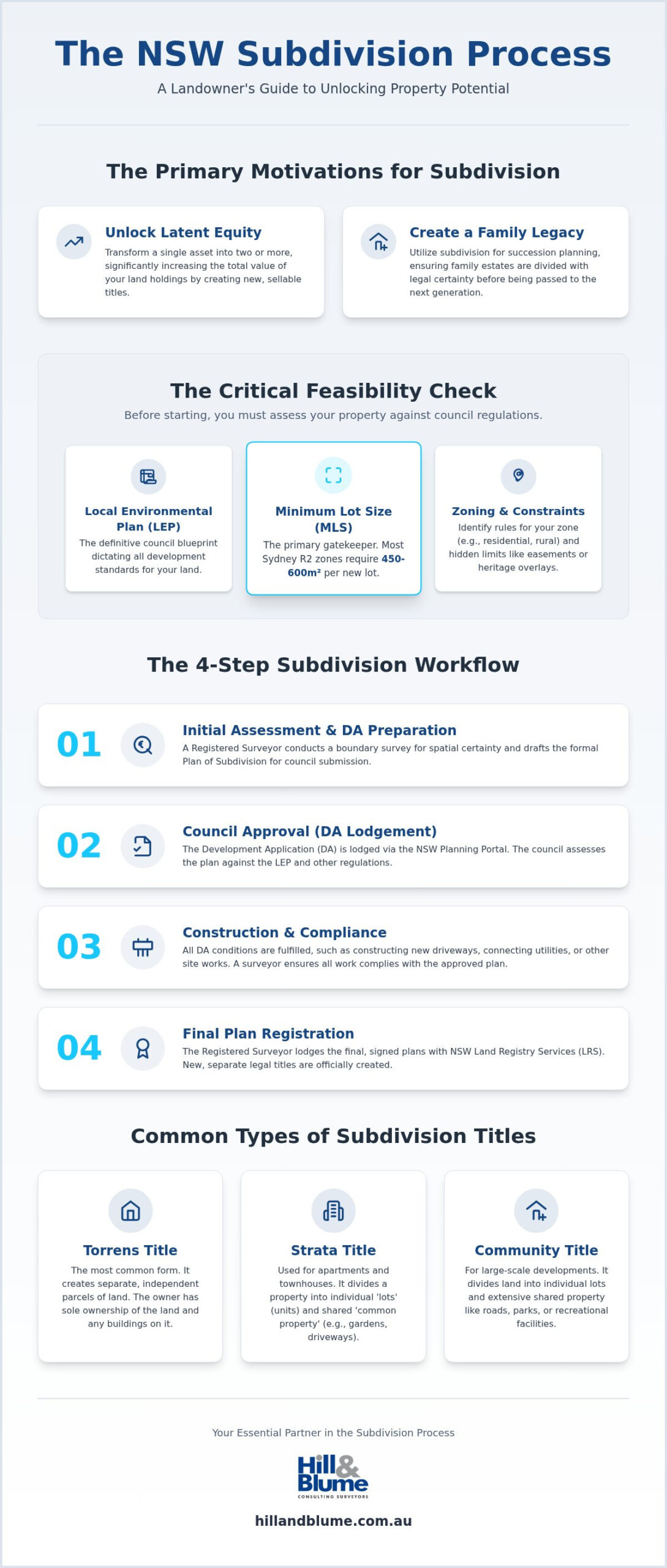
Subdivision is often a journey toward financial freedom or family legacy. For those starting the subdivision process nsw requires, the motivation is usually clear: value. It’s about unlocking the latent equity trapped in a large backyard. By creating a second title, you transform a single asset into two, significantly increasing the total value of your holdings. Others use the process for succession planning, ensuring family estates are divided with legal certainty before they’re passed to the next generation. Whether you’re planning a dual occupancy or a multi-dwelling project, our Subdivision Plans provide the structural clarity needed to realize these goals. It’s about making your land work harder for you.
Assessing Feasibility: Minimum Lot Sizes and Zoning Laws
Before the first peg is driven into the ground, the subdivision process nsw begins with a rigorous feasibility assessment. Your local council’s Local Environmental Plan (LEP) serves as the definitive blueprint for what’s permissible on your land. It’s a sophisticated document that dictates development standards, with the ‘Minimum Lot Size’ (MLS) acting as the primary gatekeeper. If your current parcel doesn’t meet the combined MLS for the proposed new lots, the project may be stalled before it begins. Most Sydney metropolitan areas in R2 Low Density Residential zones require between 450 and 600 square metres per created lot, though these figures vary significantly between local government areas.
Zoning dictates the very nature of your subdivision path. A residential project follows a vastly different trajectory than a rural or commercial division. Beyond the obvious lines on a map, you must identify ‘hidden’ constraints that could impact your yield. Heritage overlays, environmental protections, and existing easements can restrict where you build or how you divide. Understanding these nuances early ensures you don’t invest in a vision that the land cannot legally support.
Navigating the NSW Planning Portal
The NSW Planning Portal’s Spatial Viewer is an essential tool for identifying property-specific controls. It allows you to peer into the regulatory DNA of your site, revealing everything from zoning boundaries to floor space ratios. However, the true depth of information lies within a Section 10.7 Certificate. This document discloses the planning rules and constraints applicable to your land at the time of issue. To truly manage risk, we recommend a preliminary boundary survey. This provides the spatial certainty needed to confirm if your aspirations align with the physical reality of the site.
Environmental and Infrastructure Constraints
Your land’s physical characteristics often dictate its legal potential. Bushfire and flood-prone classifications can dramatically reduce permissible lot yields or necessitate expensive mitigation works. You must also consider the practicalities of a Subdivision Certificate, which requires proof that each new lot can be adequately serviced. This includes water, sewer, and telecommunications connections. Existing biodiversity, such as significant trees or protected vegetation, may also require offsets that impact your site layout. If you’re unsure how these layers affect your property, speaking with a registered surveyor can provide the clarity you need to move forward with confidence.
Types of Subdivision in NSW: Torrens, Strata, and Community Titles
Selecting the right title structure is a pivotal decision that shapes your property’s marketability and management for decades. The subdivision process nsw recognizes three primary legal frameworks, each offering a different level of autonomy and shared responsibility. Whether you’re carving out a legacy for your family or developing a sophisticated multi-unit scheme, your choice will dictate everything from infrastructure costs to future maintenance levies. Navigating the subdivision process nsw effectively requires an understanding of how these titles impact your project’s long-term value and feasibility.
Torrens Title remains the gold standard of land ownership in Australia. It grants you absolute independence over your parcel of land and the structures upon it. There are no shared walls, no common property, and no body corporate fees. This is often the preferred route for traditional residential lots and high-end duplexes, as it generally commands a premium in the Sydney market. It represents a clean, uncomplicated form of ownership that buyers find inherently reassuring.
Strata Title, by contrast, allows for the horizontal and vertical division of property. It’s the engine behind modern apartment living and townhome complexes. Here, you own your specific unit or lot, while sharing ownership of common areas like driveways, gardens, and structural walls. For larger estates with shared private infrastructure, Community Title offers a hybrid solution. It functions similarly to Torrens Title but includes shared facilities, such as private roads or parklands, managed by a neighbourhood association.
Torrens Title Subdivision vs. Strata Schemes
Your choice between Torrens and Strata often hinges on the physical layout of your development and your budget for infrastructure. Torrens Title duplexes require completely independent service connections for water, sewer, and electricity, which can increase your initial capital outlay. However, the absence of ongoing strata levies is a significant drawcard for many buyers. For multi-unit projects where shared facilities are unavoidable, engaging expert strata plan surveyors ensures that common property boundaries are defined with absolute precision, protecting the interests of every future owner and the developer’s reputation.
Consolidation and Boundary Adjustments
Not every project involves creating new parcels from scratch. Sometimes, the most strategic move is consolidation, merging several smaller lots to facilitate a more ambitious development. Alternatively, you might simply need a boundary adjustment to resolve an encroachment or better align a fence line with your vision. These adjustments often benefit from a streamlined approval process because they follow the “no new lots” rule. Even so, the legal stakes remain high. Every shift in a boundary must be documented by a registered surveyor to ensure the new lines are legally binding and correctly registered. This meticulous attention to detail transforms a simple line on a map into a secure property right.
The 4-Step Subdivision Workflow: From DA to Registration
The subdivision process nsw follows a deliberate, rhythmic progression that transforms a single vision into a collection of legal titles. It’s a journey that requires patience and precision, moving from the conceptual design on a screen to the physical infrastructure in the ground. While many property owners focus solely on the initial approval, the true expertise lies in navigating the final transition to the Land Registry Services (LRS). This workflow ensures that every regulatory box is ticked, protecting your investment from the risk of costly delays or non-compliance.
- Step 1: Preparation and Lodgement: This begins with your Development Application (DA) through the NSW Planning Portal. It’s the stage where your project’s feasibility is tested against local council standards.
- Step 2: Subdivision Works Certificate (SWC): Once the DA is approved, you must obtain an SWC. This is your “green light” to begin physical construction, such as installing drainage, roads, or utility connections.
- Step 3: The Subdivision Certificate (SC): After construction is complete and all DA conditions are met, the council issues the SC. This is their final sign-off, verifying that the new lots are ready for independent existence.
- Step 4: Registration: The final act involves lodging your plans with the LRS. Once registered, the old title is cancelled, and your new legal titles are born.
The Role of the Section 88B Instrument
A successful subdivision is defined by more than just physical boundaries; it’s defined by the rights and restrictions that govern the land. The Section 88B instrument is the legal document that creates easements for services, rights of way, and restrictive covenants. It works in tandem with your subdivision plan to ensure that future owners understand their obligations. Drafting this document requires a sophisticated touch; even a minor clerical error can lead to an LRS requisition, halting your progress for weeks. We pride ourselves on the craftsmanship of these instruments, ensuring they’re as polished as the properties they describe.
Final Survey and Plan Registration
As you approach the finish line, the demand for precision reaches its peak. A final survey must be conducted to confirm that all infrastructure has been built exactly where the plan intended. You’ll also need to manage a “Statement of Compliance” from various utility providers, including NBN, water, and power authorities. These documents prove that each new lot is fully serviced and ready for habitation. At Hill & Blume, we act as your steady hand during this final lodgement phase, managing the intricate details of registration so you don’t have to. If you’re ready to begin this journey with a partner who values quality over quantity, reach out to our team today to discuss your project.
Choosing Your Partner: Why Hill & Blume for NSW Subdivisions
Selecting a partner for your property journey is about more than technical skill; it’s about finding a steward for your vision. At Hill & Blume, we’ve spent over 90 years refining the subdivision process nsw requires, building a heritage of precision that began in 1932. We don’t believe in high-volume turnover. Instead, we operate as a boutique agency where you gain direct access to senior registered surveyors. This ensures your investment is anchored by traditional integrity while benefiting from the most sophisticated modern technology available. It is a partnership oriented narrative that places your goals at the centre of every measurement we take.
Our commitment to a rhythmic, polished service means we respect both your time and your intelligence. We understand that a subdivision is often the largest financial undertaking of a lifetime. By choosing a specialized local authority, you’re ensuring that your project is handled with the calm confidence that only comes from nearly a century of experience. We act as the steady hand that navigates the complexities of the planning portal, allowing you to focus on the future potential of your land.
Our Expertise in Complex Sydney Terrains
Sydney’s topography is as beautiful as it is demanding. From the steep sandstone slopes of the Northern Beaches to the sensitive foreshores of Sydney Harbour, each site presents a unique puzzle that requires an intimate understanding of local geography. We’ve spent decades navigating these complex heritage and environmental overlays in our most established suburbs. Success in these areas isn’t accidental. It begins with our contour and detail surveys, which provide the essential spatial foundation for every subsequent decision. We understand the nuances of local council expectations in Newcastle and the Central Coast just as deeply as we do in Sydney metropolitan areas, ensuring your project moves forward without the friction of unexpected regulatory hurdles.
Securing Your Property Legacy
The true value of a subdivision lies in its permanence. A single error today can become a legal headache for future generations. Our commitment to surgical precision prevents boundary disputes before they can even begin, securing a legacy of land that remains beyond dispute. We view our role as a partnership, guiding you through the often frustrating labyrinth of council requirements with a sense of calm confidence. It’s a polished service designed to respect your investment and your peace of mind. When you’re ready to navigate the subdivision process nsw with a partner who values quality over quantity, contact our expert team for a tailored subdivision consultation. Let us be the specialized authority that brings your property vision to life.
Realising Your Property’s Future Potential
Your land holds a future that is waiting to be defined. Throughout this guide, we’ve explored how the subdivision process nsw landowners navigate requires a blend of rigorous feasibility analysis and surgical technical precision. Whether you’re opting for the independent legacy of a Torrens Title or the sophisticated management of a Strata scheme, the success of your project rests on a clear understanding of your local council’s standards. You now have the roadmap to move from a conceptual vision to a legally registered asset.
Hill & Blume brings over 90 years of NSW surveying experience to your project, acting as the steady hand for developments across Sydney, Newcastle, and the Central Coast. As Registered and Licensed Surveyors, we don’t just draw lines on a map; we create the legal framework for your property’s increased equity and long-term security. We believe that property development should feel like a refined partnership rather than a bureaucratic battle.
The path from a Development Application to final registration is complex, but it doesn’t have to be overwhelming. When you’re ready to transform your vision into a registered reality, secure your property’s future with a professional subdivision consultation. Your property’s next chapter starts with a single, precise measurement.
Frequently Asked Questions
How long does the subdivision process typically take in NSW?
The typical timeline for a subdivision in NSW, from the initial development application to final title registration, is between 12 and 18 months. This duration accounts for council assessment periods, physical construction of infrastructure, and the final administrative steps with Land Registry Services. While simpler projects might move faster, complex sites with significant environmental overlays often require the full 18 month window to ensure every regulatory standard is met.
Can I subdivide my property if there is an existing mortgage?
You can certainly subdivide a property with an existing mortgage, though it requires the formal consent of your lending institution. Because the subdivision changes the legal description of the security held by the bank, they must review the new plans and partial discharge of the original title. It’s a collaborative process where your lender ensures that the combined value of the newly created lots continues to meet their loan to value requirements.
What is the difference between a DA and a CDC for subdivision?
A Development Application (DA) is a merit based assessment by your local council, whereas a Complying Development Certificate (CDC) offers a faster approval pathway for projects that meet strict, pre-determined standards. While a CDC can be approved in around 20 business days, it’s not available for land affected by heritage, flood, or bushfire classifications. For most complex sites, the DA remains the essential route for navigating the subdivision process nsw requires.
Do I need a surveyor if I am only doing a boundary adjustment?
A Registered Surveyor is mandatory for any boundary adjustment, regardless of how minor the shift may seem. Even if you aren’t creating new lots, moving a boundary line requires a new Plan of Subdivision to be lodged and registered with the state government. This ensures the legal titles accurately reflect the physical reality of the land, providing both you and your neighbour with permanent legal certainty and preventing future disputes.
What are Section 7.11 and 7.12 developer contributions?
These are mandatory financial contributions paid to the council to fund local infrastructure like roads, parks, and community facilities. Section 7.11 contributions are calculated based on the specific demand the new lots will place on services, often ranging from $15,000 to over $50,000 in growth corridors. Section 7.12 levies are instead calculated as a percentage of the development cost, typically between 0.5% and 1%, offering an alternative for different project types.
What happens if my subdivision application is refused by Council?
If your application is refused, you generally have two primary paths: a section 8.2 review or an appeal to the Land and Environment Court. A review allows a different council officer to reassess the proposal, often after you’ve made minor adjustments to address the initial concerns. If a resolution cannot be reached through negotiation, a formal appeal provides a structured legal setting to argue the merits of your development under the expert guidance of your project team.
Can I subdivide a rural property in NSW differently than an urban one?
Rural subdivisions are governed by distinct zoning rules and significantly larger Minimum Lot Sizes compared to urban residential projects. While an urban lot might require only 450 square metres, a rural parcel in an RU1 or RU2 zone might require 40 hectares or more to preserve agricultural viability. The subdivision process nsw applies in rural settings also places a higher emphasis on primary production, biodiversity conservation, and sustainable land management practices.
How much does a registered surveyor charge for a subdivision plan?
The professional fees for a registered surveyor vary based on the complexity, scale, and specific title structure of your project. Because every parcel of land presents unique topographical and legal challenges, costs are tailored to the depth of work required, from initial boundary definition to final LRS lodgement. Engaging a boutique firm ensures you receive a customized fee structure that reflects the specialized attention and senior expertise your property investment deserves.
Disclaimer
The information provided in articles published on this website is for general informational purposes only. While we make every effort to ensure the accuracy, completeness, and timeliness of the content, the material is based on our understanding of the industry at the time of writing and may not reflect the most current developments, regulations, or standards. All opinions expressed in our articles are those of the respective authors and do not necessarily represent the official position of the website or its affiliates. The content should not be considered professional, legal or technical advice, and should not be relied upon as a substitute for consultation with qualified professionals