That timber fence separating your home from your neighbour’s rarely tells the true legal story. Across Sydney, the Central Coast, and Newcastle, physical boundaries can sit surprisingly far off-line, turning an exciting renovation or sale into an unexpected legal entanglement. When certifiers halt a final Occupation Certificate or settlement looms with unanswered boundary questions, obtaining a valid surveyor certificate of compliance nsw is far more than a routine council check. It’s an essential seal of quality, establishing the true cadastral integrity of your land.
We know how exhausting it feels to balance strict council conditions against technical survey jargon when all you want is absolute clarity. Discover exactly how to secure a Surveyor’s Certificate of Compliance in NSW to protect your property investment and ensure regulatory peace of mind. From current statutory standards under the Surveying and Spatial Information Regulation 2024 to critical construction hold points, this guide walks you through every step toward effortless compliance and boundary confidence.
Key Takeaways
- Understand the legal authority behind boundary certification and why only a Registered Land Surveyor can protect your build from costly council or certifier delays.
- Discover how a comprehensive Identification Survey provides the vital foundation for securing your surveyor certificate of compliance nsw ahead of your final Occupation Certificate.
- Explore the technical craftsmanship involved in reconciling historical Land Registry Services records with millimetre-accurate on-site boundary measurements.
- Follow a clear, stress-free roadmap from gathering initial title documents to coordinating with certifiers for a seamless property settlement.
- Learn how over 90 years of local cadastral expertise across Sydney, Newcastle, and the Central Coast ensures your property carries a lasting seal of quality.
What is a Surveyor’s Certificate of Compliance in NSW?
At its core, a surveyor certificate of compliance nsw is a formal legal instrument confirming that your building works align precisely with approved plans, height limits, and boundary setbacks. Rather than guessing whether a brick wall or roof overhang encroaches onto neighbouring land, this certificate provides certified certainty. In New South Wales, only a Registered Land Surveyor accredited by the Board of Surveying and Spatial Information (BOSSI) holds the statutory authority to issue this certification, applying rigorous cadastral surveying principles to verify every millimetre of your property line.
Many property owners mistake a general survey report for a compliance certificate. While an identification report visually maps existing physical improvements relative to the title boundaries, a certificate of compliance serves an actionable regulatory role. It explicitly confirms that finished construction satisfies the precise conditions set by your local council Development Application (DA) or private Complying Development Certificate (CDC). For solicitors, lenders, and certifiers, this distinction makes the certificate the definitive legal baseline for the property.
The Legal Weight of Compliance in 2026
Under the NSW Conveyancing Act 1919 and the Encroachment of Buildings Act 1922, property sales carry clear risks regarding physical occupation. Standard sale contracts offer statutory warranties, but vendors are not legally bound to guarantee that dividing fences sit on true cadastral boundaries. If an unapproved extension, carport, or retaining wall crosses a boundary, rectification costs fall squarely on the current title holder. Ultimately, the certificate acts as an immutable legal safeguard, shielding owners from expensive neighbour disputes, Land and Environment Court orders, and unexpected structural remediations.
Who Requires This Document?
Securing regulatory approval across Sydney, Newcastle, and the Central Coast demands clear documentation at key project milestones. You will generally need a surveyor certificate of compliance nsw for three core parties:
- Local Councils and Private Certifiers: Required as a mandatory hold-point check before issuing an interim or final Occupation Certificate (OC), verifying building heights and setbacks against approved plans.
- Mortgage Lenders: Requested by financial institutions during underwriting to confirm that the physical security for the loan rests entirely within the legal lot.
- Discerning Purchasers: Commissioned during pre-purchase due diligence to ensure you are buying genuine title land rather than an unapproved encroachment. You can review our full range of registered boundary and identification survey services to understand how these reports support your transaction.
The Technical Process Behind Your Compliance Report
Precision begins long before a surveyor steps onto your land. The process starts inside the digital archives of NSW Land Registry Services (NSW LRS), where our team examines historical deposited plans, strata plans, and surrounding title records. Understanding earlier survey monuments and century-old boundary definitions is essential, especially in established suburbs across Sydney and the Hunter. Under the Surveying and Spatial Information Act 2002, only a registered professional possesses the legal authority to reconcile these historical deeds against contemporary boundary marks.
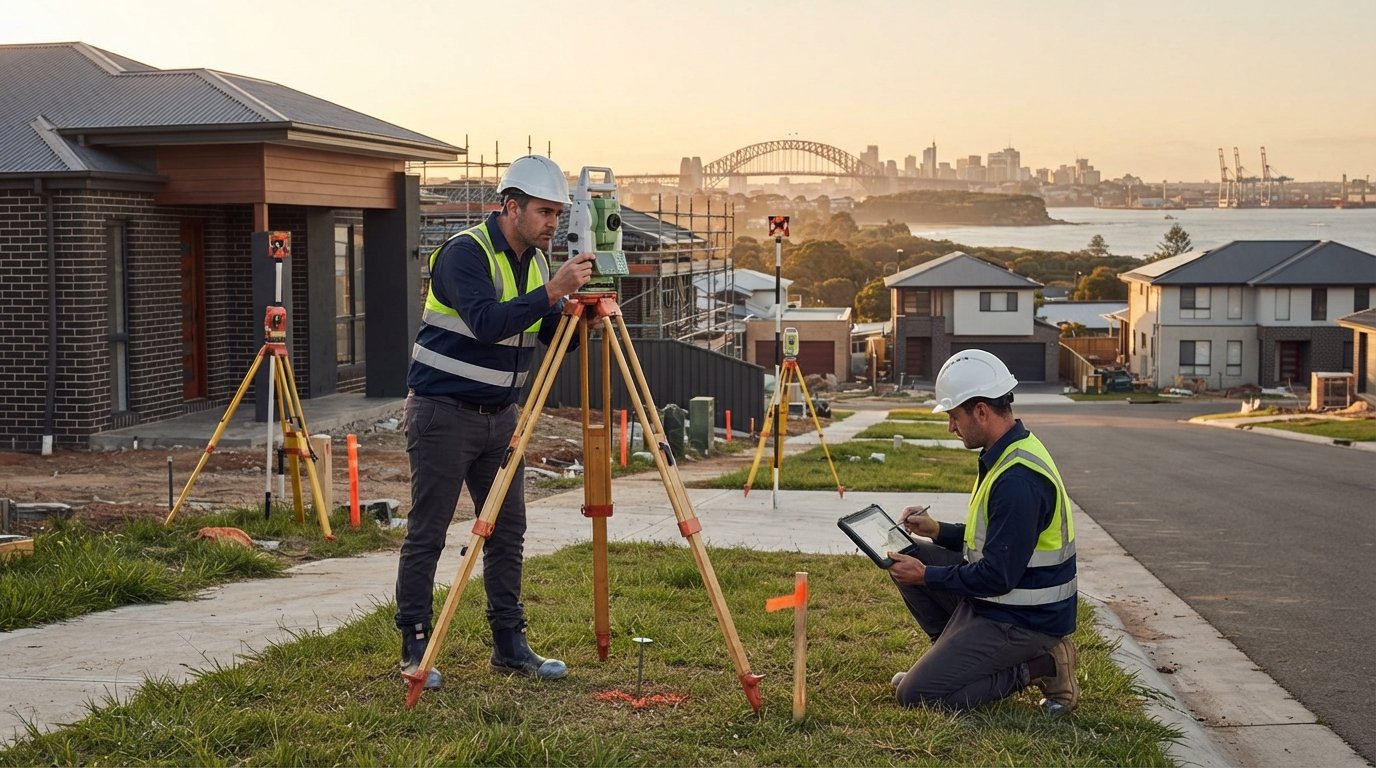
Once archival research establishes the cadastral framework, our field team performs millimetre-accurate on-site measurements. Using precision robotic total stations and survey-grade GNSS equipment, we locate permanent survey marks, existing structures, eaves, and boundary fences. Back in the office, we compute the exact spatial relationship between your physical improvements and the legal title lines. This rigorous calculation culminates in a formal surveyor certificate of compliance nsw, complete with detailed technical sketches, reduced levels (RLs), and certified compliance statements for your certifier.
Identifying Boundary Encroachments
Physical inspections frequently reveal that dividing fences do not align with the true boundary line. Encroachments happen easily: a retaining wall wandering 60 millimetres over a side line, or guttering overhanging neighbouring airspace. Surveyors distinguish between minor intrusions (such as low boundary fencing or minimal eaves) and substantial structural incursions that involve load-bearing walls or permanent slabs. Commissioning registered Identification Surveys before committing to a purchase or pouring concrete remains the most reliable way to expose these hidden liabilities before they trigger legal disputes under the Encroachment of Buildings Act 1922.
Verification of Building Covenants and Easements
A compliant property must respect more than just perimeter setbacks. Your title deed may contain Section 88B instruments creating restrictions on the use of land, such as drainage easements, rights of carriageway, or building envelope covenants. Modern robotic total stations allow our team to achieve tolerances of 10 millimetres or better, ensuring your newly constructed pool, extension, or garage never infringes upon a registered asset. If you are preparing for a council inspection or require expert guidance on your site boundaries, feel free to reach out to our consulting team for tailored advice.
Identification Survey vs. Certificate of Compliance
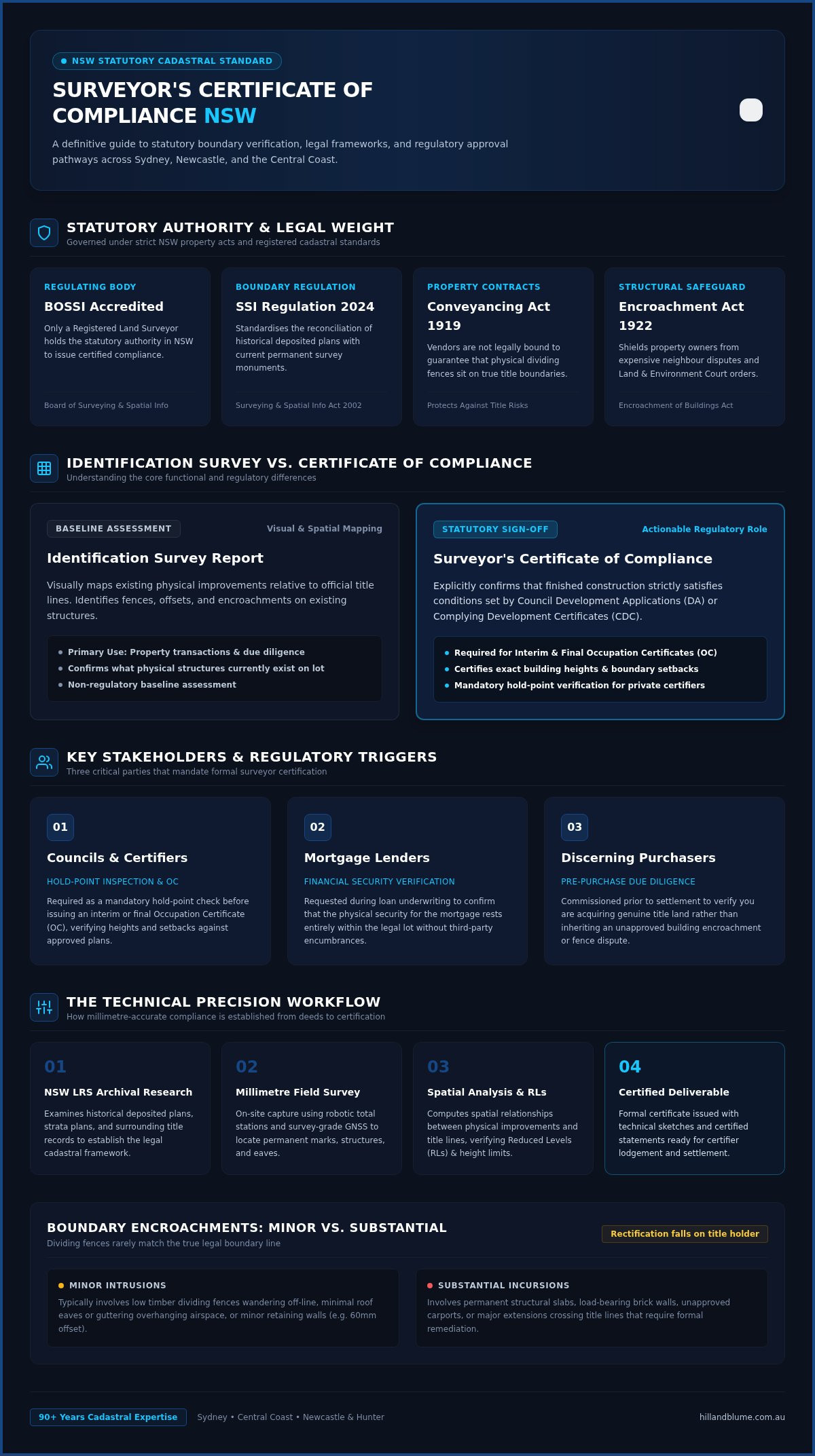
Property owners often wonder whether an Identification Survey and a Certificate of Compliance are identical. While closely linked, they fulfil distinct functions. An Identification Survey defines the legal allotment boundaries and sketches all improvements, fences, and visible easements in relation to those lines. It provides a complete diagnostic portrait of where physical improvements sit. In contrast, an actionable surveyor certificate of compliance nsw takes that measurement data and explicitly certifies to your certifier or council that those improvements satisfy the height limits, setbacks, and conditions of your approved DA or CDC.
Consider two common situations. When selling a home in Sydney or Newcastle, your solicitor typically requests an Identification Survey during conveyancing to assure prospective buyers that the residence sits cleanly within the title lines. Conversely, when completing a major build, your private certifier mandates a compliance certificate under Part 6 of the EP&A Act before issuing an Occupation Certificate. A standard boundary peg-out survey alone will rarely satisfy a lender or certifier, because it marks the ground without delivering the formal certification report verifying structural clearance.
Choosing the Right Survey for Your Needs
Selecting the correct report prevents costly settlement delays. Commissioning an identification report is appropriate for pre-purchase due diligence or resolving dividing fence queries. If your private certifier requires sign-off at critical hold points, such as slab pour or eaves framing, you need a statutory compliance certificate. To better understand these professional qualifications, read our detailed guide on what is a registered surveyor in NSW.
The Role of the Registered Surveyor
In New South Wales, this distinction carries substantial legal weight. Building consultants, architects, and unregistered draftspersons cannot legally determine cadastral boundaries or issue compliance certificates under the Surveying and Spatial Information Regulation 2024. Only land surveyors registered with the Board of Surveying and Spatial Information (BOSSI) possess statutory standing, having completed a 4-year degree, at least 104 weeks of practical training, and five Board examinations. Backed by extensive statutory liability and rigorous training, their formal sign-off serves as an enduring seal of quality that safeguards the legal and financial integrity of your property.
How to Secure Your Certificate in Sydney and NSW
Securing a surveyor certificate of compliance nsw is a structured, collaborative process designed to give certifiers, lenders, and property owners absolute clarity. Navigating this pathway involves five practical steps:
- Gather title records: Assemble your deposited plan (DP), architectural site plans, and council development consent or CDC documents.
- Consult your Registered Surveyor: Discuss the specific stage of your project and clarify whether your certifier requires setback, boundary, or height verification.
- Coordinate the site visit: Our field surveyors inspect the property, observing physical improvements alongside established cadastral marks.
- Review the draft analysis: We reconcile field measurements against legal boundaries, confirming that all offsets and finished levels sit safely within council consent.
- Receive final certification: You receive an official, signed certificate and technical sketch, ready for immediate submission to your private certifier or conveyancer.
Preparing for the Surveyor’s Visit
Smooth site access makes a tangible difference to measurement accuracy and turnaround speed. Ensure boundary fence lines are accessible, side gates remain unlocked, and any family pets stay securely indoors. If your project began with a registered Construction Set-out, field checks proceed effortlessly because foundations were already aligned to true boundary marks. Communicating your certifier’s exact hold-point checklist upfront guarantees our team captures every required reduced level and clearance during a single visit.
Timing and Local Factors in Sydney
Local geography shapes every survey across Greater Sydney, Newcastle, and the Central Coast. Steeply sloping terrain in the Northern Beaches, dense coastal pockets, or tight terrace alignments in Sydney’s Inner East often demand specialized field adjustments to locate original survey reference marks. Following fieldwork, standard compliance documentation typically takes between three to seven business days to finalize. Early scheduling ensures your surveyor certificate of compliance nsw is ready well before your planned settlement or final Occupation Certificate inspection. Ready to protect your build or property purchase? Contact Hill & Blume today to arrange your site survey with our experienced cadastral team.
Hill & Blume: 90 Years of Compliance Excellence
Founded in 1932, Hill & Blume brings over nine decades of cadastral surveying experience to New South Wales property. That heritage matters immensely when interpreting early colonial grants, Victorian-era terrace alignments, and complex strata redevelopments. Historical title anomalies can easily confuse less seasoned practitioners, but our deep archival understanding transforms historical ambiguity into clear legal certainty. We combine that generational knowledge with sophisticated spatial technology, ensuring every surveyor certificate of compliance nsw we prepare provides absolute protection for your asset.
When unexpected boundary variances or complex easements arise, you need more than raw measurements; you need a thoughtful, collaborative partner. Our registered surveyors act as a calm, trusted bridge between homeowners, developers, certifiers, and municipal councils. We take genuine pride in crafting a polished, stress-free experience, replacing technical friction with transparent communication so your property project advances without hesitation.
The Boutique Surveying Experience
Rather than chasing high-volume turnover, we deliberately maintain a boutique consulting model centred on care, precision, and enduring relationships. Every client across Sydney, Newcastle, and the Central Coast receives our undivided professional focus. Our clear compliance reports and meticulous plans serve as a definitive seal of quality for certifiers and lenders, ensuring your documentation satisfies every statutory standard on the first review.
Your Next Steps Toward Compliance
Securing the final regulatory approvals for your home or preparing an estate for market should be a celebration of your investment, not a bureaucratic hurdle. By collaborating with our registered team early in your journey, you secure the peace of mind that every boundary line, height limit, and council condition is rigorously verified. We invite you to contact Hill & Blume for expert compliance advice and discover how our boutique service can protect your property today.
Securing Lasting Boundary Certainty for Your Property
Navigating council requirements and final sign-offs doesn’t need to be an overwhelming hurdle. True peace of mind comes from knowing your investment rests on verified ground, with every setback, height plane, and easement rigorously confirmed. When you secure an authentic surveyor certificate of compliance nsw, you aren’t just checking a box for certifiers; you are establishing an enduring foundation of legal security for your family or project.
Backed by over 90 years of Sydney surveying expertise, our team of Registered NSW Surveyors treats every cadastral plan with refined precision. As specialists in complex boundary identification across Sydney, Newcastle, and the Central Coast, we believe in personal partnership, clear guidance, and meticulous care. Secure your property’s integrity with a Hill & Blume compliance survey, and step into your settlement or final inspection with complete confidence.
Frequently Asked Questions
Is a Surveyor’s Certificate of Compliance mandatory for selling a house in NSW?
It is not strictly mandatory by NSW statute to include one in a Contract for Sale, but conveyancers and lenders strongly advise it. Without a recent survey, purchasers risk inheriting unapproved encroachments or boundary misalignments. Obtaining an identification report or compliance certificate gives buyers absolute confidence and prevents eleventh-hour settlement delays if a mortgage lender questions existing improvements.
How long does it take to get a Surveyor’s Certificate of Compliance in Sydney?
Turnaround usually takes between three and seven business days once on-site measurements are complete. The initial archival research at NSW Land Registry Services requires one to two days, followed by the field inspection. Heavily vegetated sites or steep parcels in Sydney’s Northern Beaches or the Central Coast may require additional field time to uncover buried historical survey marks.
What happens if the survey reveals my fence is on the neighbour’s property?
The certificate simply documents objective physical reality, distinguishing legal title lines from physical occupation. Minor fence variations are common across older Sydney suburbs and rarely require immediate court action. You can resolve the issue through informal neighbour agreements, replacement under the Dividing Fences Act 1991, or formal boundary adjustments with council approval if permanent structures are impacted.
Can I use a survey report from five years ago for a current sale?
You can provide an older report, but lenders and prospective buyers frequently reject surveys that aren’t recent. Any renovations, retaining walls, or fence replacements completed over the preceding five years make an older survey legally obsolete. Securing a fresh surveyor certificate of compliance nsw ensures that all current improvements comply with title boundaries and local planning approvals.
Does a Certificate of Compliance cover internal building regulations?
No, a surveyor’s compliance certificate focuses exclusively on external spatial positioning, boundary setbacks, building heights, and registered easements. Internal building compliance, structural engineering, plumbing, and fire safety fall strictly under the National Construction Code. Those internal elements are inspected and signed off by licensed certifiers, structural engineers, or trade specialists rather than a registered land surveyor.
How much does a Surveyor’s Certificate of Compliance cost in NSW?
The fee depends on several site-specific factors rather than a single flat rate. Survey costs vary based on the size of your parcel, the steepness of the terrain, property location across Sydney, Newcastle, or the Central Coast, and the accessibility of original survey marks. Engaging a registered surveyor for an initial site assessment ensures an accurate, transparent quote tailored to your property.
What is the difference between a Surveyor’s Certificate and an Occupation Certificate?
A Surveyor’s Certificate verifies spatial accuracy against boundary lines and approved plans, whereas an Occupation Certificate (OC) formally authorizes you to occupy the building. Your private certifier or local council requires a valid surveyor certificate of compliance nsw as a mandatory hold-point document before granting the OC, confirming that finished construction strictly adheres to approved setbacks and height planes.
Can a surveyor help resolve an encroachment dispute identified in the report?
Yes, a registered surveyor provides the definitive factual foundation needed to resolve boundary disputes smoothly. While surveyors remain impartial professionals rather than legal counsel, our precise boundary plans and expert cadastral consulting assist solicitors, neighbours, and the courts under the Encroachment of Buildings Act 1922. We help negotiate equitable solutions, including formal boundary realignments or registered easement adjustments.
Disclaimer
The information provided in articles published on this website is for general informational purposes only. While we make every effort to ensure the accuracy, completeness, and timeliness of the content, the material is based on our understanding of the industry at the time of writing and may not reflect the most current developments, regulations, or standards. All opinions expressed in our articles are those of the respective authors and do not necessarily represent the official position of the website or its affiliates. The content should not be considered professional, legal or technical advice, and should not be relied upon as a substitute for consultation with qualified professionals