
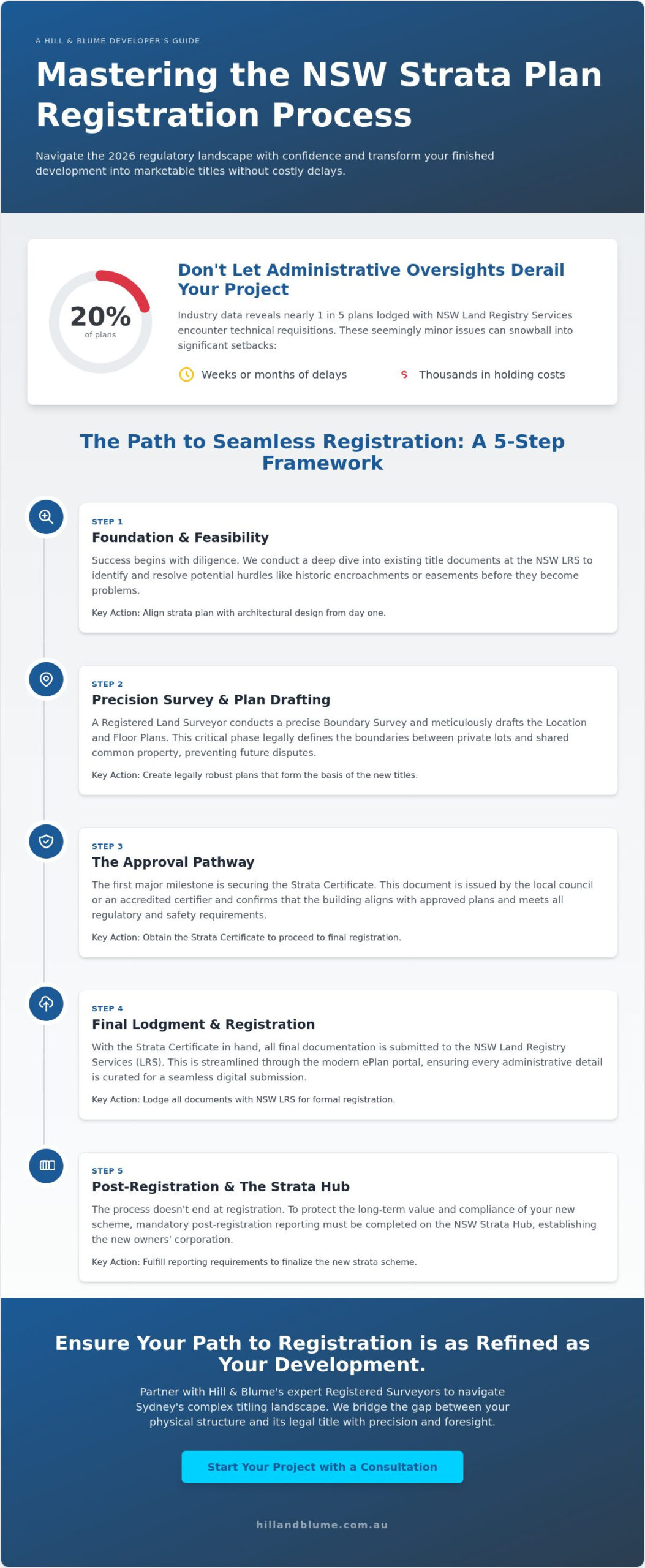
A single administrative oversight at the NSW Land Registry Services can stall a multi-million dollar Sydney development for months, turning a vision of growth into a costly exercise in patience. You likely understand that while the physical build is a feat of craftsmanship, the final hurdle of securing individual titles is often the most opaque. It’s frustrating to face council delays or the looming fear of plan rejection when your capital is tied up in a finished structure. Industry data indicates that nearly 20% of plans lodged with the LRS encounter technical requisitions, which can add weeks to your timeline and thousands to your holding costs.
At Hill & Blume, we believe the path to registration should be as refined as the properties you create. We’ve curated this guide to help you master the strata plan registration process nsw, ensuring your transition to marketable titles is as seamless as the architecture itself. This framework breaks down the 2026 regulatory landscape into a bespoke, step-by-step path to compliance under the Strata Schemes Development Act 2015. You’ll discover how to navigate council approvals and LRS requirements with the calm confidence of a seasoned partner.
Key Takeaways
- Define the precise boundaries between private lots and common property to ensure your property vision is articulated with absolute clarity and legal integrity.
- Master the strata plan registration process nsw by navigating the transition from council certification to final lodgment with expert-led confidence.
- Streamline your final submission through the ePlan portal, ensuring every administrative detail is curated for a seamless registration experience.
- Protect the long-term value of your new scheme by fulfilling mandatory post-registration reporting requirements on the NSW Strata Hub.
The Foundation: Understanding Strata Schemes and NSW Requirements
A strata plan represents more than just a technical drawing. It’s the legal architecture that transforms a single building into a community of individual owners. By definition, it’s the formal subdivision of land into lots, which you own exclusively, and common property, which you share with your neighbors. This structure relies on a foundation of Understanding Strata Schemes, a concept that pioneered in NSW back in 1961 to manage the complexities of urban living. Today, the Strata Schemes Development Act 2015 and the 2016 Regulations govern every modern development with rigorous precision.
The strata plan registration process nsw follows a deliberate two-step path to completion. First, your local council or an accredited certifier must issue a Strata Certificate. This document confirms the building matches the approved plans and meets all safety requirements. Second, the final documents are lodged with NSW Land Registry Services (LRS) for formal registration. In the Sydney market, you’ll typically encounter freehold schemes, where you own the lot indefinitely. However, leasehold schemes are common in specific precincts like Barangaroo or Sydney Olympic Park, where the land is leased from a government authority for a fixed term, often 99 years.
The Role of the Registered Land Surveyor
In New South Wales, the law is clear: only a Registered Land Surveyor can legally sign the administration sheet of a strata plan. This isn’t merely a formality. It’s a guarantee of precision that draws on a 90-year legacy of defining Sydney’s complex title boundaries. Your surveyor acts as the bridge between the physical structure and the legal title. They ensure every balcony, car space, and storage cage is exactly where the plan says it is. This level of detail protects your investment and prevents future boundary disputes between neighbors, projecting a sense of calm confidence for all stakeholders involved.
Preliminary Site Assessment and Feasibility
Success begins long before the first line is drawn on a plan. A bespoke approach to strata development requires a deep dive into existing title documents at the NSW LRS to identify potential hurdles. We look for historic encroachments or forgotten easements that could stall your progress. By consulting with architects early, we align the strata plan with the original building design, ensuring a seamless transition from construction to titling. This early diligence transforms a complex strata plan registration process nsw into a predictable, curated experience that respects both your time and your vision.
The Survey Phase: Drafting Your Strata Plan with Precision
The survey phase is where your architectural vision transforms into a precise legal framework. It begins with an exacting measurement of both the building’s interior spaces and its exterior boundaries. This step is foundational to the strata plan registration process nsw. A registered land surveyor must first conduct a Boundary Survey to confirm the parent parcel of land. This ensures that the building doesn’t encroach on neighboring properties and that the title is clean before any subdivision occurs.
During this stage, the surveyor distinguishes between “Lots” and “Common Property.” Lots represent your private sanctuary, such as the apartment interior or a private courtyard. Common Property includes the shared elements that define the community’s character, like landscaped gardens, hallways, and driveways. Defining these boundaries with absolute clarity prevents future ambiguity regarding maintenance responsibilities. It’s a meticulous process that requires a deep understanding of how people will live and interact within the space.
Creating the Location and Floor Plans
A Location Plan situates the building within the land boundaries, providing a bird’s-eye view of the site’s integrity. The Floor Plans then detail the vertical and horizontal boundaries of each individual lot. These plans must capture structural elements and clearly allocate exclusive use areas like balconies or designated car spaces. Accuracy here is paramount, as these documents form the basis for the Final Lodgment and Registration with NSW Land Registry Services. Every line drawn on these plans dictates the legal reality of the property for decades to come.
The Schedule of Unit Entitlements
The Schedule of Unit Entitlements is perhaps the most critical financial component of your strata plan. It determines your share of ownership and, consequently, your contribution to levies and your voting power. These figures aren’t arbitrary; they’re calculated by a qualified valuer based on the market value of each lot at the date of the strata plan’s registration. This ensures the strata plan registration process nsw remains transparent and equitable for all future owners.
A valuer provides a certificate of unit entitlement to ensure the distribution is fair. For instance, if a penthouse is valued at A$3,200,000 and a ground-floor unit at A$1,100,000, their respective entitlements will reflect this discrepancy. Getting this right from the outset fosters a sense of trust and prevents disputes within the Owners Corporation. If you’re looking for a bespoke approach to your property’s transition, professional guidance ensures every detail is curated for long-term harmony and value.
The Approval Pathway: Navigating Council and Strata Certificates
Your journey through the strata plan registration process nsw reaches a critical junction once the physical structure is complete. This is the moment your architectural vision transforms into a legal reality. You must secure a Strata Certificate, which acts as the final endorsement from either your local council or an accredited private certifier. This step ensures that the subdivision mirrors the original Development Application (DA) approvals with absolute fidelity. The transition from the construction phase to the subdivision phase is often where complexity resides. Whether you’re developing in the heart of Sydney, the coastal stretches of Newcastle, or the growing hubs of the Central Coast, local nuances will dictate your timeline. Sydney councils often require specific heritage or landscaping sign-offs that Newcastle might bypass. You can explore our full list of surveying services to see how we manage these intricate council filings for our clients with a bespoke approach.
Applying for the Strata Certificate
Securing this certificate requires a curated package of documentation. You’ll need the final drafted strata plan, administration sheets, and proof of payment for council fees. Most 2026 developments face specific conditions of consent, such as evidence of utility connections or the creation of complicated easements. These conditions must be satisfied before any certificate is issued. While private certifiers often provide a more agile, 14-day turnaround, some Sydney councils offer a sense of traditional integrity that satisfies conservative lending criteria, even if they take 30 days or more. It’s a choice between speed and the perceived security of a local government seal. We help you weigh these options to find the path that aligns with your project’s financial goals.
Managing Council Requisitions
Delays often stem from incomplete Work-as-Executed (WAE) reports or minor discrepancies in site boundaries. We’ve found that early-stage precision is the best defense against these setbacks during the strata plan registration process nsw. Our Contour and Detail Surveys provide the essential foundation that prevents these errors from surfacing years later. In the 2026 regulatory environment, the NSW Planning Portal has streamlined reviews, yet a single missing signature or an outdated survey can still pause your progress for weeks. Typical council review timelines are currently averaging 21 to 28 days, provided the initial submission is flawless. We treat every requisition as a priority, ensuring your project maintains its momentum and professional polish without the stress of unexpected hurdles.
Final Lodgment and Registration with NSW Land Registry Services
The culmination of your development journey arrives with the digital lodgment at NSW Land Registry Services (LRS). By 2026, the strata plan registration process nsw relies entirely on the ePlan portal, a sophisticated system designed for precision and speed. This phase isn’t merely a formality; it’s the moment your vision transforms into legally recognized property. Central to this package is the Administration Sheet (Form 3.01). This document carries the essential signatures and certificates that validate the entire plan. It acts as the definitive record of consent from all vested parties, ensuring your project meets every regulatory benchmark with integrity.
Precision during the earlier drafting stages remains your best defense against LRS requisitions. When a plan is “requisitioned,” it means the LRS has identified a technical discrepancy that pauses the registration. These delays can be costly and disruptive. By ensuring every boundary and easement is mapped with a bespoke level of detail, you minimize the risk of frustrating back-and-forth correspondence. Once the LRS is satisfied, they issue individual Certificates of Title (CTs) for every lot. These digital titles represent the final, seamless transition from a single plot of land to a collection of private residences.
The Lodgment Checklist for 2026
- The final Strata Plan, digitally signed by your registered surveyor and the local council or an accredited private certifier.
- Section 88B instruments, which are vital for establishing new easements, positive covenants, or restrictions on the land’s use.
- Confirmation of payment for LRS registration fees. You should consult the July 2025 fee update to ensure your A$ payments align with the current 2026 schedule.
The Registration Timeline
Efficiency defines the modern NSW LRS experience. For a standard residential strata plan, you can typically expect a processing window of 10 to 15 business days. This timeframe is a critical component of the overall strata plan registration process nsw. While Sydney developments often seek “Fast-Track” or urgent processing options, these are generally reserved for cases demonstrating genuine hardship or specific contractual deadlines. If your plan receives a requisition, the clock stops. Responding within 24 hours is essential to maintain your place in the queue and keep your settlement schedule on track. At Hill & Blume, we believe a bespoke approach to documentation is the only way to ensure these timelines remain predictable.
Post-Registration: Transitioning to the Strata Hub and Beyond
The moment the LRS finalizes the strata plan registration process nsw, your vision transforms into a legal entity. It’s a significant milestone, yet it triggers a series of essential compliance windows. You must register the new scheme on the NSW Strata Hub within 3 months of the registration date. This digital platform isn’t just a filing system; it’s the foundation of your scheme’s public identity and legal standing.
The 2026 Strata Hub Requirements
The NSW Government now mandates annual reporting to maintain the integrity of every scheme. You’ll need to provide specific data points, including building insurance valuations, fire safety statements, and the number of lots. By January 2026, the Capital Works Fund Planner tool has become a central feature of this ecosystem. It helps your committee forecast long-term maintenance costs with precision, ensuring the building’s value remains protected. Your strata manager requires immediate access to these digital plan records to manage the A$100,000 plus budgets often seen in modern Sydney developments.
The developer or original owner carries the initial reporting burden. You must facilitate the first Annual General Meeting (AGM) within two months of the initial period ending. This gathering is where the Owners Corporation truly takes form. It’s the time to elect a committee, appoint a strata manager, and finalize the first year’s levies. A successful first AGM sets a tone of transparency and professionalism for the years ahead.
Future-Proofing Your Development
A building is a living thing that evolves over time. As your scheme matures, residents may seek internal renovations or the Owners Corporation might decide to upgrade common property assets. Maintaining accurate, high-resolution survey records is essential for these future shifts. Hill & Blume provides the continuity you need, ensuring that the original vision of the development remains intact even years after the final brick is laid.
We believe in a bespoke approach to long-term property management. This means our partnership doesn’t end when the plan is registered. We offer ongoing survey support for exclusive use by-laws, boundary redefinitions, or plan amendments. Our commitment to quality ensures your property remains a premium asset in the Southern Highlands or Sydney markets. We pride ourselves on being a trusted local expert, moving beyond simple data to offer a curated experience for every client. Contact Hill & Blume to begin your strata journey today.
Bringing Your Strata Vision to Life
Navigating the strata plan registration process nsw requires a blend of technical precision and sophisticated local insight. Success hinges on a flawless survey phase and a proactive approach to the latest 2026 regulatory requirements. By ensuring your lodgment with the NSW Land Registry Services is handled with care, you protect your investment and create a seamless transition for future residents.
At Hill & Blume, we offer a partnership grounded in over 90 years of cadastral surveying experience. Our Registered Land Surveyors bring deep expertise to projects across Sydney, Newcastle, and the Central Coast, ensuring 100% legal compliance through a bespoke approach. We value the integrity of your vision and provide the calm confidence you need to move forward without delay. It’s our mission to turn complex regulations into a curated experience for every client.
Secure your development with a bespoke strata survey from Hill & Blume
Your path to a successful registration is clear, and we’re ready to help you take the next step with absolute certainty.
Frequently Asked Questions
How long does the strata plan registration process take in NSW?
The strata plan registration process nsw typically takes between 4 and 8 weeks once the final documents reach the NSW Land Registry Services. This timeline depends on the accuracy of your surveyor’s work and the current volume of applications. Our bespoke approach ensures every detail is polished before submission to prevent unnecessary delays. It’s about maintaining a seamless flow from the final construction phase to the moment you hold your new titles.
Can I register a strata plan before the building is finished?
You can’t register a strata plan until the building is substantially complete and a Strata Certificate is issued. Local councils or accredited certifiers only provide this certificate after verifying the structure aligns with the approved development consent. It’s a vital step that ensures the integrity of the new community you’re creating. This requirement prevents titles from being created for buildings that don’t meet the strict safety standards of the Southern Highlands region.
What is the difference between a strata plan and a subdivision plan?
A strata plan creates individual titles for units within a building and establishes common property, while a subdivision plan divides a single parcel of land into separate lots. Strata schemes focus on shared living spaces and structural boundaries. Subdivisions are generally for traditional land developments where no shared structural elements exist between the new titles. Each path requires a different legal framework to ensure the long term value of your property investment.
Do I need a lawyer or a surveyor to register my strata scheme?
You must engage a registered land surveyor to prepare the physical plans and a solicitor or conveyancer to manage the legal lodgement. The surveyor ensures the boundaries are precise to the millimetre. Your legal partner then ensures the strata plan registration process nsw adheres to the Strata Schemes Development Act 2015. This partnership protects your vision and ensures the transition to a registered scheme is handled with professional care and expertise. For the legal and accounting professionals managing these property transactions, AML Partners provides the necessary expertise to navigate anti-money laundering compliance requirements effectively.
How much are the NSW LRS registration fees in 2026?
As of the July 2024 fee schedule, the base lodgement fee for a strata plan at NSW LRS is A$436.40, with an additional A$436.40 for each lot created. These figures are subject to annual CPI adjustments every July. You should also budget for the A$165.40 fee for the management statement if your scheme includes shared facilities. Planning for these specific costs early ensures your project’s financial integrity remains intact as you move toward final registration.
What is a Section 88B instrument and do I need one?
A Section 88B instrument is a legal document that creates easements, rights of way, or restrictions on the use of land during the registration process. You’ll need one if your development requires shared access paths or specific building covenants. It’s a curated tool that defines how the land is used, ensuring long term harmony within the local community. This document is essential for protecting the unique character and privacy of your Southern Highlands property.
What happens if my strata plan is rejected by the council?
If your council rejects the plan, they’ll issue a formal notice of refusal detailing why the application didn’t meet the 19 criteria required for a Strata Certificate. You have a 12 month window to lodge an appeal with the NSW Land and Environment Court. Most issues are resolved earlier through a Section 8.2 Review, which allows for a formal reconsideration. We believe in navigating these challenges with calm confidence to reach a successful resolution.
How do I update my strata scheme information on the Strata Hub?
You update your scheme information by logging into the NSW Strata Hub portal using your verified digital identity. All schemes must report their details annually within 3 months of their Annual General Meeting to remain compliant. Failure to complete this digital declaration can result in fines of A$1,100 for the owners corporation. It’s a simple yet vital task that keeps your scheme’s records accurate and transparent for every member of your community.
Disclaimer
The information provided in articles published on this website is for general informational purposes only. While we make every effort to ensure the accuracy, completeness, and timeliness of the content, the material is based on our understanding of the industry at the time of writing and may not reflect the most current developments, regulations, or standards. All opinions expressed in our articles are those of the respective authors and do not necessarily represent the official position of the website or its affiliates. The content should not be considered professional, legal or technical advice, and should not be relied upon as a substitute for consultation with qualified professionals