
Could a single line on a plan be the difference between a harmonious neighborhood and a decade of legal tension? When you share boundaries, the lines between cooperation and conflict are often thinner than we’d like to admit. You likely feel that your property is more than just an asset; it’s a legacy that deserves protection from the ambiguity of informal agreements. Engaging a specialized surveyor for easement creation nsw ensures that these vital access rights or utility paths are etched into the landscape with absolute legal clarity. It’s about replacing the anxiety of “what if” with the quiet confidence of a title that’s beyond reproach.
In this guide, you’ll discover how a registered surveyor navigates the intricate legal landscape of New South Wales to safeguard your property’s value and your peace of mind. We’ll walk you through the meticulous steps involved in the current digital lodgement landscape, including the mandatory LandXML files and the 2024 Regulations that now govern every new plan. This overview provides a clear roadmap for creating professional documentation that passes LRS scrutiny the first time. You’ll gain the insight needed to secure a legally binding easement that preserves your rights and prevents future litigation before it even begins.
Key Takeaways
- Understand why a registered surveyor for easement creation nsw is legally essential to meet the rigorous 2024 LRS digital lodgement standards.
- Learn how a Section 88B Instrument acts as the definitive legal bridge between your property’s physical boundaries and your shared rights.
- Identify the specific requirements for various easement types, from vital Right of Carriageway access to essential service infrastructure for drainage and power.
- Discover how meticulous preliminary research and precise on-site measurements prevent costly boundary disputes and ensure a seamless registration process.
- Gain the clarity needed to protect your property’s long-term value by formalizing access rights with professional documentation that passes scrutiny the first time.
Understanding Easement Creation in NSW: Why Professional Surveying is Essential
Property ownership isn’t always an absolute, isolated experience; it’s often a shared narrative between neighbors and the community. At its core, what is an easement is a legal right that allows one party to use a specific portion of another person’s land for a very particular purpose. It’s a delicate balance of rights. While you retain the title to the soil, another entity, perhaps a neighbor or a utility provider, holds a registered interest in how that land is accessed. In New South Wales, this isn’t a matter for casual conversation or a signed napkin over a fence. The NSW Land Registry Services (LRS) requires a precision-engineered plan prepared by a registered surveyor for easement creation nsw to ensure every boundary is beyond dispute.
At Hill & Blume, we view our role as more than just measuring distances. We act as translators, taking the dense, often impenetrable language of property law and manifesting it as clear, indisputable physical markers. By formalizing these rights through a professional survey, you prevent the “handshake agreement” friction that frequently arises decades later when memories fade or properties change hands. Our work ensures that your property rights are protected under the law, providing a definitive record that survives for generations. For those who also manage property interests in Texas, you can discover Massingill Attorneys & Counselors at Law to ensure your entire estate is protected through professional probate and planning services.
The Basics of Easements: Dominant vs. Servient Tenements
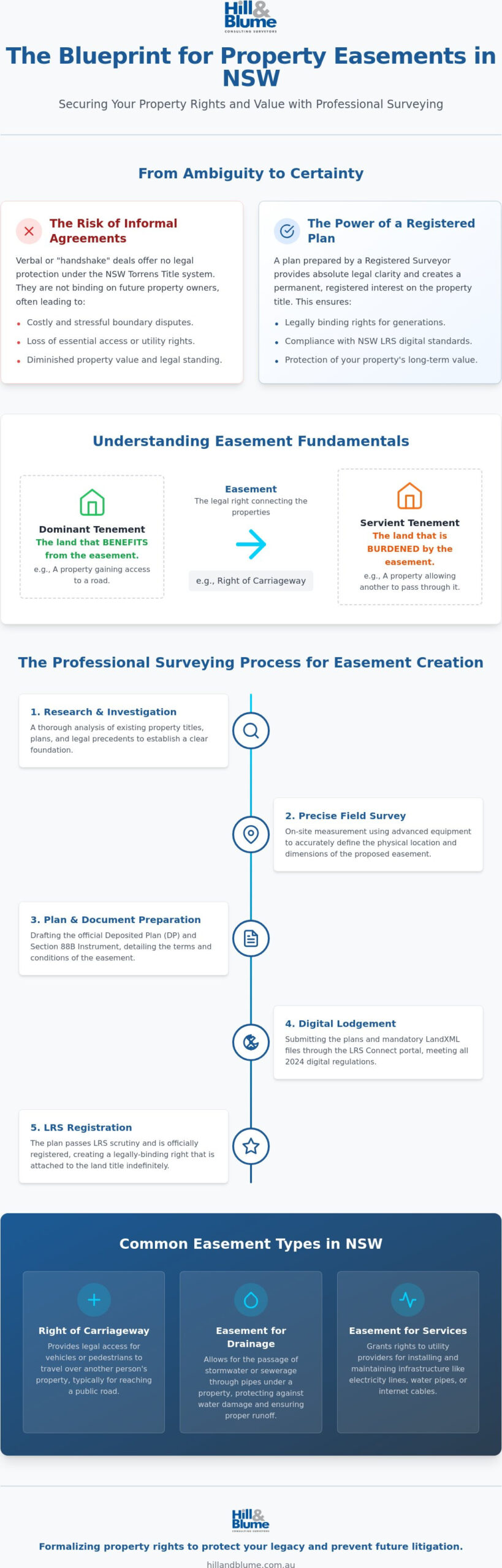
Every easement involves two distinct roles that define the relationship between land parcels. The “dominant tenement” is the land that enjoys the benefit, such as a right of way to reach a main road. Conversely, the “servient tenement” is the land burdened by the easement, providing the space or access required. Clarity here is the foundation of property harmony. In New South Wales, the legal relationship is defined by the dominant tenement holding a specific, registered right over the servient tenement that remains attached to the land title regardless of who owns either property.
Why DIY Easement Agreements Fail in NSW
The temptation to save time with an informal agreement is understandable, yet the risks are profound. New South Wales operates under the Torrens Title system, where “what you see on the register is what you get.” An unregistered interest, like a verbal agreement with a neighbor, offers almost no protection once the property is sold. Future buyers aren’t legally bound by informal arrangements made by previous residents, which often leads to expensive, emotionally draining court battles. Without a professional plan, your property’s legal standing is compromised. A professional, registered Plan of Easement, included in our comprehensive surveying services, provides the ultimate peace of mind. It ensures that your property’s legacy is secure and its value is protected against the unpredictability of future developments.
The Legal Framework: NSW LRS Requirements and Section 88B Instruments
Creating an easement in New South Wales is a sophisticated legal transformation that turns a physical concept into a registered property right. It isn’t enough to simply agree on a path or a pipe location; the law requires that these rights be meticulously documented to survive the scrutiny of the NSW Land Registry Services (LRS). Since the commencement of the Surveying and Spatial Information Regulation 2024 on 1 March 2025, the standards for these plans have become significantly more rigorous. A professional surveyor for easement creation nsw doesn’t just draw a line; they craft a legal cornerstone that ensures your property’s legacy remains intact under the heavy weight of the Conveyancing Act 1919.
As of 1 July 2026, the transition to a fully digital landscape is complete. Every new easement plan must now be accompanied by Stage 1 LandXML digital files and administration sheets produced through the LRS Connect portal. These digital requirements are designed to eliminate ambiguity, yet they demand a level of technical precision that only a specialist can provide. The NSW Government’s methods for easement creation emphasize that a Deposited Plan (DP) is the primary vehicle for these rights. When a Registered Surveyor signs that plan, they are placing their professional reputation and personal liability on the line, certifying that the boundaries are accurate and the legal interests are correctly positioned.
Registered Surveyors: The Only Licensed Authority in NSW
It’s vital to recognize that not everyone holding a measuring tape is authorized to create property rights. While a technician can capture data, only a Registered Land Surveyor has the legal authority to sign off on a plan for LRS lodgement. You can explore the depth of this role in our guide on What is a Registered Surveyor in NSW? These professionals carry an ethical burden to protect the integrity of the state’s land title system. Their signature is a seal of quality that reassures you, your neighbors, and future buyers that the easement is valid and enforceable.
The Role of the Section 88B Instrument
If the survey plan is the “where,” the Section 88B Instrument is the “how.” This essential document defines the specific terms of the easement, detailing who is responsible for maintenance and how costs are shared. While standard wording exists, boutique service often involves bespoke terms that reflect the unique lifestyle or operational needs of your specific area. The Section 88B instrument is legally tethered to the physical survey plan, ensuring the written rights and the mapped boundaries function as a single, unbreakable legal entity. If you’re ready to formalize your property’s shared rights with this level of detail, you might consider how a tailored consultation can bring clarity to your project.
Common Types of Easements in Sydney and the Central Coast
The landscape of New South Wales is as diverse as the properties that grace it, from the tightly packed terraces of Paddington to the sprawling acreage of the Central Coast. This geographic variety necessitates a nuanced approach to land rights. Choosing an experienced surveyor for easement creation nsw allows you to navigate these specific categories with precision, ensuring that the legal footprints left on your title are as light as possible. Every easement we define must align with the General requirements for creating easements set out by the LRS, ensuring they’re both valid and enforceable for the long term.
Right of Carriageway and Access Easements
In established Sydney suburbs, shared driveways and “battle-axe” blocks are common. A Right of Carriageway provides legal vehicle access across a neighbor’s land to reach a landlocked parcel. Our role involves determining the exact width required for modern vehicles while balancing the servient owner’s right to privacy. We ensure the access path is measured with absolute accuracy to prevent future disputes over parking or maintenance boundaries.
Drainage and Utility Easements
The “Easement to Drain Water” is perhaps the most frequent, and often the most contentious, type of interest. These easements manage how storm water or sewerage flows across property lines. Because water follows gravity rather than legal boundaries, technical precision is vital. We map underground pipes and natural flow paths to ensure infrastructure is protected. This clarity prevents accidental damage during future landscaping or construction projects.
Beyond access and water, easements for support are becoming increasingly critical in high-density Sydney developments. These protect the structural integrity of shared walls or land that provides physical support to a neighboring building. Each of these interests requires a deep understanding of the site’s unique topography. Hill & Blume identifies the most harmonious and least intrusive path for these new interests during our Detail and Level Survey process. By mapping every existing feature before an easement is drawn, we ensure the new legal right sits comfortably within the physical reality of your land, preserving both its utility and its aesthetic charm.
The Step-by-Step Surveying Process for Easement Creation
The journey from a conceptual need for access to a legally registered right on a title is a meticulous five-stage process. It requires a specialized surveyor for easement creation nsw who understands that every millimeter matters. A professional surveyor for easement creation nsw acts as the bridge between your physical land and the legal title, ensuring your property rights are articulated with absolute clarity. This isn’t a task to be rushed; it’s an act of technical craftsmanship that follows a proven path to registration.
- Step 1: Preliminary Research. We begin by diving into historical land records and existing Deposited Plans (DPs). This foundation ensures we aren’t building on shifting legal sands or overlooking existing interests.
- Step 2: On-Site Surveying. Our team visits the property to take precise measurements, ensuring the proposed area is physically viable and correctly positioned relative to boundaries.
- Step 3: Plan Drafting. This is where technical data becomes a formal Plan of Easement, ready to meet the rigorous 2024 standards of the LRS.
- Step 4: Negotiation and Consent. We coordinate the necessary signatures from affected neighbors and mortgagees, a step that requires both diplomacy and legal clarity.
- Step 5: LRS Lodgement. The final registration through the LRS Connect portal formalizes the easement on the title, securing your rights permanently.
Site Investigation and Technical Measurement
During the on-site phase, we use high-precision equipment to define the exact site of the easement. It’s a delicate task of identifying existing boundary markers and reconciling them with modern GPS data. We’re careful to ensure the easement doesn’t clash with existing structures or heritage trees, preserving the character of your land while providing the necessary utility. This technical depth is why choosing a surveyor in Sydney with local experience is so vital for complex projects.
Lodgement and the Path to Registration
The administrative phase is often where projects stall due to LRS requisitions. Since the 1 July 2026 mandate for LandXML digital files, the margin for error has vanished. Hill & Blume’s 90-year reputation in the region assists in a smoother administrative process, as our plans are known for their clarity and adherence to the latest 2024 regulations. We manage the complexity of these digital lodgements through the LRS Connect portal so you don’t have to. If you’re ready to begin this process with a team that values precision, reach out for a professional consultation to discuss your property’s needs.
Securing Your Property’s Future with Hill & Blume’s Expertise
Choosing a professional surveyor for easement creation nsw is an investment in your property’s enduring harmony. It’s a decision that echoes through decades of ownership; it’s the difference between a seamless title and a legacy of legal ambiguity. At Hill & Blume, we understand that your land is a curated asset. Our role is to ensure that every easement, whether for access or utilities, is defined with a level of craftsmanship that respects both the law and your lifestyle. We don’t just provide data; we deliver the Hill & Blume seal of quality, a standard of precision that protects your property value for generations to come.
Our 90-year heritage in Sydney gives us a perspective that high-volume firms simply can’t replicate. We’ve spent nearly a century interpreting local land records and LRS patterns, allowing us to bridge the gap between historical titles and the modern digital requirements of 2026. We partner closely with your legal team to ensure the Section 88B instrument’s terms are perfectly synchronized with our physical measurements. This collaborative approach ensures that the “where” of the survey and the “how” of the legal document function as a single, unbreakable shield for your rights.
The Boutique Advantage in Complex Boundary Work
In a field that can often feel clinical and detached, we prioritize the depth of our relationships. High-volume firms often miss the subtle nuances that lead to frustrating LRS requisitions, especially under the strict Surveying and Spatial Information Regulation 2024. Our boutique approach allows for a calm confidence during high-stakes negotiations with neighbors or authorities. We treat your property as a unique project requiring tailored solutions, ensuring that every detail is scrutinized before it ever reaches the LRS Connect portal. It’s about providing a polished, effortless experience that respects your time and your intelligence.
A Legacy of Precision Across NSW
Our commitment to excellence extends across Sydney, Newcastle, and the Central Coast. We maintain extensive historical archives that give us a distinct edge when reconciling difficult boundaries or identifying long-forgotten interests. This deep local knowledge is invaluable as the industry moves toward the mandatory LandXML digital plan files required from 1 July 2026. By anchoring modern technology in traditional integrity, we provide a service that is both forward-thinking and deeply rooted in local culture. If you’re ready to formalize your property’s future with a team that values quality over quantity, enquire about your easement project with Hill & Blume today and experience the difference of a hand-crafted approach to surveying.
The Path to Permanent Property Harmony
Creating a legally binding easement is more than a technical requirement; it’s a commitment to the long-term integrity of your land. Precision is non-negotiable. You’ve seen how aligning physical boundaries with a meticulously drafted Section 88B instrument ensures your rights are protected from future disputes. Engaging a specialist surveyor for easement creation nsw transforms a complex regulatory hurdle into a seamless asset management strategy. It’s about replacing uncertainty with the quiet confidence of a title that’s beyond reproach.
Since 1932, Hill & Blume has been a trusted authority in the local landscape, offering the calm confidence that only nearly a century of experience can provide. Our Registered Land Surveyors are specialists in NSW LRS compliance, ensuring your documentation is right the first time. We invite you to Partner with Hill & Blume for your Easement Survey and experience a boutique service that treats your property with the craftsmanship it deserves. Your property’s legacy is in expert hands, and we look forward to helping you secure it.
Frequently Asked Questions
How much does it cost to create an easement in NSW?
The total investment for creating an easement involves several components, including LRS registration fees and professional consulting. As of July 2026, the NSW LRS fee for a standard transfer of property is $182.73, while PEXA electronic lodgement fees sit at $146.30. Beyond these fixed government costs, the complexity of your site and the extent of the required survey will influence the final figure. It’s best to view this as a long-term investment in your property’s legal security.
Can an easement be removed or extinguished once it is created?
Yes, an easement can be extinguished, though the process requires formal legal action or mutual agreement. You can remove an interest by registering a dealing with the NSW LRS, which typically involves both the dominant and servient parties signing a formal release. In cases where an easement is no longer used or is deemed obsolete, an application to the Supreme Court under Section 89 of the Conveyancing Act 1919 may be necessary to clear the title.
Does an easement reduce the value of my property?
An easement’s impact on property value is nuanced and depends largely on how it affects the buildable area. While a drainage easement might restrict where you can place a pool or extension, a Right of Carriageway can significantly increase the value of a landlocked parcel by providing legal access. A registered surveyor for easement creation nsw can help you position these rights strategically to minimize the footprint on your usable land, ensuring your property remains a desirable asset.
How long does the easement surveying and registration process take?
The timeline for creating and registering an easement typically spans several months, depending on the complexity of negotiations and authority approvals. While obtaining specific authority approvals might take between 2 to 8 weeks, the entire process from initial site measurement to final LRS registration often requires 6 to 24 months for complex modifications. We manage each step with deliberate care to ensure your plan moves through the digital lodgement portal without unnecessary delays or requisitions.
Who pays for the surveyor when creating a new easement?
Generally, the party who benefits from the easement, known as the dominant tenement, covers the professional costs associated with its creation. This includes the surveying fees, legal drafting of the Section 88B instrument, and the government lodgement fees. However, these arrangements are often subject to private negotiation between neighbors. It’s common for a benefited owner to offer compensation to the burdened owner in exchange for the permanent right to use a portion of their land.
Can I build a fence or a structure over an existing easement?
Building a structure over an existing easement is usually restricted, as the beneficiary must maintain clear access to the land for maintenance or passage. You may be able to build light, removable structures like fences, but permanent foundations often require specific “build over” approval from the relevant authority or council. This process can add several weeks to your project timeline and may require significant foundation modifications to ensure the underlying infrastructure remains protected and accessible.
What happens if my neighbour refuses to sign the easement plan?
If a neighbor refuses to consent to a necessary easement, the Conveyancing Act 1919 provides a legal pathway through Section 88K. This allows the Supreme Court to grant an easement if it is reasonably necessary for the effective use or development of your land. The court will consider whether the easement is in the public interest and if the neighbor can be adequately compensated. Professional surveying documentation is essential in these cases to prove the necessity and exact location of the proposed right.
Disclaimer
The information provided in articles published on this website is for general informational purposes only. While we make every effort to ensure the accuracy, completeness, and timeliness of the content, the material is based on our understanding of the industry at the time of writing and may not reflect the most current developments, regulations, or standards. All opinions expressed in our articles are those of the respective authors and do not necessarily represent the official position of the website or its affiliates. The content should not be considered professional, legal or technical advice, and should not be relied upon as a substitute for consultation with qualified professionals