
The most enduring property developments in New South Wales aren’t defined by their architecture alone; they’re built on the invisible, precise lines that balance individual autonomy with the elegance of shared luxury. You likely recognize that while Strata offers convenience and Torrens offers control, finding the sophisticated middle ground for a premium multi-lot project often feels like navigating a legal maze. It’s natural to feel a sense of trepidation regarding the long-term maintenance of shared infrastructure or the potential for boundary disputes in complex layouts. We understand that your goal is to create a legacy of quality, not a future of administrative friction.
This definitive guide clarifies the community title subdivision nsw process, providing the professional insight you need to secure your investment and ensure seamless LRS registration. We’ll explore the latest April 2026 regulatory shifts, the nuances of Association Property, and how meticulous surveying creates a foundation for lasting property value. You’ll gain a clear understanding of how to move from a conceptual vision to a legally compliant subdivision plan that reflects the high-end lifestyle your project promises. Let’s explore how precision meets vision in the modern landscape of New South Wales land development.
Key Takeaways
- Discover why this subdivision structure is the premier choice for developers seeking to balance private land ownership with the allure of shared, high-end amenities.
- Master the 2026 regulatory requirements for a community title subdivision nsw to ensure your project meets the latest LRS standards for seamless registration.
- Learn how to define Association Property and boundaries with surveyed precision, protecting your development from future infrastructure disputes and maintenance confusion.
- Gain a step-by-step understanding of the surveying workflow, starting from the initial detail and level assessment through to the final management statement.
- Identify the unique architectural and financial advantages that community schemes offer compared to traditional strata or Torrens title models for complex estates.
Understanding Community Title in the NSW Property Landscape
A community title subdivision nsw isn’t just a legal framework; it’s a blueprint for a shared lifestyle. While traditional models often force a choice between total independence and collective living, this structure offers a refined middle ground. It allows for the creation of distinct, privately owned lots that benefit from high-end shared infrastructure. These common assets, ranging from private access roads to meticulously landscaped parklands, are managed by a Community Association. This body acts as the administrative heart of the scheme, overseeing the insurance, maintenance, and rules of shared assets to ensure they remain in pristine condition. These assets often include sophisticated private drainage networks and specialized lighting that define the character of the estate.
This structure is increasingly popular for gated estates and luxury Sydney developments where exclusivity is paramount. Unlike a standard subdivision survey that focuses primarily on the delineation of individual parcels, a community scheme requires a holistic view of how residents interact with their environment. It’s about creating a harmonious ecosystem where shared recreational and utility assets add tangible value to every individual lot. By choosing this path, you’re not just dividing land; you’re crafting a community with a clear, professional vision for the future.
The Hybrid Nature of Community Title
This model draws from the best of both worlds. You own your land outright under the Torrens title system, giving you the freedom to design a bespoke home. However, you also share ownership of “Lot 1,” the designated Association Property. This creates an exclusive atmosphere where “community” signifies a private, curated experience rather than public access. You gain the security of a gated estate without sacrificing the pride of individual land ownership. It’s a sophisticated way to live, blending autonomy with the benefits of shared craftsmanship.
Why Developers Choose Community Schemes for Sydney Projects
In the diverse topography of Sydney, from Crows Nest to the Northern Beaches, land development presents unique challenges. A community title subdivision nsw provides the flexibility to manage private roads and complex drainage systems that council might otherwise refuse to adopt. This control allows developers to maintain a cohesive aesthetic through enforceable by-laws. It fosters a sense of shared pride among residents while maximizing ROI on boutique projects, transforming a simple plot into a premium destination. It ensures that the unique charm of a local area is preserved and enhanced through thoughtful, collaborative planning.
The Anatomy of a Community Scheme: Association Property and Boundaries
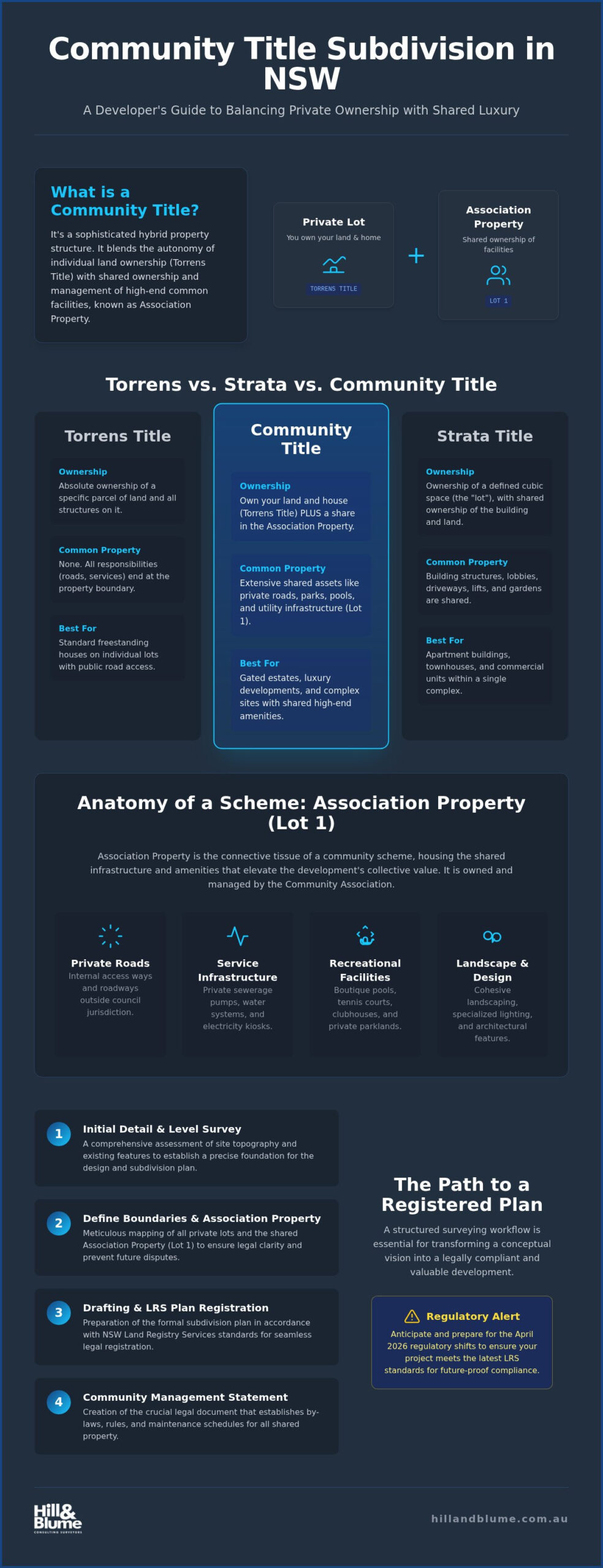
Every successful community title subdivision nsw relies on a clearly defined relationship between private ownership and collective assets. Unlike a standard Torrens title lot where your responsibility typically ends at your fence line, a community scheme introduces a shared layer of infrastructure. This is the “Association Property,” almost always designated as Lot 1 on your registered plan. It acts as the connective tissue of the development, housing the private roads, utilities, and recreational spaces that elevate the property’s collective value. Understanding how these spaces are mapped is the first step toward a harmonious development.
Defining Association Property (Lot 1)
Lot 1 isn’t just leftover land; it’s a purposefully mapped asset designed for the benefit of all members. As outlined in the NSW Government guide to community schemes, this property is owned and managed by the Community Association. This shared land often includes:
- Private access ways and internal roadways that remain outside council jurisdiction.
- Shared recreational facilities such as boutique pools, tennis courts, or nature reserves.
- Critical service infrastructure, including private sewerage pumps, water reticulation systems, and electricity kiosks.
The surveyor’s role is to mark the exact physical transition from a private sanctuary to these shared spaces. This clarity is vital. It ensures every resident knows exactly where their maintenance duties end and the Association’s responsibility begins, preserving the premium feel of the estate for decades.
Boundary Precision: Surveyed Dimensions vs. Structural Limits
One of the most significant advantages of this model is how boundaries are defined. In Strata, boundaries are often determined by the center of a wall or the surface of a floor. In a community title subdivision nsw, boundaries are defined by surveyed dimensions. This allows for far more architectural freedom. You can build bespoke footprints that don’t rely on shared structural walls, offering the kind of autonomy that luxury homeowners demand.
This flexibility makes boundary surveys even more critical during the planning phase. A registered surveyor doesn’t just look at where a building stands; they verify the cadastral pegs against the registered plan with absolute precision. This prevents encroachment disputes before the first brick is laid. Managing shared services like electricity and water requires an expert eye for detail, as service lines often cross multiple lots. Ensuring these are correctly identified and protected by easements is a hallmark of our boutique service. If you’re ready to map your project with 90 years of expertise, you can connect with our team for a consultation.
Torrens, Strata, or Community Title: A Practical Comparison
Selecting the right legal framework for your project is a strategic decision that shapes both the developer’s ROI and the resident’s lifestyle. While the Torrens title system remains the bedrock of Australian land ownership, modern developments often require more nuance. A community title subdivision nsw acts as a sophisticated hybrid, bridging the gap between the total independence of Torrens and the collective living of Strata. Understanding these distinctions is essential for any developer aiming to deliver a premium product in the Sydney market.
Ownership Rights and Maintenance Responsibilities
The primary difference lies in what you own and who looks after it. In a Torrens title arrangement, you have complete autonomy over your land and building, but you lack the ability to create shared private amenities. Strata title, conversely, is built around shared structural maintenance. The Owners Corporation is responsible for the “common property,” which typically includes the roof, external walls, and foundations. This can often limit a homeowner’s ability to make bespoke architectural changes.
A community scheme shifts this focus. While you’re entirely responsible for your own building’s maintenance, you share the upkeep of the land-based infrastructure. This includes:
- Private roads and street lighting that define the estate’s entry.
- Extensive landscaping and nature corridors that enhance the local charm.
- Shared utility networks that sit within the Association Property.
This management structure, led by a Community Association, ensures that the high-end feel of the neighbourhood is preserved without the intrusive structural oversight often found in Strata schemes. It’s a partnership-oriented approach that values long-term quality.
Flexibility in Design and Future Development
For master-planned communities, the flexibility of a community title subdivision nsw is unmatched. It allows you to stage developments effectively, registering individual lots while larger communal facilities are still under construction. This staging can significantly improve cash flow and project viability. Because boundaries are based on surveyed dimensions rather than building footprints, architects have the freedom to design detached, luxury homes that don’t share walls.
Determining which structure will yield the highest property value requires a deep understanding of local regulations and buyer expectations. Consulting with an expert surveyor in Sydney early in the process is vital. We help you weigh the cost implications of long-term maintenance against the immediate premium that shared high-end amenities can command. It’s a delicate balance that, when executed with precision, creates a legacy of quality and a superior return on investment.
The Surveying Workflow: From Concept to Registered Plan
Transforming a vision into a legally recognized community title subdivision nsw requires a disciplined, multi-stage workflow. It begins long before the first fence is erected. The process is a careful choreography of technical measurement, legal collaboration, and regulatory navigation. In the unique landscape of Sydney, where steep sandstone slopes or heritage-listed features often dictate the buildable area, this journey starts with a deep understanding of the land’s physical constraints.
The first tangible step is a comprehensive Detail and Level Survey. This assessment captures the nuances of your site, from existing vegetation to the subtle changes in elevation that influence drainage and road design. This data forms the foundation for your development application. Without this initial precision, even the most inspired architectural designs can face costly revisions during the council approval phase. It’s about grounding your aspirations in the reality of the Sydney terrain.
Drafting the Community Management Statement (CMS)
While the surveyor maps the physical boundaries, they also work alongside legal experts to draft the Community Management Statement. This document is the “constitution” of your development. It outlines the by-laws, architectural standards, and maintenance schedules that preserve the estate’s premium character. Our role is to ensure these rules align perfectly with the physical lot layout. We verify that every easement for shared services and every designated Association Property boundary is reflected accurately in the text. This prevents future administrative friction and ensures the scheme can expand or evolve without legal ambiguity.
Navigating LRS Lodgement in 2026
The final hurdle is the formal registration with NSW Land Registry Services (LRS). As of 2026, the lodgement process is entirely digital, demanding a high level of technical compliance. For a standard plan, the lodgment fee for examination is $384.78 for the first lot, with an additional $384.78 for each subsequent lot. Beyond these fees, developers in growth regions must also account for the Housing and Productivity Contribution, currently set at $12,974.62 per additional residential lot.
Hill & Blume’s 90-year history provides a distinct advantage here. Our deep-rooted understanding of cadastral law ensures a “right first time” approach, minimizing delays that can arise from plan requisitions. Once council has endorsed the subdivision certificate, we perform the final cadastral survey, placing the physical boundary markers that define each owner’s sanctuary. This final act of precision triggers the issue of new titles, turning your project into a tangible reality. If you’re ready to begin this journey with a steady, expert hand, you can reach out to our Sydney team today to discuss your project requirements.
Securing Your Vision with Hill & Blume’s Precision
Building a community title subdivision nsw isn’t merely a technical exercise. It’s a commitment to quality that requires a partner who understands the weight of your investment and the nuance of local regulations. At Hill & Blume, we’ve spent over 90 years refining our craft. Since 1932, our firm has served as a steady hand for developers navigating the most intricate projects across New South Wales. We don’t view surveying as a simple transaction. Instead, we see it as a strategic partnership designed to secure your vision from the first boundary mark to the final registration.
Our approach combines technical excellence with a calm, professional narrative that reassures our clients they’re in expert hands. We move beyond the transactional nature of the industry to offer a relationship-driven service model. Every project we undertake is an opportunity to contribute to the local fabric of our region, ensuring that your development stands as a testament to craftsmanship and care. We value quality over quantity, which allows us to provide the meticulous attention your property deserves.
Boutique Service for Complex Sydney Terrains
The geography of our region is as diverse as the communities we help create. Whether you’re developing on the rugged Hornsby Plateau or managing the delicate coastal slopes of the Northern Beaches, you need more than just data. You need the specialised expertise of a registered land surveyor who knows how to translate challenging terrain into a viable development plan. Our boutique approach means we prioritise depth of relationship over high-volume turnover. We take the time to understand the unique charm of your specific area, ensuring that our work acts as a seal of quality for your project. This focus on detail is what allows us to navigate high-density urban environments with effortless confidence.
Request a Tailored Fee Proposal
We understand that project budget certainty is paramount for any developer. That’s why we provide professional, fixed-fee consulting for your community title subdivision nsw. This transparency allows you to plan your project finances with precision, avoiding the anxiety of unexpected costs. Our narrative is one of trust and local approachability, ensuring you feel supported at every stage of the journey. Whether your project is in the heart of Sydney, the burgeoning suburbs of Newcastle, or the serene Central Coast, the first step is a considered conversation about your aspirations.
Your property deserves a foundation built on traditional integrity and modern expertise. When you choose us, you’re not just hiring a surveying firm; you’re engaging with a local authority that values quality over quantity. Let’s work together to create a seamless path to registration and maximise the value of your shared high-end amenities. To begin your journey, you can speak with a Registered Surveyor at Hill & Blume today.
Crafting Your Legacy in the New South Wales Landscape
Your vision for a modern estate deserves a foundation that matches your ambition. We’ve explored how a community title subdivision nsw offers the perfect balance of land autonomy and shared luxury, provided the initial cadastral mapping is flawless. By understanding the nuances of Association Property and the latest 2026 LRS digital standards, you can transform complex terrain into a cohesive, high-value neighbourhood. It’s about grounding your aspirations in technical precision and strategic planning.
Success in land development is rarely about volume; it’s about the depth of the relationship between your vision and the experts who ground it. With over 90 years of professional surveying experience, our team at Hill & Blume specialises in these complex schemes. We offer a boutique, relationship-driven service that ensures your project is treated with the care it deserves. Every boundary we mark is a promise of quality and a step toward a seamless registration. When you’re ready to move from conceptual plans to a registered reality, we invite you to Request a Professional Subdivision Consultation. We look forward to helping you build a lasting legacy in our local community.
Frequently Asked Questions
What is a community title subdivision in NSW?
A community title subdivision nsw is a sophisticated land structure where owners hold individual Torrens title lots while sharing ownership of communal facilities. This arrangement is governed by a Community Association, which manages shared assets like private roads or parklands. It bridges the gap between traditional land ownership and the collective benefits of strata living. This model is particularly popular for premium gated estates in areas like Sydney’s Northern Beaches or the Central Coast.
How does community title differ from strata title?
The main distinction lies in how boundaries and maintenance are defined. In Strata, the owners corporation usually maintains the building’s structure, such as the roof and external walls. Conversely, a community title scheme focuses on land-based infrastructure. Owners are responsible for their own building’s maintenance, while the association manages shared land assets. This offers more architectural freedom for detached luxury homes compared to traditional strata units in high-density Sydney developments.
Who owns the shared facilities in a community title scheme?
Shared facilities are owned by the Community Association, which is a legal entity made up of all individual lot owners. These assets are typically designated as “Lot 1” on the registered plan and are known as Association Property. Ownership is shared collectively, meaning no single resident has exclusive rights to these areas. This collaborative structure ensures that high-end amenities like private roads and pools are maintained to a premium standard for everyone’s benefit.
What is a Community Management Statement?
A Community Management Statement (CMS) serves as the governing constitution for the entire development. It outlines the specific by-laws, architectural standards, and maintenance schedules that all residents must follow. This document ensures the estate’s aesthetic and lifestyle are preserved over time. It’s drafted in collaboration with legal and surveying experts to ensure the rules align perfectly with the physical layout of the community title subdivision nsw, protecting the long-term value of your investment.
Do I need a registered surveyor for a community title subdivision?
Yes, engaging a registered land surveyor is a mandatory legal requirement for any subdivision in New South Wales. Only a registered professional can prepare and sign the formal plans required for lodgement with NSW Land Registry Services. At Hill & Blume, our surveyors provide the technical precision needed to define complex boundaries and shared infrastructure. This expertise ensures your plan meets strict 2026 regulatory standards, preventing costly delays during the registration and council approval phases.
Can a community title lot be further subdivided?
Yes, a community title lot can often be further subdivided into a subsidiary scheme, such as a neighbourhood or strata plan. This “layered” approach is common in large-scale, master-planned developments across Sydney and Newcastle. It allows developers to create smaller clusters of dwellings with their own specific rules within the broader community framework. However, any further subdivision must comply with the original Management Statement and receive approval from the relevant local council and the Association.
What are the typical costs associated with managing a community scheme?
Management costs primarily include administrative and capital works fund levies paid by each lot owner. These funds cover the insurance, maintenance, and repair of shared infrastructure like private roads and communal landscaping. As of 2026, prospective buyers may pay fees for inspecting association records, currently set at $60 for the first hour and $30 for each subsequent half hour. These levies ensure the premium quality of the estate’s shared amenities is preserved indefinitely.
How long does it take to register a community plan in NSW?
The timeline for registering a community plan typically spans several months, depending on project complexity and council processing times. The process involves multiple stages, from the initial survey and development application to the final LRS digital lodgement. In 2026, digital workflows have streamlined some aspects, but meticulous preparation remains vital to avoid requisitions. Our 90-year history allows us to navigate these timelines with calm confidence, ensuring your documentation is compliant and ready for registration.
Disclaimer
The information provided in articles published on this website is for general informational purposes only. While we make every effort to ensure the accuracy, completeness, and timeliness of the content, the material is based on our understanding of the industry at the time of writing and may not reflect the most current developments, regulations, or standards. All opinions expressed in our articles are those of the respective authors and do not necessarily represent the official position of the website or its affiliates. The content should not be considered professional, legal or technical advice, and should not be relied upon as a substitute for consultation with qualified professionals