
The true value of a survey plan isn’t found in the drafting hours, but in the legal certainty it provides for your property’s future. When you begin researching the cost of strata plan nsw, it’s easy to feel overwhelmed by layers of industry jargon and the lack of transparent pricing. You likely want to move your development forward without the nagging fear of hidden lodgement fees or a plan that fails to meet the strict 2026 digital mandate. We understand that this isn’t just a line item in your budget. It’s the foundation of your investment’s legal identity, requiring a level of precision that only a seasoned partner can provide.
This guide pulls back the curtain on the specific factors that influence your surveying costs, from unit entitlement calculations to the nuances of the new Conveyancing (General) Regulation 2026. You’ll learn how to distinguish between administrative management fees and the professional surveying expertise required for a successful lodgement. We’ll provide you with a clear framework to compare quotes with confidence, ensuring your project remains both elegant and compliant. By the end, you’ll have the clarity needed to budget for your development with professional precision and calm confidence.
Key Takeaways
- Understand why a strata plan is a vital legal instrument rather than a simple diagram, ensuring your property boundaries are defined with absolute precision.
- Gain clarity on the specific variables that dictate the cost of strata plan nsw, including lot counts and the structural complexity of your unique build.
- Navigate the 2026 NSW Land Registry Services lodgement process with confidence by understanding the mandatory digital forms and statutory fee structures.
- Learn how registered surveyors use cadastral research to safeguard your investment against future boundary disputes or title errors.
- Discover a professional framework for comparing quotes that prioritizes high-quality craftsmanship and a deep understanding of local Sydney property history.
Understanding the Strata Plan: More Than Just a Diagram
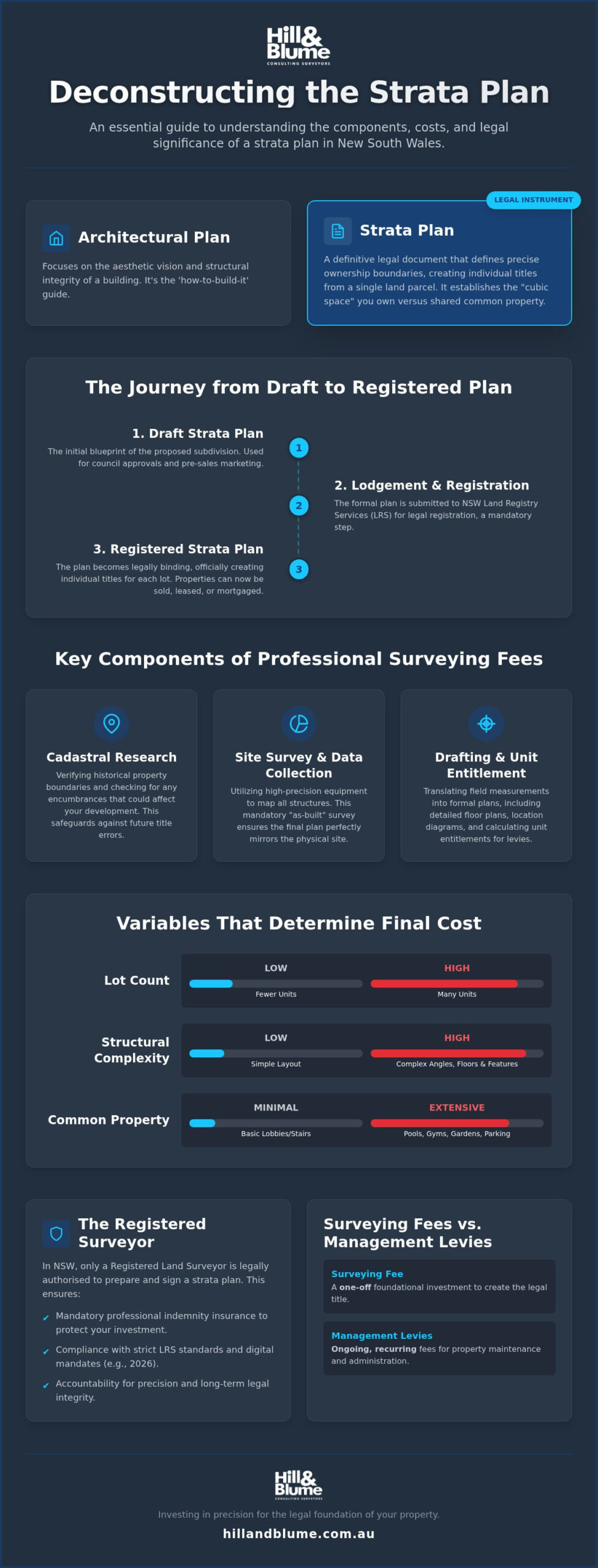
A strata plan is far more than a technical drawing. It’s the definitive legal instrument that carves a single parcel of land into individual titles. While an architectural plan focuses on the aesthetic vision and structural integrity of a building, a strata plan defines the precise legal boundaries of your ownership. It establishes the “cubic space” you own, clearly separated from the common property shared by the collective. Understanding What is a Strata Plan? is the first step in appreciating why the cost of strata plan nsw reflects a high level of legal liability and technical precision.
The journey from a Draft Strata Plan to a Registered Strata Plan is a critical path for any property developer. A draft plan serves as the blueprint for your proposed subdivision, often used for pre-sales or securing council approval. However, it only becomes a legally binding document once it’s registered with NSW Land Registry Services (LRS). This registration creates the individual titles that allow you to sell, lease, or mortgage your property. Without this formal registration, your development remains a single entity on paper, regardless of how many front doors you’ve installed.
Strata Plan vs. Strata Management Fees
It’s common to conflate the one-off surveying expenses with the ongoing levies paid to a management firm. The initial surveying fee covers the craftsmanship required to measure, draft, and lodge your plan with the LRS. This is a foundational investment. A precise survey prevents the costly boundary disputes that often plague poorly defined schemes years down the line. For those who value long-term property integrity, ensuring accuracy through professional Boundary Surveys in Sydney is an essential safeguard against future legal friction.
Who is Authorised to Prepare a Strata Plan in NSW?
In New South Wales, the law is clear: only a Registered Land Surveyor is authorised to sign and certify a strata plan. This requirement isn’t just a formality. It ensures that the professional handling your project carries mandatory professional indemnity insurance, protecting your investment from technical errors. At Hill & Blume, we leverage over 90 years of historical records and local expertise to navigate even the most complex Sydney titles. We prioritize a boutique, partnership-oriented approach, focusing on the depth of our relationship with you rather than high-volume turnover. When you evaluate the cost of strata plan nsw, you’re investing in a legacy of precision and a team that values quality over quantity.
Key Components of Professional Surveying Fees in NSW
While many property owners focus on quarterly levies, the technical labor involved in the cost of strata plan nsw represents the true foundation of your title. This investment encompasses a meticulous sequence of professional tasks that ensure your property is legally sound from the moment of registration. It begins with deep cadastral research. We delve into the parent property’s history to verify boundaries that may have been established decades ago, ensuring no historical encumbrances threaten your modern development.
You can view existing property records via the NSW Government’s strata search portal, but creating a new plan requires a fresh, expert gaze. Our team balances this archival research with modern technology to produce a document that satisfies both the NSW Land Registry Services and your own high standards for quality. Our comprehensive surveying services ensure every technical detail is managed with care and expertise.
The Site Survey and Data Collection
Precision is the hallmark of our field work. We utilize high-precision equipment to map every internal wall and external boundary with surgical accuracy. This stage is where we distinguish between your private lot space and the common property shared by the future owners corporation. An “as-built” survey is a mandatory legal requirement for strata registration, serving to verify that the final plan precisely mirrors the physical structures as they exist on the site.
Drafting and Unit Entitlement Calculations
Once data is captured, our drafting team translates these measurements into a formal plan. This includes detailed floor plans and location diagrams that meet the strict requirements of the Strata Schemes Development Act. A critical part of this process is the calculation of Unit Entitlements. These figures determine the relative value of each lot, which in turn dictates your voting power and the proportion of levies you’ll pay.
We work in close consultation with your developers and solicitors to ensure these values are equitable and legally defensible. This collaborative approach ensures that the final document isn’t just a technical requirement, but a strategic asset for your project. If you’re ready to discuss the specific requirements of your next development, our team is available to provide a tailored consultation that reflects your unique vision and the specific needs of your property.
Variables That Determine the Final Cost of Your Strata Plan
The final calculation for the cost of strata plan nsw is rarely a static figure. It’s a reflection of the unique architectural and legal DNA of your property. Every project presents a different set of challenges, from the sheer volume of lots to the intricate layering of shared spaces. When you engage with a boutique firm like ours, you aren’t just paying for a document. You’re investing in the careful navigation of these variables to ensure your project’s long-term viability and legal clarity.
Scale and Lot Quantity
The number of lots within your development is the most obvious driver of surveying costs. A two-lot duplex requires a high level of precision, but the drafting time and unit entitlement calculations are naturally more contained than those for a multi-unit complex. In larger developments, while the total investment is higher, you often benefit from an economy of scale where the per-lot cost decreases. This strategic approach to land use mirrors the principles found in A Guide to Subdivision Surveys in Sydney, where every square metre is optimized for its best use.
Physical and Legal Complexity
Beyond the lot count, the physical layout of the building introduces significant nuance. A simple, rectangular block is straightforward. However, contemporary Sydney architecture often features irregular shapes, multi-level high-rises, and sophisticated mixed-use splits. Mixed-use developments, which combine residential and commercial spaces, require a more nuanced approach to define shared utility lots and separate access points. This complexity directly impacts the time required for both field measurements and office-based drafting.
External features such as balconies, tandem car spaces, and storage cages add layers of detail to the final plan. Each of these must be precisely defined to avoid future disputes among owners. At Hill & Blume, we take pride in handling these intricacies, especially in heritage-listed buildings or high-end architectural projects where standard templates simply won’t suffice. We manage any encroachments or easements identified during our surveying services with a calm confidence. This ensures that even the most complex “limited” strata schemes are registered without friction, protecting the aesthetic and legal integrity of your development.
Navigating the Lodgement Process and Statutory Fees
The final phase of your development journey involves the formal lodgement with NSW Land Registry Services (LRS). While the technical drafting is a major milestone, the administrative registration introduces its own specific considerations for the cost of strata plan nsw. Since the July 1, 2026, fee schedule update, government charges are structured as a base lodgement fee paired with a sliding scale for each additional lot. Navigating this landscape requires more than just submitting paperwork; it demands an intimate understanding of the digital mandates that now define the NSW property industry.
The transition toward a fully digital environment reached a critical point on July 1, 2026, when the NSW Government mandated the use of Digital Forms for all survey plans. This move to ePlan ensures a more seamless integration into the state’s land title system, yet it leaves no room for technical ambiguity. Our team embraces these modern submission standards with calm confidence. We ensure your plan is formatted for immediate acceptance, avoiding the friction of administrative delays that can stall a project’s momentum.
Statutory Charges and Government Levies
Government levies are non-negotiable components of your project budget. Beyond the LRS lodgement fees, you must account for the Strata Certificate. This essential document is issued by either your local council or a private certifier, confirming that the building complies with all relevant planning approvals. It’s a vital seal of quality that allows the registration process to proceed.
One of the most frustrating hidden expenses for developers is the “requisition fee.” The LRS applies these charges whenever a plan contains technical errors or omissions that require correction. By choosing a registered surveyor with specialist expertise, you’re investing in “first-time” acceptance. We treat every submission as a curated experience, leveraging our 90 years of industry knowledge to avoid the pitfalls that lead to these extra costs. Our strata and community title services are designed to provide this exact level of legal security.
Timeline and Administrative Management
The registration process is a delicate orchestration between your surveyor, solicitor, and lender. Turnaround times for government registration can vary based on the complexity of the scheme and the current volume at the LRS. We maintain a steady, deliberate communication rhythm during this phase, providing you with the reassurance that every detail is being managed with professional precision.
We don’t just hand over a plan; we act as your partner, managing the flow of information to ensure all parties are aligned for a successful lodgement. This boutique approach prioritizes the depth of our relationship with you, ensuring that your path to title creation is as polished as the development itself. If you’re ready to secure your property’s legal future with precision, we invite you to reach out for a professional consultation regarding your lodgement needs.
Why Precision Matters: The Hill & Blume Approach to Strata
When you evaluate the cost of strata plan nsw, you’re choosing the level of legal security you want for your property’s future. At Hill & Blume, we believe that true value isn’t found in a race to the bottom on price, but in the enduring precision of a perfectly executed plan. We don’t operate as a high-volume agency. Instead, we function as a boutique firm where every client receives the benefit of our full technical attention and a partnership-oriented narrative. This approach ensures that your development isn’t just another number in a system, but a carefully crafted legal entity designed to stand the test of time.
Our firm is uniquely positioned to handle the complexities of the Sydney landscape. With over 90 years of industry experience and an extensive archive of historical records, we often possess insights into local property titles that others simply cannot access. This depth of knowledge acts as a seal of quality for your project. A Hill & Blume plan is recognized by solicitors and lenders alike for its accuracy, facilitating smoother property sales and providing you with the calm confidence that your titles are beyond reproach. If you’re still in the early stages of your project, our guide on Choosing a Surveyor in Sydney offers a professional framework for making an informed decision.
Boutique Service for Discerning Developers
We respect your time and your intelligence. You won’t find yourself navigating layers of administrative staff or waiting weeks for a response. When you engage with us, you have direct access to Registered Surveyors who understand the nuances of the 2026 regulatory environment. Our signature promise is that every plan we produce is a masterclass in detail, reflecting a commitment to craftsmanship that has defined our firm for nearly a century. We take pride in a polished, effortless service that mirrors the high-end lifestyle our clients aim to provide for their own future residents.
Requesting Your Customised Strata Quote
To provide you with an accurate fee proposal, we take a considered look at your project’s specific requirements. We don’t believe in opaque pricing or hidden surprises. By reviewing your architectural plans and discussing the intended lot layout, we can offer a transparent, fixed-fee structure that allows you to budget with professional precision. This clarity is essential for modern development budgeting, ensuring that the cost of strata plan nsw is a known and manageable factor in your project’s success. We invite you to experience a more refined level of surveying expertise. When you’re ready to move forward, you can request a tailored strata survey quote from Hill & Blume to begin our partnership.
Securing Your Development’s Legacy with Precision
Securing your property’s legal future is a milestone that deserves both technical excellence and a personal touch. You now have the framework to understand how the cost of strata plan nsw reflects the intricate balance between architectural complexity and 2026 digital compliance. By prioritizing precision during the initial survey and unit entitlement calculations, you protect your investment from the friction of future boundary disputes or title errors. It’s a foundational step that transforms a physical structure into a collection of valuable, legally distinct assets.
At Hill & Blume, we bring over 90 years of Sydney surveying expertise to every project we undertake. Our team of Registered Surveyors specializes in providing a boutique, relationship-focused service that respects the unique vision you have for your property. We don’t just lodge plans; we curate a seamless path toward title registration with calm confidence and local authority. When you’re ready to define your property’s boundaries with absolute clarity, we invite you to request a tailored strata survey quote from Hill & Blume. We look forward to partnering with you on your next successful development.
Frequently Asked Questions
How much does a strata plan cost in NSW for a duplex?
The cost of a strata plan for a duplex varies based on the site’s complexity and the specific “as-built” measurements required for registration. While a duplex is smaller in scale than a high-rise, the professional precision needed remains high to ensure legal compliance with NSW Land Registry Services. Factors such as the property’s location in Sydney or the Central Coast and the clarity of existing title records will influence the final fee proposal.
Do I need a new strata plan for a minor renovation?
A new strata plan is generally required if your renovation alters the structural boundaries of a lot or encroaches upon common property. Minor internal cosmetic changes usually don’t trigger a new registration, but adding a balcony or extending a room into shared space necessitates a formal amendment. Consulting a Registered Surveyor early ensures you don’t inadvertently breach the Strata Schemes Development Act, protecting your property’s legal integrity during the renovation process.
What is the difference between a strata plan and a subdivision plan?
A strata plan defines ownership of cubic space within a building, whereas a subdivision plan divides a single parcel of land into two or more distinct Torrens Title lots. While both create new titles, strata schemes include shared common property and an owners corporation. Understanding these differences is essential when calculating the cost of strata plan nsw compared to traditional land subdivision expenses for your specific development project.
How long does it take for a strata plan to be registered at NSW LRS?
Registration at the NSW Land Registry Services typically takes between two to six weeks once the plan is lodged. This timeline depends on current government volumes and the technical accuracy of the submission. Before lodgement, you must also account for the time required for field measurements, drafting, and obtaining the Strata Certificate from your local council. Our boutique approach ensures a deliberate rhythm that avoids the technical errors causing lengthy delays.
Can a building surveyor prepare a strata plan?
No, a building surveyor cannot prepare a strata plan in New South Wales. The law requires a Registered Land Surveyor to certify the accuracy of the boundaries and ensure compliance with LRS standards. While building surveyors focus on structural integrity and safety, only a land surveyor has the legal authority to define property titles. Engaging a firm like Hill & Blume ensures your plan is signed by a qualified expert with professional indemnity protection.
What are Unit Entitlements and how do they affect my costs?
Unit Entitlements represent the relative value of each lot within a strata scheme, determining your proportional share of levies and voting power. While these calculations are a critical part of the professional drafting process, they don’t typically increase the surveying fee itself. Instead, they impact your ongoing ownership costs. Accurate entitlements are vital for a harmonious owners corporation, ensuring that every member contributes fairly to the building’s administrative and capital works funds.
Are there hidden government fees when registering a strata scheme?
The most common “hidden” costs are LRS requisition fees, which are charged if a plan contains technical errors that require correction after lodgement. Other statutory expenses include the cost of the Strata Certificate from a certifier and the base lodgement fee plus per-lot government charges. We prioritize first-time acceptance to mitigate these risks. By leveraging our 90 years of experience in the Sydney region, we help you navigate these levies without surprises.
Disclaimer
The information provided in articles published on this website is for general informational purposes only. While we make every effort to ensure the accuracy, completeness, and timeliness of the content, the material is based on our understanding of the industry at the time of writing and may not reflect the most current developments, regulations, or standards. All opinions expressed in our articles are those of the respective authors and do not necessarily represent the official position of the website or its affiliates. The content should not be considered professional, legal or technical advice, and should not be relied upon as a substitute for consultation with qualified professionals