
The true value of a land subdivision isn’t just found in the soil, but in the absolute precision of the lines drawn upon it. You likely understand that dividing your property is a significant step toward unlocking its potential, yet the fear of a hidden subdivision survey cost nsw or the anxiety of Council DA delays can feel like a heavy weight. It’s frustrating when a simple quote doesn’t seem to cover the full reality of the professional investment required. We believe that clarity is the foundation of any successful partnership.
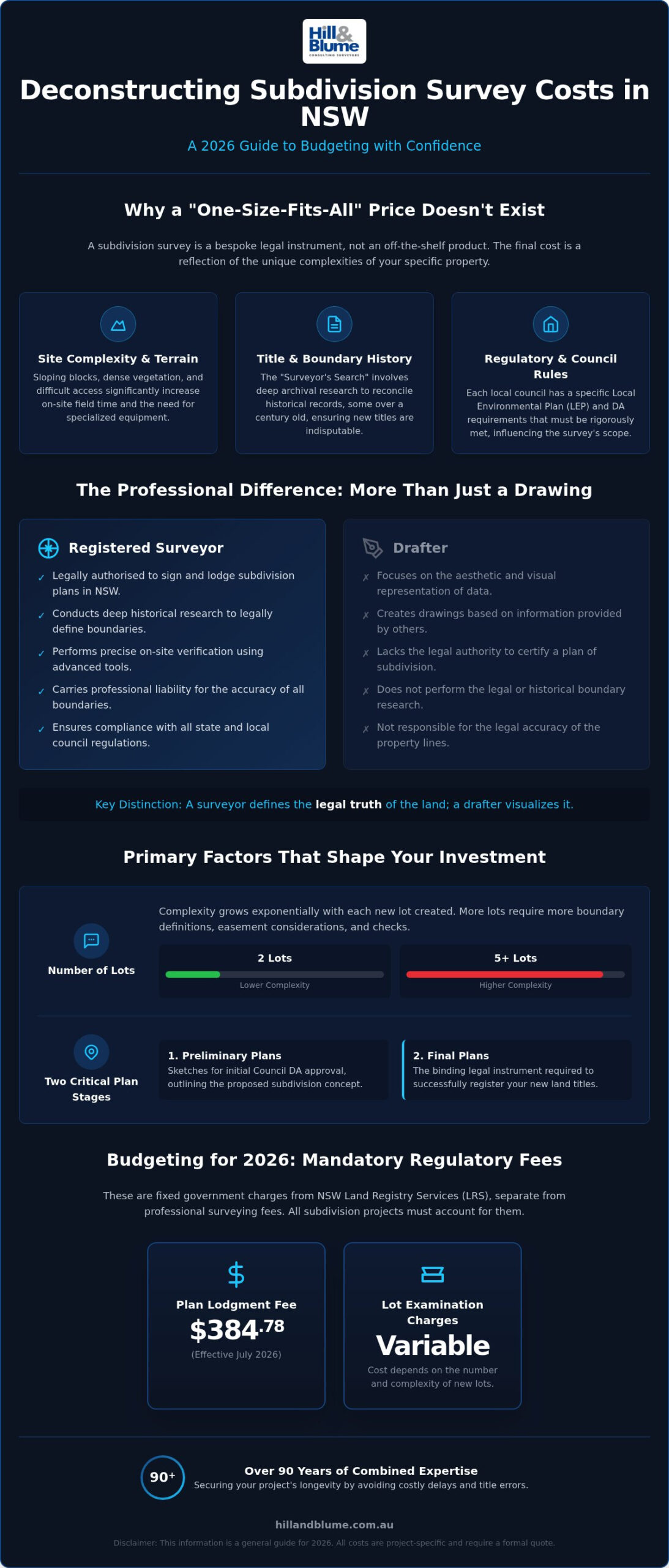
This guide details the regulatory and professional landscape for 2026, offering you the clarity needed to budget with total confidence. We’ve gathered the most recent NSW Land Registry Services fees, including the $384.78 lodgment fees effective from July 2026, to ensure your figures are grounded in current reality. You’ll learn the vital difference between preliminary sketches and final plans, and how a partnership with a registered professional ensures your property journey is as seamless as the lifestyle you’re looking to create. We’ll explore the transparent factors that influence your final bill and provide a clear roadmap for your project requirements.
Key Takeaways
- Learn how your property’s specific terrain and title history define your subdivision survey cost nsw, ensuring you budget for a precise legal instrument rather than a simple map.
- Gain clarity on the 2026 NSW Land Registry Services fee updates, including the specific lodgment and lot examination charges that apply to your project.
- Identify the critical differences between preliminary plans for Council approval and the final plans required to successfully register your new land titles.
- Ensure your project’s longevity by understanding why registered cadastral expertise is the only way to avoid costly delays during the subdivision certificate stage.
Understanding Subdivision Survey Costs in NSW: Why Estimates Vary
A subdivision survey is far more than a simple drawing of lines on a page; it is a binding legal instrument that defines your property’s value for generations. When you begin your development journey, you’ll find that a fixed subdivision survey cost nsw is rarely quoted at first glance. This isn’t due to a lack of transparency, but rather a reflection of the unique complexities inherent in the land itself. Each project requires a bespoke approach that honors the specific history and topography of your site.
The 2026 market reflects a shift toward higher regulatory scrutiny and digital integration. As councils move toward more detailed reporting, the value of professional stewardship has never been higher. “Off-the-shelf” pricing is a myth because no two parcels of land share the same history or physical constraints. Several variables prevent a one-size-fits-all approach:
- The age and quality of existing boundary records.
- The complexity of the physical terrain and vegetation.
- The specific requirements of your local Council’s Local Environmental Plan (LEP).
By choosing a boutique firm, you ensure that senior expertise is applied to every stage of your project. This high-touch service model prioritizes the depth of your relationship and the quality of your final outcome, protecting your property’s future marketability against title errors.
The Legal Weight of a Registered Surveyor
In New South Wales, the law is clear: only a Registered Surveyor has the authority to sign a plan of subdivision. This requirement exists to protect you. When you engage a firm like Hill & Blume, you’re accessing over 90 years of expertise in navigating complex cadastral law. Our registered surveyors carry the professional liability for every boundary defined, ensuring your Development Application (DA) meets the rigorous standards set by local councils and the state government. Precision isn’t just a goal; it’s a legal necessity that secures your land’s future.
Surveying vs. Drafting: Understanding the Professional Fee
It’s a common misconception that surveying is merely a matter of measurement. While modern tools like GNSS and Robotic Total Stations provide incredible accuracy, the true professional investment lies in the intellectual work behind the scenes. Your surveyor must delve into historical records and the cadastral divisions of Australia to re-establish boundaries that may have been recorded over a century ago. This deep research ensures that your new titles are indisputable. Unlike simple drafting, which focuses on aesthetics, surveying focuses on the legal truth of the land. This meticulous process is what ultimately determines the subdivision survey cost nsw, reflecting the hours of archival work and on-site verification required to protect your property’s marketability.
The Primary Factors Influencing Your Subdivision Survey Investment
While the legal framework provides a structure, the physical and archival realities of your property truly define the subdivision survey cost nsw. It’s rarely a matter of just walking the land. The number of proposed lots, for instance, adds layers of complexity. Creating two lots is relatively direct; creating five requires exponentially more boundary definitions, easement considerations, and rigorous checks to meet Subdivision Certificate requirements. Every additional line on the plan represents a new legal entity that must be perfectly reconciled with existing titles.
Terrain and Vegetation Challenges
The landscape of New South Wales is as beautiful as it is demanding. If you’re developing a block in the Northern Beaches or the dense, timbered pockets of the Blue Mountains, the field time increases significantly. Heavy bushland often requires surveyors to manually clear lines of sight for optical equipment. This process is far more time-intensive than working on a flat, cleared suburban lot in Western Sydney. Sloping blocks also demand more frequent measurements to accurately map contours and levels, ensuring your design fits the land’s natural rhythm without costly structural surprises later.
Beyond the physical site, your surveyor must invest time in the “Surveyor’s Search.” This involves pulling historical records from the NSW Land Registry Services (LRS). In older parts of Sydney or regional hubs like Maitland, these records can be archaic. Travel also plays a role. While we are deeply rooted in Sydney, projects in regional NSW involve logistics and travel time that are carefully factored into the professional investment to ensure the same boutique level of care regardless of the postcode.
The Complexity of Existing Boundary Evidence
The most significant variable is the state of existing boundary evidence. If your property’s original survey markers have vanished over the decades, a surveyor must “re-establish” the boundary. This involves analyzing neighboring properties and historical maps to find the “legal truth” of your land. This is particularly complex with “Old System” titles, which require a more intensive chain of title investigation than modern Torrens Title land. Encroachments, such as a neighbor’s shed slightly over the line, or disputed fence positions, require the delicate touch of an experienced professional to resolve before your subdivision can proceed. If you’re unsure how your property’s history might impact your plans, a conversation with our senior team can help clarify the path forward.
Navigating the Stages: Preliminary Plans vs. Final Plans of Subdivision
A successful subdivision is a journey of two distinct acts. You cannot reach the final registration of your new titles without first securing the blessing of your local council. This multi-stage process is essential for ensuring that every new lot is functional, legal, and compliant with modern planning standards. Because these stages occur months or even years apart, the total subdivision survey cost nsw is typically distributed across your project timeline. Understanding this rhythm allows you to manage your capital with the same precision we apply to your boundaries.
For a deeper look at how these stages integrate with the local landscape, you can explore our Guide to Subdivision Surveys in Sydney. This resource provides broader context on how we help clients unlock the hidden potential of their property through expert cadastral work.
Stage 1: Preliminary Plans for DA and CDC
The first stage is about possibility. A Preliminary Plan of Subdivision is the core document required for your Development Application (DA) or Complying Development Certificate (CDC). It outlines your vision, showing proposed lot lines, essential easements, and required setbacks. At this point, the foundation of your success rests on accurate contour and detail surveys. These surveys map the current state of your land, including existing structures and natural levels. Without this data, your preliminary plan risks being rejected by Council due to inaccurate setbacks or drainage issues. Typically, once the field work is complete, your surveyor will deliver these plans within two to three weeks, though Council review periods can extend for several months depending on your specific LGA.
Stage 2: Final Cadastral Survey and Plan Lodgement
The second stage is about finality and the law. Once your physical works are complete and Council has issued a Subdivision Certificate, the Final Plan is prepared. This is when a Registered Surveyor returns to your site to place permanent survey pegs, physically marking the birth of your new lots. This document, officially known as a Deposited Plan (DP), is what the NSW Land Registry Services (LRS) uses to create your new titles. Crucially, this stage includes the preparation of the 88B Instrument. This sophisticated legal document defines the easements, covenants, and restrictions that will govern the new lots. Whether it’s a right of way or a restriction on building materials, the 88B Instrument ensures your property legacy is protected. Paying for both stages is standard practice because the preliminary work secures the right to build, while the final work secures the right to sell.
Hidden Costs and Regulatory Fees: Budgeting for 2026 Requirements
Calculating your total subdivision survey cost nsw requires a clear distinction between professional service fees and state-mandated regulatory charges. These government fees are non-negotiable. They typically appear as disbursements on your final invoice. In 2026, the fiscal landscape for land registration is highly structured, with specific costs tied to the complexity of your new titles. Understanding these figures early prevents the budget creep that often causes friction in larger development projects.
One often overlooked investment is the Plan of Redefinition. If your property’s boundaries were last surveyed many decades ago, the original markers may have shifted or vanished entirely. In such cases, the NSW Land Registry Services (LRS) usually requires a formal re-establishment of the boundaries before any subdivision can be registered. This meticulous process ensures your new titles are anchored in absolute legal certainty. It protects you from future boundary disputes with neighbors and secures your land’s marketability.
LRS and Government Charges
As of 1 July 2026, the NSW Land Registry Services has updated its pricing for plan examinations and lodgments. For a standard deposited plan, the lodgment fee for examination is $384.78. Crucially, this fee applies to each lot after the first one as well. If you’re creating a three-lot subdivision, you’ll pay the base fee plus an additional $384.78 for each subsequent lot. If your plan requires a Section 88B Instrument to define new easements or restrictions, the LRS charges $182.71 for each affecting interest. These costs, combined with a $133.98 plan requisition fee should any corrections be needed, form the baseline of your regulatory investment.
Dealing with Council Conditions
Beyond the registry office, your local council has its own administrative requirements. The NSW Planning Portal now handles most of these applications, with a service fee of $47 for both the Subdivision Works Certificate and the final Subdivision Certificate. There’s also a modest $6 registration fee for each certificate. However, the more significant costs often stem from the conditions of your DA. If your project involves new drainage or road infrastructure, you’ll likely need Work-As-Executed (WAE) surveys to prove the services were installed exactly as planned. We often assist clients with high-precision construction set-outs during this phase to ensure every pipe and boundary peg aligns perfectly with approved drawings. Managing this final administrative hurdle requires a steady hand and deep knowledge of council expectations. To ensure your budget accounts for every regulatory detail, we invite you to request a tailored fee proposal for your specific site.
Securing Your Legacy: The Hill & Blume Boutique Surveying Experience
Your property is more than a simple asset; it’s a legacy in the making, a piece of the local fabric that deserves a considered approach. Selecting the right partner to define its future is a choice that should be grounded in trust and expertise. At Hill & Blume, we’ve spent over 90 years refining the art of high-precision surveying across Sydney and New South Wales. This deep history means we don’t just see coordinates on a screen; we understand the historical layers and the legal nuances of the land we tread. When you inquire about the subdivision survey cost nsw, you’re seeking more than a line item in a budget. You’re looking for the assurance that your project is anchored by a century of integrity and a personal touch that larger, more clinical agencies simply cannot replicate.
We pride ourselves on a boutique service model that prioritizes the depth of our relationship with you over high-volume turnover. You won’t find yourself handed off to junior clerks or lost in a corporate hierarchy. Instead, you’ll have direct access to senior registered surveyors who bring a refined aesthetic and meticulous attention to detail to every boundary we define. This curated approach ensures that the complexities of cadastral law and the specific requirements of your local council are managed with a sense of calm confidence. We’re committed to a transparent, partnership-oriented narrative, providing fixed-fee professional consulting where possible so you can focus on your vision while we handle the intricate legalities of the subdivision survey cost nsw.
Why a Registered Surveyor is Non-Negotiable
The legal architecture of property ownership in New South Wales is sophisticated and demands absolute precision. Engaging an unlicensed “measurer” for boundary work carries significant risks that can compromise your title and lead to expensive disputes years down the line. Only a Registered Surveyor possesses the legal authority and the specialized training required to redefine property boundaries and sign off on subdivision plans. You can explore the vital role these professionals play in our guide on what is a Registered Surveyor in NSW. By choosing Hill & Blume, you’re engaging experts who treat your property rights with the same care they would their own, protecting your investment through expert cadastral knowledge.
Start Your Subdivision Journey with Confidence
Every property tells a different story, and every subdivision project comes with its own unique set of aspirations. We invite you to begin your journey with a tailored fee proposal that reflects the true requirements and potential of your specific site. The Hill & Blume name serves as a seal of quality, representing a promise of craftsmanship, care, and local authority. We move smoothly from identifying your goals to offering a bespoke solution that respects your time and your intelligence. Contact our boutique team today to discuss your site’s potential. Let’s work together to ensure your subdivision is a seamless experience that reflects the high-end lifestyle you’re looking to create.
Building Your Property Future with Precision
Navigating a subdivision in New South Wales is a journey that rewards those who value detail and legal certainty. You’ve seen how your property’s unique terrain and historical title records influence the professional investment required. By distinguishing between the mandatory 2026 LRS regulatory fees and the skilled work of a registered surveyor, you can approach your project with a clear, realistic budget. This transparency is the foundation of a successful development.
Understanding the total subdivision survey cost nsw is about more than just numbers; it’s about securing a legacy that stands the test of time. With over 90 years of Sydney surveying expertise, Hill & Blume provides the boutique service and professional precision your property deserves. Our registered cadastral surveyors act as your partners in potential, ensuring every boundary is a mark of quality and every plan is a seal of excellence.
Ready to take the next step in unlocking your land’s value? We invite you to Request a Professional Subdivision Survey Quote to receive a tailored fee proposal for your specific site. Your vision for your property is attainable, and with the right expertise, the path forward is clear and confident.
Frequently Asked Questions
How much does a 2-lot subdivision survey cost in NSW in 2026?
The total investment for a 2-lot subdivision varies based on your land’s topography and the complexity of its title history. While your quote covers the professional expertise of a registered surveyor, you must also budget for fixed 2026 regulatory charges. For example, the NSW Land Registry Services (LRS) currently charges a $384.78 lodgment fee for plan examination, with an additional fee for each lot created. Your total subdivision survey cost nsw will reflect both these state-mandated disbursements and the hours of meticulous field work required for your specific site.
How long does the surveying process take for a land subdivision?
The initial surveying phase, including the field work and the drafting of preliminary plans, typically takes two to four weeks. However, the complete lifecycle of a subdivision is tied to Council approval and the completion of physical works. You should expect the final cadastral survey and the placement of permanent pegs to happen once all Council conditions are met, which often occurs several months after the initial site visit. We work closely with you to ensure our timing aligns with your project milestones.
Do I need a new survey if I already have an old site plan?
Yes, you will almost certainly require a fresh survey for a subdivision project. Old plans often lack the precision required for modern cadastral work, and physical boundary markers frequently shift or disappear over the decades. A new survey ensures that your new land titles are anchored in the legal truth of the land as it exists today. This precision protects your property rights and prevents costly title errors that could arise from relying on outdated data.
What is the difference between a boundary survey and a subdivision survey?
A boundary survey re-establishes existing property lines, whereas a subdivision survey is a far more complex legal process that creates entirely new ones. While a boundary survey is often used for fencing or building setbacks, a subdivision survey involves the creation of a Deposited Plan (DP) and an 88B Instrument. These documents define new easements, covenants, and restrictions that are essential for the registration of new titles with the NSW Land Registry Services.
Are Council lodgement fees included in the surveyor’s quote?
No, Council and state government fees are typically treated as separate disbursements and are not included in the surveyor’s professional fee. You should budget for the $47 NSW Planning Portal service fees for both your Subdivision Works Certificate and your Subdivision Certificate. By keeping these regulatory costs separate, we provide you with a transparent view of the professional investment required for our senior expertise and high-precision equipment.
Can I subdivide my land without a registered surveyor?
No, it is a legal requirement in New South Wales that only a Registered Surveyor can sign and certify a plan of subdivision. Unlicensed individuals do not have the authority to define legal boundaries or lodge plans with the NSW Land Registry Services. This regulation is in place to protect the integrity of the state’s land title system and to ensure that your new property boundaries are indisputable and legally sound.
What happens if my surveyor finds a boundary encroachment?
If an encroachment is discovered, such as a neighbor’s structure over your boundary, it must be resolved before the subdivision can be finalized. This may involve negotiating an easement, relocating the structure, or adjusting the proposed lot lines. Our senior surveyors act as your professional partners, providing the expert advice and precise data needed to resolve these delicate issues with integrity and minimal disruption to your project timeline.
Does the cost of a subdivision survey change for strata titles?
Yes, the subdivision survey cost nsw for a strata title project reflects a different set of complexities compared to a standard Torrens Title subdivision. Strata plans require the precise measurement of vertical and horizontal spaces within a building to define individual lots and common property. This specialized work requires a different approach to measurement and documentation, ensuring that every unit and shared area is perfectly accounted for in the final plan.
Disclaimer
The information provided in articles published on this website is for general informational purposes only. While we make every effort to ensure the accuracy, completeness, and timeliness of the content, the material is based on our understanding of the industry at the time of writing and may not reflect the most current developments, regulations, or standards. All opinions expressed in our articles are those of the respective authors and do not necessarily represent the official position of the website or its affiliates. The content should not be considered professional, legal or technical advice, and should not be relied upon as a substitute for consultation with qualified professionals