
The true character of a shared estate isn’t found in its architecture, but in the precision of the invisible boundaries that protect every resident’s peace of mind. Securing a professional community title survey nsw is the only way to ensure these lines are drawn with absolute certainty, especially as the 2026 regulatory landscape introduces stricter digital standards. You’ve likely felt the weight of complexity when trying to distinguish between Association Property and the Common Property seen in traditional strata schemes. It’s a nuanced territory where NSW subdivision laws can feel more like a maze than a roadmap, and the fear of boundary encroachment is a valid concern for any discerning property owner.
We understand that your property is more than an asset; it’s a lifestyle you’ve carefully curated. This guide will demystify how community title surveys define your specific boundaries and shared association land to safeguard your investment for the long term. We’ll walk you through the latest 2026 mandates, from mandatory LandXML digital plan files to increased developer accountability under the Community Land Development Act. You’ll gain a clear understanding of your property rights and a preview of the steps required for successful registration with the NSW LRS, all backed by a legacy of local expertise.
Key Takeaways
- Understand how the Community Land Development Act creates a unique hybrid of ownership, blending individual land rights with shared association responsibilities.
- Distinguish your investment by learning why community titles rely on precise land-based boundaries rather than the structural footprints common in strata schemes.
- Secure your estate’s future by ensuring your community title survey nsw provides the accurate cadastral data required for a seamless Management Statement and LRS registration.
- Follow the journey of a professional survey from the initial deep dive into historical records to the final, physical placement of markers on your site.
- Recognize the value of choosing a boutique partner with decades of local Sydney experience to navigate the evolving 2026 digital lodgment standards.
What is a Community Title Survey in NSW?
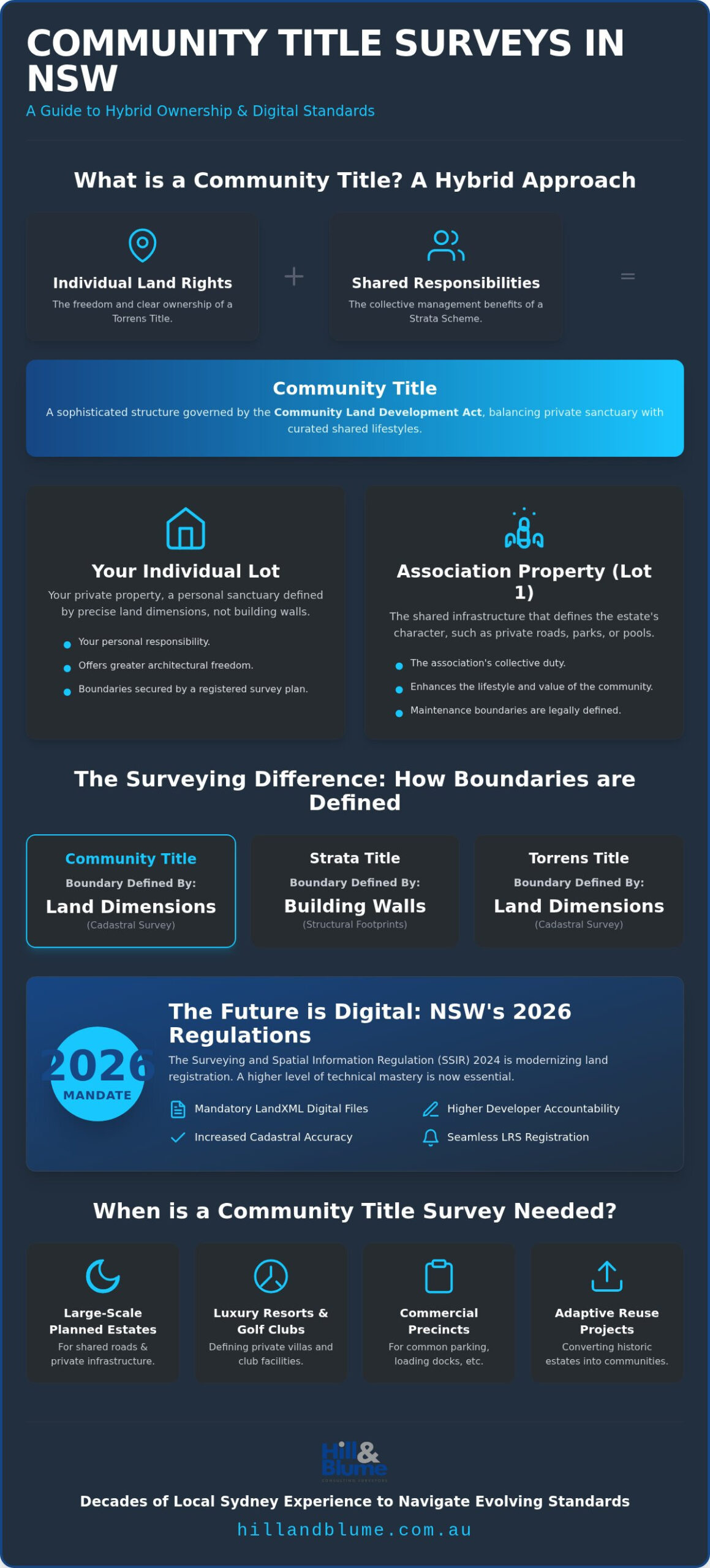
A community title survey nsw represents a sophisticated hybrid of property ownership, blending the absolute land rights of a Torrens title with the shared management benefits of a strata scheme. It’s a specialized land division system designed for those who appreciate the independence of a standalone lot but value the curated lifestyle offered by shared amenities like private parklands, tennis courts, or gated entrances. Unlike a standard subdivision, this survey creates a tiered structure where your individual parcel is governed by a broader community plan. It’s a delicate balance of private sanctuary and collective responsibility, all anchored by the Community Land Development Act.
The role of a registered surveyor in this process is one of both artist and legal technician. At Hill & Blume, we draw on over 90 years of local records to ensure that every boundary is defined with surgical precision. This is particularly vital as we move through 2026, where the transition to mandatory LandXML digital files and updated standards under the Surveying and Spatial Information Regulation (SSIR) 2024 demands a higher level of technical mastery. Our specialized surveying services ensure that your development isn’t just a collection of lots, but a legally sound community that meets the rigorous requirements of the NSW Land Registry Services (LRS).
Individual Lots vs. Association Property
The heart of a community title survey lies in the distinction between your private property and the shared “Lot 1,” known as Association Property. While your individual lot is defined by surveyed land dimensions rather than the walls of a building, Lot 1 encompasses the collective infrastructure that defines the estate’s character. This might include private roads, water treatment facilities, or recreational hubs. The survey plan serves as the definitive legal document that dictates maintenance boundaries. It ensures there’s no ambiguity about where your personal responsibility ends and the association’s duty begins, which is essential for protecting the long-term value of your investment.
When Do You Need a Community Title Survey?
You’ll typically require a community title survey nsw when creating a lifestyle-oriented development that goes beyond a simple boundary split. This is the preferred choice for:
- Large-scale planned estates where residents share private infrastructure like internal road networks or irrigation systems.
- Luxury resorts and golf communities that require precise divisions between private villas and shared club facilities.
- Commercial precincts where multiple businesses share common parking, loading docks, or high-end landscape features.
- Adaptive reuse projects that involve converting expansive historic estates into managed residential communities.
Choosing this path allows for a higher degree of architectural freedom while maintaining a cohesive aesthetic across the entire property. It’s a strategic move for developers who want to offer a premium, managed environment that resonates with discerning buyers.
Community Title vs. Strata vs. Torrens: The Surveying Difference
Choosing the right title for your development is about more than just legal paperwork; it’s about how you physically experience and modify your land. You might be familiar with the absolute independence of a Torrens title or the vertical shared living of a strata scheme. A community title survey nsw sits elegantly between these two, offering the land-based freedom of Torrens with the sophisticated shared infrastructure of a managed estate. Understanding the technical nuances of how these boundaries are defined is the first step in securing your property rights.
The precision required for these surveys is absolute. Under the Surveying and Spatial Information Regulation (SSIR) 2024, every measurement must meet rigorous standards to be accepted by the NSW Land Registry Services. Since July 1, 2026, these plans must also be lodged as mandatory LandXML digital files. This digital transition ensures that your property’s cadastral data is more accurate and accessible than ever before, but it requires a surveyor who masters both traditional fieldcraft and modern data management.
Cadastral Dimensions vs. Building Walls
The most significant technical difference lies in what the surveyor actually measures. In a strata scheme, your boundaries are usually defined by the structure itself, often following the center of a wall, floor, or ceiling. If you decide to move a wall, you’re physically moving your boundary. In contrast, a community title survey nsw defines boundaries by land-based cadastral dimensions. We use physical pegs, offsets, and coordinated points in the ground to mark where your lot begins. Because your rights are tied to the land rather than the building, you enjoy far greater flexibility for future architectural modifications or extensions without needing to redraw the entire plan.
Management and Ownership Structures
While a Torrens title lot is a solo endeavor, a community lot is part of a collective. The survey plan does more than just show lines; it dictates the “unit entitlement” for the entire scheme. This entitlement determines your voting power and your share of the maintenance levies for shared facilities. Developers often favor this structure for infrastructure-heavy projects, such as estates with private water networks or elaborate landscaping, because it allows for a sophisticated management statement that is directly informed by the survey’s data. It’s a partnership-oriented way of living that prioritizes long-term quality and shared values.
If you’re weighing the benefits of these different title structures for your next project, reaching out to a specialized local authority can provide the clarity you need to move forward with confidence.
Key Components of a NSW Community Title Plan
A successful community scheme is built upon a foundation of technical excellence and clear legal definitions. When you commission a community title survey nsw, you aren’t just buying a map; you’re securing a comprehensive blueprint for how a shared estate will function for decades. This process begins with a Detail and Level Survey, which captures the physical reality of the site, its contours, existing trees, and utility services. This data forms the canvas upon which your property boundaries are eventually sketched, ensuring that every design choice is grounded in geographical fact.
The integrity of these plans is paramount to preventing future neighborly disputes. By identifying boundaries with surgical precision, we remove the ambiguity that often leads to encroachment issues or maintenance disagreements. In an era where digital accuracy is the baseline, Hill & Blume leverages over 90 years of local records to verify these lines, providing a level of certainty that modern data alone cannot match. This historical depth is particularly valuable when navigating the complexities of the Community Land Development Act, ensuring your investment is protected by more than just a digital coordinate.
The Role of the Management Statement
Perhaps the most critical intersection of surveying and law is the Management Statement. While the survey plan defines the physical space, the statement dictates its use. Your community title survey nsw must perfectly align with the legal descriptions in this document to ensure that usage rights for shared facilities, like private parks or gyms, are enforceable. We map out exclusive use areas with meticulous care, ensuring that a specific lot owner’s right to a private garden or parking bay is clearly demarcated on the registered plan. This alignment ensures that the community’s by-laws are rooted in physical reality, providing a seamless experience for all residents.
Staged Developments and the Survey Plan
Large-scale projects often unfold over several years, requiring a staged approach to subdivision. This introduces a unique challenge: Stage 2 must align perfectly with Stage 1, even if years have passed between the two. Our surveyors utilize advanced cadastral data to map out these future expansions within the initial community scheme. This foresight prevents costly misalignments and ensures that infrastructure, such as private roads or drainage, flows naturally across the entire estate. For a deeper look at how these processes unlock value, you might find our A Guide to Subdivision Surveys in Sydney particularly useful. It offers a broader perspective on how strategic planning transforms raw land into a curated community.
The Process: How a Community Title Survey is Conducted
Transforming a vision of shared living into a registered reality requires a deliberate, multi-stage approach. A professional community title survey nsw is a journey that begins long before a tripod is leveled on your site. It starts with an exhaustive dive into historical boundary analysis, where we reconcile modern digital data with the physical records of the past. This forensic research ensures that every subsequent step is built on a foundation of absolute legal certainty, protecting your investment from the very first day.
The path to registration follows a refined sequence designed to meet the rigorous standards of 2026:
- Initial Site Research: We perform a deep analysis of historical titles and existing survey plans to resolve any legacy discrepancies.
- Fieldwork and Marking: Our teams place physical boundary markers on-site to define the precise limits of individual lots and Association Property.
- Drafting the Community Plan: We prepare the detailed plan as a mandatory LandXML digital file, ensuring compliance with the latest NSW LRS lodgment standards.
- Collaborative Finalisation: We coordinate with your architects and legal counsel to ensure the survey data perfectly mirrors the Management Statement and development contracts.
- Official Registration: The final plan is lodged with NSW Land Registry Services (LRS) for formal registration, marking the birth of your community scheme.
Fieldwork and Boundary Identification
Our field teams utilize advanced GPS and total station technology to achieve millimetre precision. This technical mastery is only one half of the equation; the other is the legal authority of a Registered Surveyor. In NSW, only these certified professionals can legally define and certify property boundaries. Hill & Blume provides a distinct advantage in this area. Our 90-year record archive allows us to resolve complex boundary discrepancies in Sydney’s established suburbs that modern satellite data alone might overlook, ensuring your boundaries are anchored in both history and technology.
Approval and Registration Hurdles
Navigating the bureaucratic landscape of local councils is often the most demanding phase of any subdivision. You’ll need to secure a Subdivision Certificate, which acts as the final seal of approval before the LRS will register your plan. This stage requires a sophisticated understanding of local planning instruments and the Community Land Development Act. Since the final stage of community land law changes commenced on April 1, 2026, developers must also navigate new accountability measures, including independent reviews for certain multi-storey schemes. For those seeking a professional consultation on these evolving requirements, our team offers the steady guidance needed to move from application to approval.
If you’re ready to define the future of your property with a partner who values quality over volume, we invite you to contact our specialized team for a tailored solution that respects your vision.
Choosing a Surveyor for Your Community Scheme in Sydney
The success of a shared estate hinges on more than just high-quality materials; it rests on the legal integrity of the land it sits upon. When you’re selecting a partner for your community title survey nsw, local expertise isn’t just a preference, it’s a non-negotiable safeguard. Sydney’s property landscape is a complex tapestry of historical titles and evolving 2026 regulations. You need a firm that understands the intricacies of both residential enclaves and high-stakes commercial precincts, ensuring that every boundary is defended by both technical data and seasoned professional judgment.
A precise survey is your primary defense against the shadow of future litigation. Boundary disputes in shared estates are notoriously costly and emotionally draining for residents. By investing in a surveyor who prioritizes depth of relationship over high-volume turnover, you’re securing a legacy of peace. We believe that a considered conversation at the start of a project is worth more than a dozen corrective filings later. It’s about creating a partnership where your vision for a curated lifestyle is protected by a seal of quality that only a Registered Surveyor can provide.
The Hill & Blume Advantage
With over 90 years of experience navigating Sydney’s evolving landscape, Hill & Blume offers a perspective that few can match. We balance traditional integrity with the latest digital surveying technology, providing the precise cadastral data required for absolute LRS compliance. Our boutique approach ensures you aren’t just another project in a corporate queue. You’ll have direct access to senior Registered Surveyors who bring a passion for regional excellence to every task. This hand-crafted feel is what distinguishes a Hill & Blume project, turning a technical requirement into a premium service experience.
Next Steps for Your Project
Moving forward with your development should feel like a natural progression, not a bureaucratic hurdle. To begin, we recommend gathering your existing property documents, such as current titles and any previous site plans, for an initial consultation. This preparation allows us to provide a tailored fee proposal that reflects the specific nuances of your scheme. If you’re still weighing your options, our Choosing a Surveyor in Sydney guide offers further insights into the standards you should expect in 2026. When you’re ready to define your boundaries with confidence, our team is here to ensure your community title survey nsw is a seamless success.
Defining the Future of Your Shared Estate
Navigating the nuances of communal living requires a partner who sees beyond the immediate lines on a map. By understanding the technical differences between title types and the critical role of the Management Statement, you’ve taken the first step toward a secure property future. A precise community title survey nsw isn’t just a regulatory checkbox; it’s a commitment to the long-term harmony and value of your investment. It ensures that the lifestyle you’ve envisioned is protected by absolute legal certainty.
Our team at Hill & Blume brings over 90 years of Sydney surveying expertise to every project. As Registered Surveyors specializing in complex community and strata plans, we offer the calm confidence that comes from nearly a century of local records and modern technical mastery. We invite you to secure your property boundaries with a professional community title survey from Hill & Blume. Let’s work together to ensure your vision is anchored by traditional integrity and a personal touch. Your property deserves the peace of mind that only true precision can provide.
Frequently Asked Questions
What is the main difference between community title and strata title in NSW?
The primary distinction lies in how your boundaries are defined. A community title survey nsw identifies boundaries by land-based cadastral dimensions, much like a traditional Torrens subdivision, whereas a strata title typically follows the physical footprint of a building. This means you own the land beneath your home in a community scheme, which offers greater architectural freedom for future modifications compared to the structure-based limits of strata.
Can a community title lot be further subdivided?
Yes, a community lot can be further subdivided into smaller community lots or even a strata scheme. This multi-tiered approach is frequently seen in large-scale resorts or master-planned estates. In these scenarios, a master community plan governs the broader infrastructure, while individual clusters of dwellings are managed as separate, smaller schemes within that framework.
Who owns the roads and parks in a community title scheme?
The Community Association owns and maintains all shared facilities, including private roads, parklands, and recreational hubs. These areas are designated as “Lot 1” on the survey plan. Every lot owner within the scheme is a member of this association, sharing the responsibility and the benefit of these curated spaces through collective management and levies.
Is a community title survey more expensive than a standard Torrens subdivision?
A community title survey nsw generally involves a higher level of technical and legal complexity than a standard Torrens subdivision. The requirement to map shared Association Property and align the survey with a comprehensive Management Statement adds to the initial investment. Most developers find this cost is balanced by the ability to create a premium, managed environment that attracts discerning buyers.
How long does it take to register a Community Plan in NSW?
The timeline for registration typically spans several months, as it involves both local council approval and examination by the NSW Land Registry Services. Since the mandatory transition to LandXML digital files in July 2026, the technical examination phase has become more streamlined. However, the total duration still depends heavily on the speed of council’s Subdivision Certificate process.
Do I need a new survey if I want to renovate my community title townhouse?
You don’t always need a new community plan for internal renovations, but an Identification Survey is a wise precaution if you’re extending your home’s physical footprint. This ensures your new structures remain strictly within your surveyed land boundaries. It also confirms that your plans don’t encroach upon any Association Property or easements defined in the original scheme.
What happens if there is a boundary dispute in a community scheme?
Disputes are resolved by referring to the original registered community plan, which serves as the definitive legal record. A Registered Surveyor can physically re-mark the boundaries on the ground using the coordinate data from the plan. If the issue remains unresolved, the matter can be taken to the NSW Civil and Administrative Tribunal (NCAT) for a formal ruling based on the survey evidence.
Can a community title scheme be terminated or converted back to Torrens?
Terminating a community scheme is possible but requires a unanimous resolution from all members of the Community Association and an order from the Supreme Court of NSW. While rare, this usually only occurs if the shared infrastructure is being transferred to a local council or if the entire estate is being redeveloped into a different form of ownership.
Disclaimer
The information provided in articles published on this website is for general informational purposes only. While we make every effort to ensure the accuracy, completeness, and timeliness of the content, the material is based on our understanding of the industry at the time of writing and may not reflect the most current developments, regulations, or standards. All opinions expressed in our articles are those of the respective authors and do not necessarily represent the official position of the website or its affiliates. The content should not be considered professional, legal or technical advice, and should not be relied upon as a substitute for consultation with qualified professionals