

What if the elegant Sydney terrace you’ve fallen in love with isn’t quite the property described in your contract? In the high-stakes world of local real estate, the distance between a “paper reality” and the physical land can be surprisingly wide. You likely feel the weight of this investment, perhaps worrying about inheriting a neighbor’s long-standing boundary dispute or discovering an illegal structure after the keys are yours. Securing an identification survey for property purchase sydney is no longer just a recommendation; it’s your most vital safeguard in an increasingly complex market.
We understand that you seek total peace of mind before settlement, and we’re here to provide that clarity. This 2026 guide explores why a professional survey acts as a legal insurance policy for your boundaries, ensuring your land use isn’t quietly restricted by hidden easements. You’ll discover how the latest Surveying and Spatial Information Regulation 2024 impacts your purchase and why this document is the gold standard for bank finance. Let’s ensure your path to property ownership is defined by confidence rather than surprise.
Key Takeaways
- Uncover why the historical map in your contract may not reflect current boundaries and how a Registered Surveyor provides the necessary physical truth.
- Discover how an identification survey for property purchase sydney meticulously documents every structure, from carports to retaining walls, to reveal hidden encroachments before they become your burden.
- Learn the vital distinction between a historical Deposited Plan and a modern identification survey to ensure your investment is anchored in today’s reality.
- Gain a clear roadmap for timing your survey within the cooling-off period, allowing for a seamless transition to settlement with total confidence.
- Understand the nuances of complex Limited and Old System titles to protect your purchase in Sydney’s most storied and established neighborhoods.
The Critical Role of an Identification Survey in Sydney Property Purchases
An identification survey, often called an “Ident” by industry professionals, is a specialized report prepared by a Registered Surveyor. It serves as a definitive bridge between the physical structures you see on-site and the legal boundaries recorded at the Land Registry. While a contract of sale usually includes a diagram, this map is frequently a relic of the past. In some established Sydney suburbs, these plans might be fifty or sixty years old. They reflect a time before modern extensions, new fences, or even the neighbors’ latest landscaping project. An identification survey for property purchase sydney ensures that the parcel of land you are paying for actually matches the fence lines on the ground.
Land surveying is a discipline built on precision; in the 2026 market, that precision is your greatest asset. Sydney’s residential landscape is uniquely challenging. Tight blocks, shared party walls in terrace rows, and heritage overlays mean there is zero margin for error. A discrepancy of just a few centimeters can trigger a complex legal dispute with a neighbor or prevent you from obtaining building approval for future renovations. You aren’t just buying a house; you’re acquiring a specific coordinate in the Sydney landscape that must be legally verified.
Why “Mandatory” Doesn’t Mean “Unnecessary”
In New South Wales, vendors aren’t legally required to provide a current survey in the contract. This creates a “buyer beware” environment where the risk of an illegal structure or a boundary encroachment sits squarely on your shoulders. You might assume title insurance covers every eventuality, but many policies contain exclusions for issues that a physical survey would have revealed. By securing an identification survey for property purchase sydney, you protect your “quiet enjoyment” of the home. It’s about knowing that the carport isn’t over the boundary line and the swimming pool meets every setback requirement before you commit your life savings. Once your pool is verified, maintaining it is essential; for instance, Pool Blitz provides expert water balancing and servicing to keep aquatic features in perfect condition. This document acts as your legal insurance policy, providing the clarity needed for a seamless settlement.
The Registered Surveyor Advantage
The legal weight of an identification report rests entirely on the credentials of the person who signs it. Only a Registered Surveyor possesses the statutory authority to define land boundaries in NSW. General draftspersons or unlicensed technicians simply cannot provide the same level of legal indemnity. At Hill & Blume, we draw upon a 90-year legacy of serving the Sydney, Newcastle, and Central Coast regions. This depth of history allows us to approach every property with a refined aesthetic and a meticulous eye for detail. We ensure your investment is supported by a standard of craftsmanship that mirrors the quality of the home itself, offering a boutique service that larger, clinical agencies often overlook.
What an Identification Survey Reveals: Beyond the Fence Line
An identification survey is a meticulous audit of a property’s physical narrative. It goes far beyond a simple line on a map. While professional marketing from UberRE helps establish the property’s visual narrative in markets across Australia, an identification survey for property purchase sydney provides a detailed portrait of how every structure, from the primary residence to the smallest retaining wall, sits in relation to the legal boundaries. This includes precise measurements of carports, garages, and even the eaves of your roof. It’s the difference between assuming you own the land and having the data to prove it.
The records held by the NSW Land Registry Services (LRS) provide the legal framework, but our surveyors provide the physical reality. We verify that the property complies with local council setbacks and “Distance from Boundary” rules. These regulations are often the first thing checked during future renovation applications. By investing in an identification survey for property purchase sydney, you’re essentially purchasing the truth of the land.
The Encroachment Nightmare: Real-World Sydney Examples
Sydney’s history is etched into its streets, but those decades of growth often lead to wandering boundaries. A fence might have been replaced three times since the original plan was lodged, moving slightly with each iteration. We frequently see gutters overhanging a neighbor’s airspace or old brick walls that have drifted thirty centimeters into the adjoining lot. These aren’t just minor inconveniences. They are legal liabilities. If you discover these issues before settlement, you gain a powerful negotiating tool to adjust the purchase price or require the vendor to rectify the matter. If you find them after moving in, the cost of moving a wall or resolving a bitter dispute falls entirely on you.
Easements, Covenants, and Restrictions
Easements are legal permissions for someone else to use a portion of your land. A common example in Sydney is a sewer line managed by Sydney Water. While these are often invisible to the naked eye, they significantly restrict your land use. You might dream of a backyard pool or a sprawling timber deck, only to find that an easement prevents any permanent structure from being built there. An identification survey identifies these “Restrictions on Use” clearly. It ensures your vision for the lifestyle the property offers is actually achievable. If you have questions about a specific property’s layout, reaching out for a tailored consultation can provide the clarity you need.
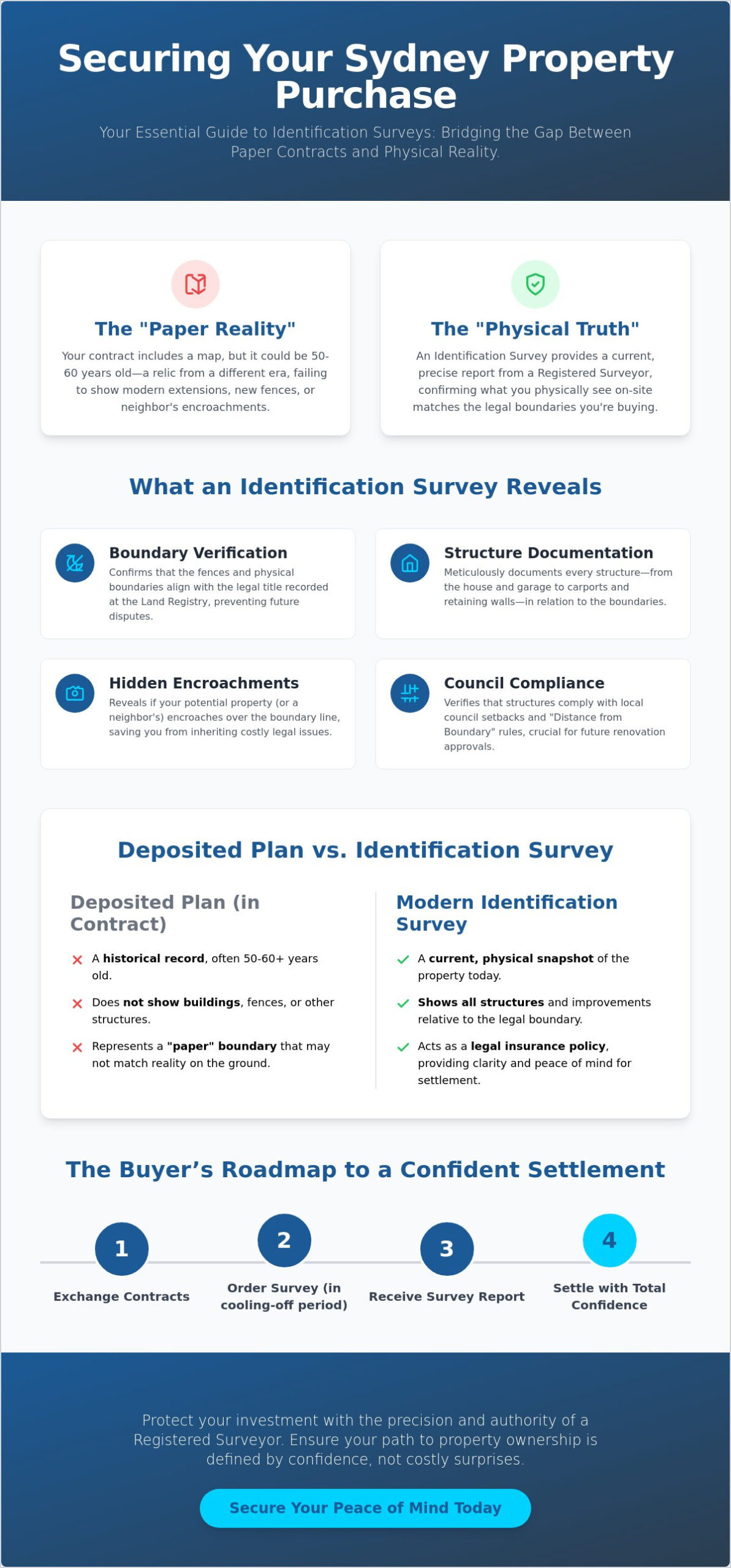
Deposited Plans vs. Identification Surveys: Understanding the Difference
When you review a contract of sale in Sydney, you’ll inevitably find a document known as the Deposited Plan (DP). This plan is the legal foundation of the land’s subdivision, yet it’s vital to recognize it as a historical record rather than a current snapshot. In heritage-rich suburbs like Paddington or Crows Nest, these plans often date back to the 1920s or earlier. Relying on a century-old map to protect a significant modern investment is a high-risk strategy. An identification survey for property purchase sydney bridges this gap by accounting for every wall, fence, and extension built since that original plan was lodged at the registry.
The DP tells you where the boundary should be, but our survey reveals where it actually sits. This “Physical Reality” test is essential because land is not static. Over decades, soil shifts, fences are replaced, and structures are added. Without a fresh survey, you’re essentially buying a property based on a historical intent rather than the present reality. In Sydney’s premium markets, where every square meter carries immense value, the distinction between a DP and an identification survey is the distinction between hope and certainty.
When the Fence is Not the Boundary
It’s a common myth that the fence line is the true boundary. In reality, many of Sydney’s older neighborhoods are defined by “fences of convenience” that were erected around existing trees or rocky outcrops decades ago. This leads to many owners unknowingly losing land area or, conversely, encroaching on their neighbor’s territory. You don’t want to discover that your garden is actually your neighbor’s land after you’ve already settled. An Identification Survey re-establishes the legal boundary through precise mathematical calculation, definitively resolving whether a fence has drifted from its rightful position.
Identifying Illegal Structures
Beyond the land itself, you must consider the legality of the structures upon it. A charming granny flat or a sun-drenched extension might appear perfect, but if it was built over the boundary or without the correct setbacks, you could inherit a significant legal burden. A survey is a critical component in verifying that all improvements comply with the original approvals. It’s often the missing link needed to secure an Occupation Certificate (OC) or to protect yourself from future Council demolition orders. By choosing a professional identification survey, you ensure your new home is a sanctuary, not a liability. This level of diligence protects your “quiet enjoyment” and secures the long-term value of your Sydney lifestyle.
Timing Your Survey: The Buyer’s Roadmap to Settlement
Success in Sydney’s fast-moving property market depends on a delicate balance of precision and timing. You shouldn’t wait until you’ve moved in to discover a boundary issue that could have been identified weeks earlier. The most effective window for an identification survey for property purchase sydney is during your due diligence phase, typically immediately after you receive the Contract of Sale. This proactive approach transforms the survey from a reactive fix into a strategic tool for negotiation and peace of mind.
- Step 1: The Initial Quote. Request a proposal the moment the contract is in your hands. This allows our team to research the land’s history and prepare for the site visit without unnecessary delays.
- Step 2: Securing Access. Arrange for the surveyor to visit the property during the cooling-off period. This is your critical window of opportunity to uncover any discrepancies between the physical site and the legal title before the contract becomes binding.
- Step 3: Professional Review. Once the report is finalized, review the findings with your solicitor or conveyancer. They will interpret the legal implications of any encroachments or easements we’ve identified on the ground.
- Step 4: Strategic Negotiation. If the survey reveals an issue, such as a neighbor’s structure sitting over your line, you can use this documented evidence to negotiate repairs or a price reduction before the final settlement.
Why Wait? The Risk of Post-Settlement Discovery
Settlement represents a point of no return. Once the keys change hands, you effectively “buy the problem” along with the home. Attempting to claim against a vendor for an undisclosed structure or a boundary error after the fact is notoriously difficult and often involves costly litigation. Beyond your own peace of mind, many bank lenders now require an identification survey for property purchase sydney as a mandatory condition of finance approval, especially for high-LVR (Loan-to-Value Ratio) loans. They want to ensure their security is physically sound and legally defined before the funds are released.
Future-Proofing Your Purchase
A survey is more than a pre-purchase safeguard; it is the first chapter of your property’s future. If you envision a renovation, a new pool, or a bespoke extension, your identification survey provides the baseline data needed for a Contour and Detail Survey. This integration ensures that your architectural plans are built on a foundation of absolute accuracy from day one. At Hill & Blume, we maintain digital records of our surveys for decades. This continuity means that if you decide to sell or refinance in ten years, you have a trusted partner who understands the unique DNA of your land. If you’re ready to secure your investment with this level of detail, request a customized quote for your Sydney property today.
Hill & Blume: Sydney’s Trusted Authority for Property Identification
Choosing the right partner for your property journey is about more than just data; it’s about trust and heritage. At Hill & Blume, we bring over 90 years of history to every project we undertake across Sydney, Newcastle, and the Central Coast. We don’t believe in high-volume turnover. Instead, we offer a boutique approach that prioritizes the depth of our relationship with you. Our expertise in complex “Limited Title” and “Old System” property identification means we can navigate the intricate layers of Sydney’s history that others might find daunting. When you commission an identification survey for property purchase sydney with us, you’re investing in a legacy of precision and care.
Our Boundary Surveys are designed to protect your most significant asset with a level of craftsmanship that mirrors the quality of the home you’re buying. We’re detail-oriented and deeply rooted in the local culture, ensuring that every report we produce serves as a seal of quality for your investment. This tailored approach distinguishes us from larger, more clinical agencies, offering you a curated experience that respects both your time and your intelligence.
Our Process: Precision Meets Personal Service
Precision starts long before we step onto your land. We begin with exhaustive research of Deposited Plans and historical records at Land Registry Services. Our field measurements utilize the latest technology to ensure absolute accuracy, yet we never lose the human element of our work. The result is a clear, elegant report that your solicitor or conveyancer will find effortless to interpret. You’ll also have direct access to our Registered Surveyors for any follow-up questions, ensuring you’re never left with unanswered concerns during the settlement process.
Secure Your Sydney Investment Today
Don’t leave your boundaries to chance in such a competitive market. A small discrepancy today can become a significant legal burden tomorrow. We invite you to contact Hill & Blume for a fixed-fee Identification Survey quote that provides the clarity you deserve. Let us provide the professional “insurance policy” your land requires so you can focus on the excitement of your new home. Enquire about our professional surveying services here and experience the bespoke service that has defined our agency for nearly a century.
Securing Your Sydney Legacy with Confidence
You are on the threshold of a significant new chapter. Your home is more than just a structure; it is the foundation of your lifestyle and a vital part of the local fabric. We’ve explored how a modern survey resolves the “Contract Gap” and why relying on historical plans is a risk you simply don’t need to take. By identifying encroachments and verifying easements today, you ensure your settlement marks the beginning of a peaceful tenure rather than the start of a boundary dispute.
Since 1932, Hill & Blume has provided this essential clarity for discerning buyers across the region. Our team of NSW Registered Surveyors brings over 90 years of expertise to every project, offering fixed-fee professional consulting that respects your time and your investment. Securing an identification survey for property purchase sydney is the final, vital step in your due diligence roadmap. It’s the legal safeguard that allows you to focus on the joy of ownership.
Request a Professional Identification Survey Quote to anchor your investment in certainty. We look forward to helping you step into your new Sydney home with total peace of mind.
Frequently Asked Questions
Is an Identification Survey compulsory when buying a house in NSW?
An identification survey is not legally mandatory for a buyer in New South Wales, but it’s a vital component of a prudent due diligence process. While the law doesn’t force you to obtain one, the risk of inheriting illegal structures or boundary disputes rests entirely with you once settlement occurs. Many legal professionals and lenders recommend an identification survey for property purchase sydney to protect your investment and ensure the land matches the title.
How much does an identification survey cost in Sydney in 2026?
The cost of a professional survey in Sydney is influenced by several factors, including the size of the parcel, the terrain, and the age of the existing records. Every property possesses a unique history, and more complex sites with limited title information often require more intensive research. While we don’t provide generic pricing, we offer fixed-fee professional consulting tailored to your specific property to ensure you have absolute clarity on the investment required.
How long does it take to get an identification survey report?
You can typically expect to receive your final report within seven to ten business days from the site visit. This timeframe allows our Registered Surveyors to conduct thorough research at the Land Registry and ensure every measurement is verified with precision. We recommend requesting your quote as soon as you receive the contract to ensure the report is ready well before your cooling-off period expires.
Can I use the survey provided by the seller?
You should exercise caution when relying on a survey provided by a vendor, as it may be outdated or fail to reflect recent additions. Crucially, a surveyor’s professional indemnity usually only extends to the person who commissioned the report. By obtaining a fresh identification survey for property purchase sydney in your own name, you ensure the legal protection and professional liability are directly tethered to your purchase.
What happens if the survey shows an encroachment?
If an encroachment is discovered, you gain a powerful opportunity to resolve the matter before the contract becomes unconditional. Your solicitor can use our report to negotiate a price reduction or require the vendor to rectify the issue with the neighbor. Finding these discrepancies early prevents you from inheriting a bitter legal dispute or the high cost of physical demolition after you’ve moved in.
Does a survey show the exact location of underground pipes?
An identification survey primarily focuses on the relationship between physical structures and land boundaries rather than underground utilities. While we identify the presence of easements that might house pipes, a specialized utility search or a Detail Survey is required to map the exact depth and location of subterranean services. Knowing where these easements lie is still essential for understanding your future building restrictions.
Is a “Peg Out” the same as an Identification Survey?
A “peg out” is a separate service, often called a Construction Set-out, used to mark the location of a future building on the ground. In contrast, an identification survey is a diagnostic report that identifies existing structures and their compliance with boundaries. While both involve precision measurement, the Ident Survey is your legal safeguard for a purchase, while a peg out is the first step of a new build.
What is the difference between a Detail Survey and an Ident Survey?
An Ident Survey is a legal verification of boundaries and improvements used for property transfers and finance. A Detail and Level Survey provides a topographical map of the land, including slopes, trees, and neighboring windows, which is essential for architects during the design phase. If you plan to renovate your new Sydney home, you’ll likely need both to ensure your vision is both legally sound and structurally viable.
Disclaimer
The information provided in articles published on this website is for general informational purposes only. While we make every effort to ensure the accuracy, completeness, and timeliness of the content, the material is based on our understanding of the industry at the time of writing and may not reflect the most current developments, regulations, or standards. All opinions expressed in our articles are those of the respective authors and do not necessarily represent the official position of the website or its affiliates. The content should not be considered professional, legal or technical advice, and should not be relied upon as a substitute for consultation with qualified professionals