
The final hurdle of your Sydney development isn’t the physical build; it is the digital proof of its precision. You’ve invested months into perfecting your vision, and the anticipation of receiving your Occupation Certificate is palpable. Yet, the realization that filing a work as executed survey for council involves navigating complex standards like ADAC XML version 6.00 can feel like an unexpected weight just as you’re ready to celebrate. You deserve a transition that is as polished and purposeful as the architecture itself.
We understand that meeting the latest 2026 regulations, including Sydney Water’s Version 4 specifications, requires a partner who values accuracy as much as you do. This guide offers a comprehensive look at how to secure your compliance without the stress of discrepancies or delays. We’ll outline the essential steps to satisfy local requirements from the Northern Beaches to Parramatta, ensuring your infrastructure records are both accurate and enduring. By the end of this article, you’ll have the clarity needed to turn a technical requirement into a seamless bridge toward your project’s successful handover.
Key Takeaways
- Understand how a work as executed survey for council serves as the definitive record of your craftsmanship, ensuring every detail aligns with the approved Development Application.
- Discover the critical infrastructure data captured during a survey, from the exact depth of stormwater systems to the verification of finished floor levels.
- Navigate the evolution of digital compliance and learn how modern requirements like ADAC XML 6.00 facilitate a more seamless integration with Sydney’s local infrastructure.
- Explore the high-precision methodology that bridges the gap between design and reality, providing the clarity your Private Certifier needs to issue an Occupation Certificate.
- Learn why the signature of a Registered Surveyor is the ultimate seal of quality, protecting your property’s integrity and mitigating future legal or drainage risks.
Understanding the Work as Executed (WAE) Survey for Council Approval
As your construction project nears its conclusion, the focus shifts from the physical labor of building to the precise art of documentation. A work as executed survey for council is far more than a simple checklist; it is the definitive, professional record of your project as it stands in reality. While the design phase was based on intent, this survey captures the truth of the site. It ensures that every pipe, road, and level reflects the craftsmanship you’ve poured into the development.
Council relies on this data to maintain the integrity of our local infrastructure. When you install new drainage systems or alter road alignments, these assets become part of the shared community fabric. Local authorities must update their records with absolute certainty to manage these assets for decades to come. This verification process confirms that your construction adheres strictly to the Development Application (DA) conditions. Ultimately, a precise work as executed survey for council serves as the critical link required before a Private Certifier can issue your final Occupation Certificate.
WAE vs. As-Built: Is There a Difference?
You might hear various terms on a worksite, including a Record (as installed, as-built) drawing. While “as-built” is a common industry phrase used during the construction phase, “Work as Executed” is the formal terminology required for official submissions in New South Wales. WAE plans focus specifically on compliance with the Subdivision Works Certificate. They provide the technical assurance that the finished product functions exactly as the engineering designs intended, protecting both the developer and the community from future infrastructure failures.
The Role of the Registered Surveyor in Final Compliance
This level of certification carries significant legal weight. Only a Registered Surveyor has the authority to sign off on these documents, providing a guarantee to local government that the data is accurate. The surveyor’s signature acts as a bond of trust, confirming that the physical structures match the digital records. At Hill & Blume, our 90-year history in Sydney means we bring a deep understanding of evolving regulatory landscapes to every project. We view our signature as a seal of quality, representing a partnership that prioritizes depth of relationship and meticulous detail. Our comprehensive surveying services are designed to offer you calm confidence during this final, pivotal stage of compliance.
What Does a WAE Survey Cover? Tracking Your Project’s DNA
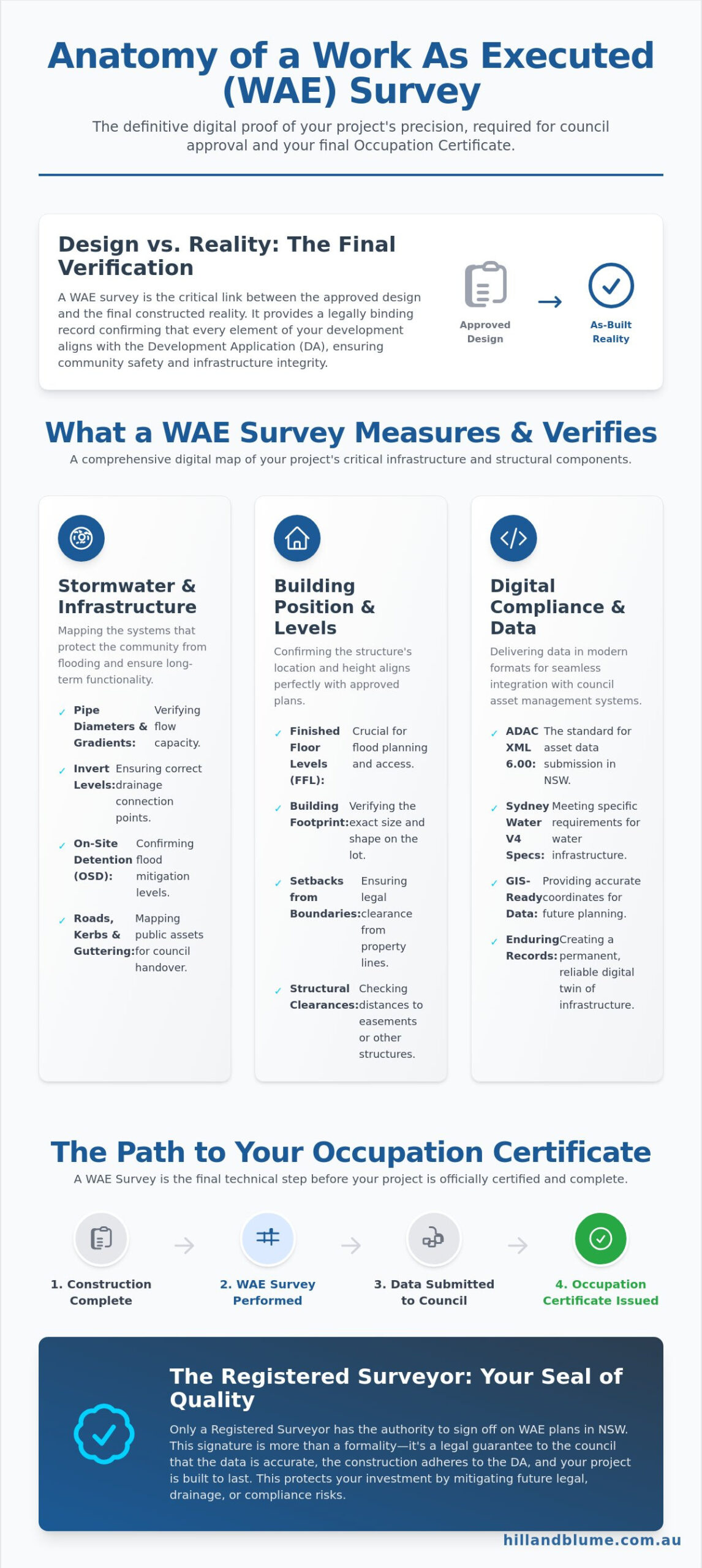
Think of this survey as the digital blueprint of your property’s reality. It goes beyond the surface to map the intricate systems that make a modern development functional, safe, and compliant. A work as executed survey for council captures the precise location and depth of newly installed stormwater drainage systems, ensuring that what was designed on paper translates perfectly into the earth. It’s a process of verification that respects the craftsmanship of your build while providing the rigorous data local authorities demand.
Stormwater and Infrastructure Verification
Stormwater compliance is frequently the most common hurdle during the final stages of approval. This isn’t just about showing where a pipe lies; it’s about verifying the technical minutiae that keep a neighborhood safe. We meticulously measure pipe diameters, gradients, and invert levels to ensure they match the engineering intent. This data is often linked back to the historical accuracy of our initial Detail and Level Surveys, creating a seamless narrative of the site’s transformation.
For subdivision projects, the scope expands to include road alignments, kerbs, and guttering. These are the public-facing assets that Council will eventually inherit. Every millimeter matters when you’re documenting ‘on-site detention’ (OSD) systems. These systems are your project’s primary defense against local flooding. If the levels are even slightly off, the entire system’s integrity is compromised, leading to potential delays in your Occupation Certificate.
Building Position and Structural Clearances
Structural precision is equally paramount. We confirm that your building sits exactly within the approved setbacks, leaving no room for future boundary disputes or legal ambiguity. It’s vital to verify that easements haven’t been encroached upon during the construction process. This is where the expertise of a professional who understands Registered Surveyor requirements becomes indispensable. Their certification ensures that your property boundary remains uncompromised and legally sound.
By finalizing a work as executed survey for council that integrates these findings with our Boundary Surveys, we provide a complete, evocative picture of the site’s evolution. This documentation verifies finished floor levels against original topographic data, providing the calm confidence you need for final sign-off. We invite you to speak with our specialists to ensure your project’s DNA is recorded with the care it deserves.
Navigating Sydney Council Requirements: From ADAC to Certifiers
The physical structure of your development is only half the story. The other half lives in the digital records that local authorities use to manage our growing city. Sydney councils are rapidly shifting toward the use of “digital twins,” which are GIS-ready data sets that provide a real-time reflection of urban infrastructure. When you submit a work as executed survey for council, you aren’t just providing a map; you’re contributing to a sophisticated digital ecosystem. This transition ensures that every pipe and road alignment is integrated into a broader network, allowing for more efficient maintenance and future planning.
Your Private Certifier acts as the crucial gatekeeper in this process. Before they can issue an Occupation Certificate (OC), they must review the WAE survey to confirm it meets the rigorous standards set by the local government area (LGA). Requirements can vary significantly across Sydney. For instance, the Parramatta Development Control Plan 2023 or the Northern Beaches’ updated specifications each have unique nuances. We ensure your data is compatible with these local standards and utility provider requirements, such as Sydney Water’s Version 4 specification for “Works as Constructed” drawings issued in February 2026.
The ADAC Standard: Digital Compliance Explained
The Asset Design and As Constructed (ADAC) standard is the modern language of infrastructure. As of June 2026, many councils have moved toward mandating ADAC XML version 6.00 for all digital submissions. This format allows your asset data to flow directly into Council databases without manual entry errors. We specialize in preparing these precise XML files, ensuring your project meets the highest technical benchmarks. This digital filing isn’t just a hurdle; it’s an investment in long-term property management and provides a solid foundation for any future Subdivision Plans you may consider.
Amended Design vs. Summary WAE Plans
It’s important to distinguish between a “red-line” markup and a clean, final survey plan. While contractors often use red-line drawings to show changes during construction, Council typically requires a formal, professionally drafted WAE plan. This document provides a polished summary of the site’s reality, clearly illustrating any minor deviations from the original engineering design. We manage these discrepancies with a steady, expert hand, ensuring that every detail is purposeful and clutter-free. This clarity respects the certifier’s time and intelligence, moving your project smoothly toward its final handover.
The WAE Process: Ensuring Precision Between Design and Reality
The journey toward a final Occupation Certificate is a deliberate sequence of verification. A work as executed survey for council is the concluding chapter of this narrative; it transforms physical structures into certified data. This process requires a discerning eye and a commitment to precision that mirrors the quality of the development itself. It is the moment where the dust of the construction site settles, and the enduring legacy of the property is formally recorded. We approach this phase with a sense of calm confidence, ensuring your project meets every technical benchmark with grace and accuracy.
Our methodology follows five essential stages:
- Design Review: We begin by meticulously analyzing your approved engineering designs and specific DA conditions to understand the project’s original intent.
- On-site Collection: Our team utilizes high-precision GNSS and total station equipment to capture the exact coordinates and levels of your infrastructure.
- Comparative Analysis: We contrast the site data against the original plans to identify any construction that falls out of tolerance or deviates from the design.
- Digital Preparation: We draft certified plans and generate the necessary PDF, DWG, and ADAC XML files required for modern Council databases.
- Final Submission: We conduct a thorough internal review before submitting the package to your Council or certifier, ensuring a polished and purposeful filing.
Bridging the Gap: Construction Set-out to Completion
The most effortless WAE surveys are those that begin long before the final brick is laid. When you engage us for your initial Construction Set-out, we establish a foundation of accuracy that carries through to the end. This continuity reduces risk by ensuring the surveyor who verified the design on the ground is the same one documenting the result. It eliminates the need for a new professional to re-learn the site’s history, which can often lead to unnecessary delays. The continuity benefit is the reduction of technical friction and data discrepancies achieved by maintaining a single surveying partner from project inception to final certification.
What Happens if the ‘As-Built’ Doesn’t Match the Design?
Construction is rarely a matter of perfect replication. Minor deviations are common, and our role is to help you distinguish between a simple technicality and a major discrepancy. If a structure deviates significantly, Council may require a Section 4.55 modification to the original approval. This can feel like a daunting hurdle, but it is simply a process of aligning the legal record with the physical reality. In these moments, our experienced surveyors act as specialized local authorities, mediating technical solutions with Council engineers to keep your project moving toward its final handover. If you’re ready to finalize your project’s compliance with confidence, contact our team today to schedule your work as executed survey for council.
Why a Registered Surveyor is Essential for Your Final Compliance
Your project is a testament to your vision and dedication. Ensuring that every detail is captured within a work as executed survey for council requires more than just technical proficiency; it demands a deep-seated respect for the local regulatory environment. The role of a Registered Surveyor carries a unique weight of professional liability and accountability. When a surveyor signs your WAE plans, they are providing a legal guarantee to the local government that the physical reality of your build matches the digital record. This signature acts as a seal of quality, protecting your investment from future disputes or compliance audits.
Hill & Blume’s legacy is built upon 90 years of navigating Sydney’s evolving landscape. We’ve witnessed the city transform, and we’ve adapted alongside every regulatory shift, from the introduction of local environmental plans to the current mandate for ADAC XML digital filing. This history provides us with a specialized local authority that large, clinical corporate firms often struggle to replicate. We offer a boutique advantage, where personalized attention to detail ensures that nothing is overlooked. We don’t just process files; we curate an experience that prioritizes the depth of our relationship with you over high-volume turnover.
A flawless paper trail is perhaps the most enduring gift you can give your property. Whether you intend to hold the asset or move toward a future sale, having a certified work as executed survey for council ensures the property’s “DNA” is recorded without error. It mitigates legal risks regarding boundary or drainage compliance, providing a sense of calm confidence for you and any future stakeholders. It is the final, polished step in a journey that values quality over quantity.
A Partnership for the Life of Your Property
Our clients often return to us for decades, moving with us from the initial purchase and boundary verification to the final WAE submission. They value the traditional integrity and personal touch that defines our work. By choosing a partner who understands the unique charm and requirements of your specific Sydney region, you ensure a seamless transition between project phases. We invite you to explore our full range of specialised surveying services to see how we can support your property’s entire lifecycle.
Next Steps: Securing Your Occupation Certificate
As your construction nears completion, the timing of your survey becomes critical. We recommend booking your site visit as soon as the major infrastructure and floor levels are finalized. This allows ample time for our team to conduct the on-site data collection and prepare the sophisticated digital files required by your certifier. If you’re ready to finalise your project with a partner who values craftsmanship and care, contact the Hill & Blume team today to begin the final step toward your Occupation Certificate.
Securing Your Project’s Legacy and Compliance
The journey from a vision on paper to a completed Sydney development is a remarkable feat of craftsmanship. As you move toward the final handover, a work as executed survey for council stands as the definitive proof of your project’s integrity. It ensures that every technical nuance, from stormwater gradients to finished floor levels, is captured with the precision that local authorities demand. By embracing modern digital standards like ADAC XML, you aren’t just meeting a requirement; you’re future-proofing your property’s records for decades to come.
Hill & Blume has been anchored in the local culture since 1932. With over 90 years of Sydney expertise, our Registered Surveyors bring a sense of calm confidence to the most complex digital submissions. We specialize in navigating the intricate requirements of LGAs across the city, ensuring your path to an Occupation Certificate is effortless and polished. Our specialized approach prioritizes the depth of our relationship with you, ensuring every detail is purposeful and every filing is flawless.
Ready to take the final step? Finalise your project with a WAE survey from Hill & Blume and experience the boutique care your development deserves. Your vision is complete; let’s ensure its record is equally perfect.
Frequently Asked Questions
What is a Work as Executed (WAE) survey in NSW?
A Work as Executed survey is the formal, professional record that certifies your project was built according to the approved engineering designs. It captures the final location and levels of critical infrastructure like drainage, roads, and building footprints. By providing this document, you’re giving Council the assurance that your development respects the original design intent and community standards. It’s an essential piece of the compliance puzzle for any modern Sydney build.
When is a WAE survey required by Sydney councils?
Sydney councils generally mandate a work as executed survey for council as a final condition before issuing an Occupation Certificate. This requirement is especially common for projects involving subdivision works or significant stormwater management systems. It allows local authorities to update their digital asset records with precision. Without this certified verification, you can’t legally occupy or finalize the handover of your new property.
Can a builder provide the WAE plan instead of a surveyor?
While a builder might provide “red-line” drawings to show construction changes, they can’t certify a formal WAE plan. In New South Wales, only a Registered Surveyor has the legal authority to sign these documents for Council submission. Their signature represents a bond of professional accountability and ensures the data meets rigorous standards like ADAC XML version 6.00. This certification is what gives Council the confidence to accept the assets.
How much does a Work as Executed survey cost in Sydney?
The cost of a work as executed survey for council is determined by the specific complexities of your project and the volume of infrastructure to be measured. There are no fixed council fees for these professional services; instead, fees are project-specific. We recommend speaking with our team for a tailored proposal that reflects the unique requirements of your site and the level of detail needed for a successful submission.
What is the difference between a WAE survey and an As-Built survey?
The difference is primarily one of formality and legal certification. An “As-Built” survey is a general term often used by contractors for internal records or mechanical systems. Conversely, a WAE survey is the formal, certified document required for regulatory compliance in NSW. It follows strict drafting standards and must be prepared by a Registered Surveyor to satisfy the specific conditions of your Development Application.
How long does it take to complete a WAE survey for Council?
Site measurements can often be completed in a single day, but the preparation of the certified plans and digital XML files typically takes longer. You should allow for at least one to two weeks for the final package to be ready for submission. Factors like the size of the subdivision and the complexity of the stormwater network will influence the final delivery time for your project.
What happens if my WAE survey shows construction doesn’t match the plans?
If discrepancies are identified, we first determine if they fall within acceptable tolerances. Minor variations are often noted on the plan without issue. However, if the construction deviates significantly from the design, you might need to seek a Section 4.55 modification. Our experienced surveyors act as a bridge between you and the Council engineers to help navigate these technical challenges with calm confidence.
Do I need a WAE survey for a granny flat or small extension?
Granny flats and small extensions often require a WAE survey if they impact stormwater drainage or are built near registered easements. Council needs to ensure that even smaller developments don’t compromise the broader infrastructure network or neighborhood flood mitigation. You should carefully review your DA consent conditions; they’ll clearly state if this survey is a prerequisite for your final sign-off.
Disclaimer
The information provided in articles published on this website is for general informational purposes only. While we make every effort to ensure the accuracy, completeness, and timeliness of the content, the material is based on our understanding of the industry at the time of writing and may not reflect the most current developments, regulations, or standards. All opinions expressed in our articles are those of the respective authors and do not necessarily represent the official position of the website or its affiliates. The content should not be considered professional, legal or technical advice, and should not be relied upon as a substitute for consultation with qualified professionals