
A PCA survey is not just a measurement; it is a financial instrument that secures the yield and integrity of your Sydney property asset. You likely recognize that in our city’s competitive commercial landscape, even a minor discrepancy in floor space can lead to significant revenue loss or strained tenant relationships. Understanding the specific pca lease area survey requirements is essential for any property owner who values precision and long term peace of mind.
We believe that a lease plan should be a document of absolute clarity, reflecting the true value of your space with sophisticated accuracy. You deserve the confidence that comes from knowing your rental income is maximized and your agreements are legally defensible. By mastering the Property Council of Australia’s measurement standards, you can transform a routine requirement into a strategic advantage for your portfolio.
In this 2026 guide, we’ll demystify the complexities of Net Lettable Area (NLA) and Gross Lettable Area (GLA) to ensure your property remains compliant. We will walk you through the essential steps to secure a legally binding lease plan that honors the unique character of your investment while protecting your financial interests.
Key Takeaways
- Learn why standard floor plans often differ from lettable area measurements and how the Property Council’s standards provide the definitive benchmark for Sydney leasing.
- Master the specific pca lease area survey requirements to accurately distinguish between Net Lettable Area (NLA) for office suites and Gross Lettable Area (GLA) for industrial assets.
- Discover how modern 3D laser scanning technology creates a high-fidelity reflection of your space, ensuring your lease plan is both precise and sophisticated.
- Understand the vital role of a Registered Surveyor in providing a legally defensible document that protects your rental yield and fosters trust with your tenants.
- Identify common measurement pitfalls, such as miscalculating vertical penetrations, to ensure your commercial agreements remain robust and free from future disputes.
What is a PCA Lease Area Survey and Why is it Required?
In the vibrant heart of Sydney, property isn’t just space; it’s a curated asset that demands precision. A PCA Lease Area Survey is a specialized measurement conducted according to the “Method of Measurement for Lettable Areas” published by the Property Council of Australia. Unlike a standard architectural floor plan that might focus on building footprint or aesthetic layout, a PCA survey is strictly focused on economic utility. It defines exactly what a tenant pays for. It’s the universal language that ensures a landlord in Barangaroo and a tenant from Surry Hills are speaking the same financial dialect.
Meeting the specific pca lease area survey requirements ensures your lease is more than just a handshake; it’s a legally defensible document. In the commercial, retail, and industrial sectors, these standards eliminate ambiguity by clarifying what constitutes “lettable” space. This often involves excluding structural columns, service ducts, or common areas that don’t directly benefit the tenant’s daily operations. By using these standards, you create a transparent foundation for every commercial interaction.
The Legal and Financial Significance of the PCA Standard
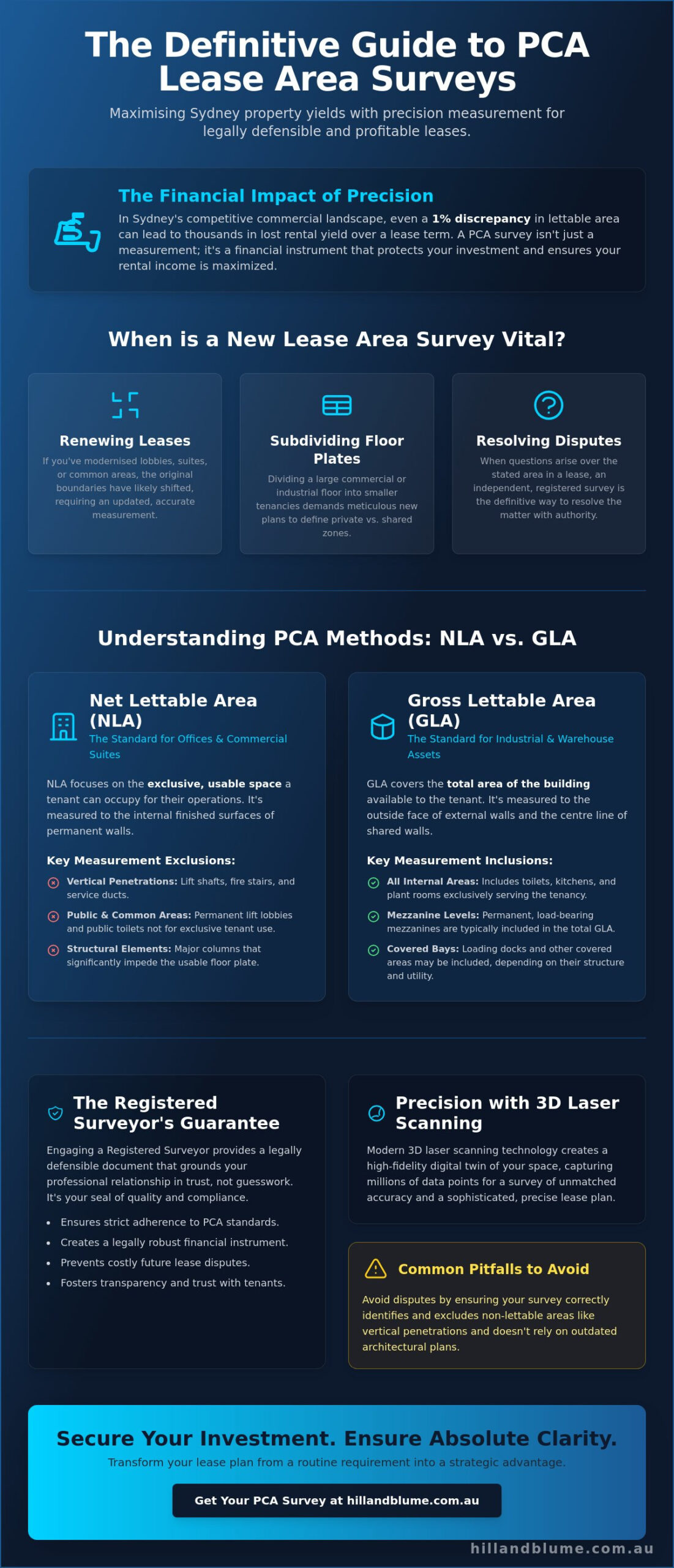
Precision is the hallmark of a high-end property portfolio. Even a 1% discrepancy in square meterage can ripple through a ten-year lease, potentially costing thousands in unrealized rental yield. Modern NSW lease contracts often mandate “Method of Measurement” clauses to prevent these invisible losses. By adhering to the PCA standard, you provide a seal of quality that reassures both parties. This grounds your professional relationship in trust rather than guesswork. It transforms the lease into a robust financial instrument that protects your long-term ROI.
When is a New Lease Area Survey Necessary?
You’ll find that certain milestones in a property’s lifecycle necessitate a fresh look at your space. We often assist clients when they are:
- Renewing long-term leases: If you’ve updated a lobby or modernized office suites, the original boundaries have likely shifted since the last agreement.
- Subdividing floor plates: Dividing a large industrial warehouse or a commercial floor into boutique tenancies requires meticulous new plans to define shared versus private zones.
- Resolving disputes: When questions arise regarding the stated area, an independent, registered survey is the only way to resolve the matter with authority.
Whether you’re managing a heritage building or a modern development, ensuring your documentation aligns with current pca lease area survey requirements is a vital step in maintaining the integrity of your Sydney property investment.
Understanding the PCA Methods: NLA vs. GLA vs. GLAR
A sophisticated lease agreement begins with choosing the correct lens for your property. Sydney’s architectural landscape is diverse, ranging from heritage sandstone terraces in the Rocks to the expansive logistics hubs of Western Sydney. Because each space serves a different purpose, the Property Council of Australia defines distinct methods to ensure your rental calculations are both fair and precise. Selecting the right method is the first step in meeting the broader pca lease area survey requirements for your asset.
Net Lettable Area (NLA) Deep Dive
In the gleaming office towers of the Sydney CBD, Net Lettable Area is the gold standard. This method focuses on the space that a tenant can actually occupy and use for their business operations. You calculate NLA by measuring to the internal finished surfaces of permanent walls. It’s a process that demands an eye for detail. We exclude areas that provide shared utility but no private benefit. These exclusions are vital for transparency and include:
- Vertical penetrations: Lift shafts, fire stairs, and service ducts.
- Public spaces: Permanent lift lobbies and public toilets.
- Structural elements: Large columns that significantly impede the usable floor plate.
For 2026, there is a renewed focus on modern building amenities. End-of-trip facilities and communal breakout zones are often treated differently than traditional office space. Ensuring these are correctly categorized protects your integrity as a landlord and provides clarity for your tenants.
Gross Lettable Area (GLA) for Industrial Assets
Conversely, the sprawling industrial hubs of Western Sydney require a broader perspective. Gross Lettable Area is typically used for warehouses, showrooms, and freestanding supermarkets. Unlike the internal focus of NLA, GLA measures to the outside face of external walls. This reflects the structural reality of industrial assets where the envelope of the building itself is the primary value driver.
In these environments, we pay close attention to mezzanines and loading docks. If a mezzanine is permanent and functional, it’s often included in the total area. However, shared breezeways and open hardstand areas require careful demarcation to avoid future disputes. The NSW Registrar General’s survey requirements provide the legal backbone for these plans, ensuring that your industrial lease is as robust as the building it describes.
For retail tenancies in shopping centres, we utilize Gross Lettable Area Retail (GLAR). This specialized method accounts for the unique nuances of shopfronts and mall entries. If you feel uncertain about which method applies to your unique floor plate, we invite you to reach out for a tailored discussion. Mastering these pca lease area survey requirements ensures your property is positioned for long-term success with documentation that is both elegant and accurate.
Technical Survey Requirements and Site Preparation
Achieving the standard of excellence required for a modern Sydney lease begins with the right technology. Gone are the days when a simple tape measure sufficed for high-end commercial assets. Today, we utilize 3D laser scanning, often referred to as LiDAR, to capture a digital twin of your property. This technology maps millions of data points per second, ensuring that every curve of a heritage wall or the exact positioning of a structural column is recorded with absolute fidelity. Meeting the pca lease area survey requirements in 2026 means embracing this level of technical sophistication.
Preparation is the silent partner of precision. To ensure a seamless survey, clear site access is paramount. We often recommend conducting these surveys after-hours. This approach minimizes disruption to your tenants and allows the laser scanner an unobstructed line of sight, which is essential for capturing a clean data set. While existing architectural plans provide a helpful foundation, they often lack the “as-built” reality that only a registered surveyor can provide through a physical site visit.
Checklist for Property Managers
A successful survey is a collaborative effort. To prepare your asset for a refined measurement experience, consider these essential steps:
- Identify common areas: Clearly mark shared corridors or amenities that should be excluded from private tenancy calculations.
- Ensure total access: Every room, closet, and service riser must be unlocked. A single missed door can delay the finalization of your lease plan.
- Provide foundational data: Supply your surveyor with the most recent Boundary Survey to ensure the lease plan aligns perfectly with the property’s legal limits.
The Accuracy Threshold
For institutional-grade assets, “close enough” is never an option. Professional PCA surveys operate within strict tolerances that reflect the high stakes of commercial leasing. These measurements form the basis of your rental yield, and even a minor discrepancy can undermine the financial integrity of your agreement. Our professional land surveying services are designed to provide the certainty you need. You receive a comprehensive suite of digital deliverables, including CAD files for your design team and high-resolution PDF plans that serve as a seal of quality for your legal documents. This meticulous approach ensures that your pca lease area survey requirements are met with a sense of calm confidence and traditional integrity.
Common Pitfalls and How to Avoid Lease Disputes
A lease dispute is more than just a legal hurdle; it’s a disruption to the harmony of your property management. In our experience across Sydney’s diverse postcodes, the most common conflicts arise from simple, avoidable oversights in the initial measurement phase. Misidentifying vertical penetrations, such as stairs or lift shafts, as lettable space is a frequent error that can lead to years of contested rental payments. These areas must be excluded to meet the rigorous pca lease area survey requirements that institutional tenants expect.
Change is a constant in the Sydney market. Following a minor “make-good” or a tenant’s fit-out alteration, the physical boundaries of a space often shift. Relying on outdated plans or uncertified floor plans for new legal documents is a risk that few owners can afford. A professional survey provides a snapshot of reality. It ensures that your lease reflects the current state of the asset, protecting you from future claims of overpayment. By ensuring your documentation aligns with pca lease area survey requirements, you are investing in the long-term stability of your commercial relationships.
The Consequences of Incorrect Measurement
The financial stakes are high. Legal precedents in NSW demonstrate that tenants can successfully claim for rent overpayment if the actual area is found to be smaller than stated in the lease. Beyond immediate legal costs, incorrect measurements negatively impact property valuations and capitalization rates during a sale. A Hill & Blume certificate serves as a “seal of quality” for your asset. It signals to investors and tenants alike that your property is managed with a refined aesthetic and traditional integrity.
Navigating Mixed-Use Developments
Modern Sydney developments often blend retail, office, and even residential elements, creating a tapestry of measurement challenges. You might need to apply NLA for an upper-level office suite while utilizing GLAR for the ground-floor boutique. Shared foyers in these developments are particularly complex, requiring a discerning eye to determine which areas are truly communal. If you’re managing a complex asset, our A Guide to Strata & Subdivision Surveys provides deeper insight into unlocking your property’s potential.
Don’t leave your rental yield to chance or outdated documentation. We invite you to secure your asset’s future by requesting a consultation for a PCA lease area survey today. This simple step ensures your agreements remain robust, accurate, and perfectly aligned with industry standards.
Engaging a Registered Surveyor for Your PCA Lease Plan
Choosing who measures your asset is a decision that impacts the legal and financial standing of your property for years to come. In New South Wales, the Surveying and Spatial Information Act 2002 isn’t just a regulatory footnote; it’s the framework that ensures your lease is binding and accurate. While a draftsman might provide an aesthetically pleasing sketch, only a Registered Surveyor possesses the legal authority to certify that your space meets the specific pca lease area survey requirements. This certification transforms a simple drawing into a legally defensible document that stands up to institutional scrutiny.
At Hill & Blume, we bridge the gap between traditional craftsmanship and modern innovation. We carry the integrity of our 1932 heritage into the digital age, utilizing 2026 technology to deliver results that are both elegant and precise. From the initial field survey using advanced 3D scanning to the final signed Lease Plan, every step is a considered conversation about the value of your property. We don’t just deliver data. We provide a seal of quality that reflects your commitment to excellence and professional depth.
The Hill & Blume Boutique Experience
We believe in the power of depth over volume. Our boutique approach means you aren’t just another project in a high-turnover system. We treat your asset with the care it deserves, tethering every survey to its specific regional Sydney identity. Whether your property is a heritage storefront in the Eastern Suburbs or a modern industrial park in the West, we understand the local fabric that makes it unique. You’ll have direct access to our senior registered surveyors, ensuring your consultation is guided by expertise and a personal touch that larger, clinical agencies often lack.
Requesting Your Customised Proposal
Securing a tailored solution for your asset is a seamless process. To provide a fixed-fee quote that respects your time and intelligence, we typically require the property address, any existing architectural plans, and the specific leasing goals you aim to achieve. Our expertise extends across Sydney, Newcastle, and the Central Coast, ensuring your regional portfolio is handled with consistent professionalism. We invite you to partner with Hill & Blume for your next PCA Lease Area Survey and experience a service that is as refined as the properties we measure. Meeting your pca lease area survey requirements has never felt more effortless or assured.
Securing Your Property’s Future with Precision
Managing a premier Sydney asset requires a blend of foresight and meticulous documentation. You’ve seen how distinguishing between NLA and GLA isn’t just a technicality; it’s a strategic move to safeguard your rental yield. By aligning your property with the latest pca lease area survey requirements, you eliminate the ambiguity that leads to disputes and foster a relationship of trust with your tenants. This precision ensures that every square metre is accounted for, providing a clear foundation for your commercial agreements.
Our approach at Hill & Blume combines over 90 years of Sydney surveying expertise with state-of-the-art 3D laser scanning technology. This ensures your lease plan is a high-fidelity reflection of your space, captured with a level of detail that traditional methods simply cannot match. Our Registered Surveyors specialize in PCA standards, providing you with a document that is both legally robust and beautifully precise. We invite you to secure your property’s value with a precise PCA Lease Area Survey from Hill & Blume.
You deserve the confidence that comes from working with experts who value quality over volume. Let’s ensure your next lease is as sophisticated and accurate as the property it represents.
Frequently Asked Questions
What is the main difference between NLA and GLA?
Net Lettable Area (NLA) is the standard for office buildings and business parks, focusing on the usable space within internal finished surfaces. It excludes shared amenities like public toilets and lift lobbies. Gross Lettable Area (GLA) is utilized for industrial assets and warehouses, measuring to the outside face of external walls and typically including all structural elements within that footprint.
Does a PCA lease area survey include common areas like toilets?
Common areas are treated differently depending on the specific method of measurement used. Under NLA standards for office suites, permanent public spaces such as toilets, stairs, and lift lobbies are strictly excluded from the lettable area. In industrial GLA calculations, these spaces are generally included if they fall within the external walls of the individual tenancy being measured.
How long does a PCA lease area survey take to complete in Sydney?
The on-site measurement for a typical Sydney office suite or warehouse usually takes between a few hours and a full day. The complexity of the floor plate and the total square meterage determine the time required. Once the field work is finished, our team processes the 3D laser scan data to produce certified digital plans within several business days.
Is a PCA survey legally required for all commercial leases in NSW?
While not a statutory requirement for every minor agreement, a professional survey is a standard contractual necessity for institutional-grade assets. Most modern NSW lease contracts mandate a survey to ensure the agreement is accurate and legally defensible. Adhering to pca lease area survey requirements is the most reliable way to prevent future rent overpayment claims or tenant disputes.
Can I use an old architectural plan instead of a new survey?
Relying on old architectural plans is risky because they often reflect design intent rather than “as-built” reality. Minor structural changes or fit-out updates over time can significantly alter the actual lettable area. A fresh survey ensures your documentation is current and meets all modern pca lease area survey requirements, providing a seal of quality for your property records.
What is the “Method of Measurement” for retail shops in shopping centres?
Retail tenancies are measured using Gross Lettable Area Retail (GLAR). This specialized method is designed to handle the unique nuances of shopping centre environments, such as shopfront treatments and mall entries. It provides a consistent framework for landlords and tenants to ensure that retail rental calculations are transparent and fair across an entire shopping precinct.
Do I need a Registered Surveyor for a lease plan in a strata building?
Yes, you must engage a Registered Surveyor if the lease plan needs to be lodged with NSW Land Registry Services. This is a common requirement for long-term leases or those within strata-titled developments. A Registered Surveyor provides the legal certification required under the Surveying and Spatial Information Act 2002, ensuring your document is recognized as a formal legal instrument.
How often should a lease area be re-measured?
You should consider a re-measurement whenever a building undergoes refurbishment, a tenancy is subdivided, or a major new lease is being negotiated. Even if the walls haven’t moved, updated measurement technology can provide a more accurate reflection of the space than older methods. Regular updates ensure your asset’s financial performance is always based on the most precise data available.
Disclaimer
The information provided in articles published on this website is for general informational purposes only. While we make every effort to ensure the accuracy, completeness, and timeliness of the content, the material is based on our understanding of the industry at the time of writing and may not reflect the most current developments, regulations, or standards. All opinions expressed in our articles are those of the respective authors and do not necessarily represent the official position of the website or its affiliates. The content should not be considered professional, legal or technical advice, and should not be relied upon as a substitute for consultation with qualified professionals