
What if the success of your multi-million dollar Sydney renovation depends entirely on a hidden set of numbers recorded long before the first brick is laid? You likely understand that navigating the NSW planning portal and local council Development Applications (DA) feels like a complex puzzle where the pieces don’t always fit. It is natural to feel a sense of unease when your architect begins sketching, wondering if those initial dimensions truly reflect the reality of your site’s unique footprint or heritage constraints.
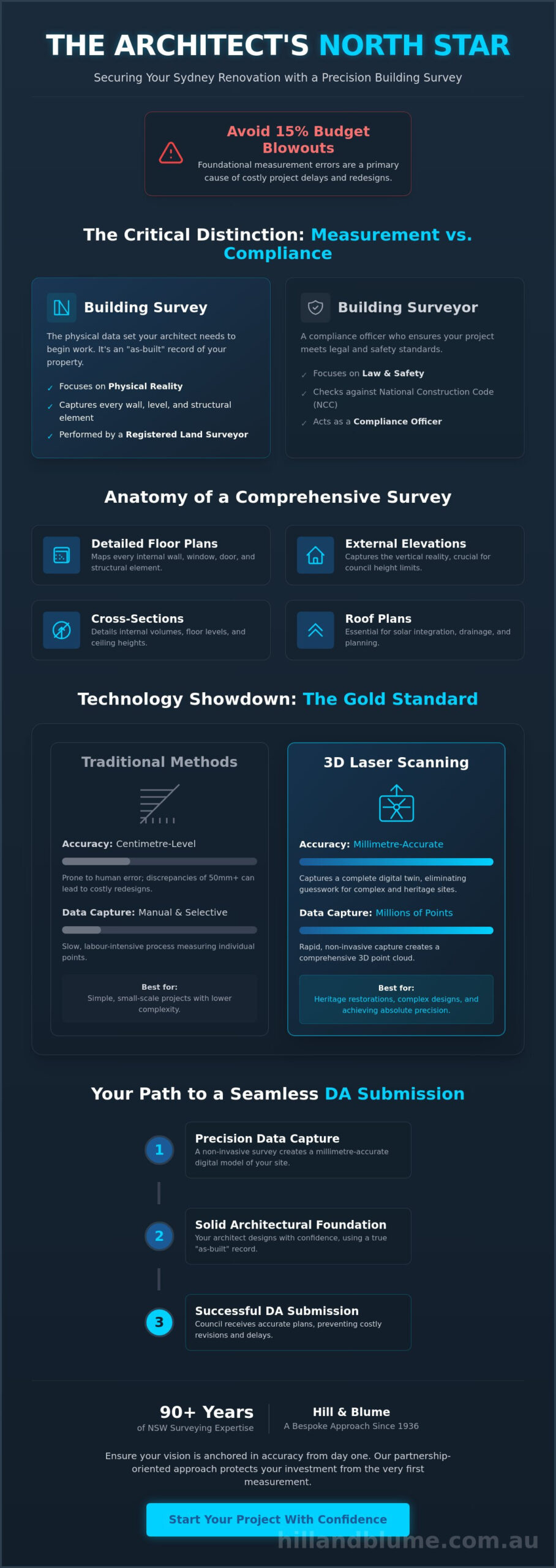
This guide ensures you move forward with absolute clarity by securing a precise building survey that serves as your project’s technical North Star. You’ll discover how to transform technical uncertainty into a seamless foundation for your design, ensuring every corner of your bespoke restoration or modern development is captured with integrity. We will explore the essential steps to obtaining accurate as-built plans, mastering Sydney council submission standards, and avoiding the 15% budget blowouts often caused by foundational measurement errors.
Key Takeaways
- Understand the critical distinction between regulatory compliance and a technical building survey to ensure your Sydney project begins with an accurate architectural foundation.
- Learn how detailed floor plans and external elevations capture the vertical reality of your property, providing the essential data required for complex Sydney council height limits.
- Discover why millimetre-accurate 3D laser scanning has become the gold standard for restoring heritage homes and navigating sophisticated architectural designs with absolute precision.
- Explore a seamless, non-invasive data capture process that integrates directly into your design workflow, offering the clarity needed for a successful Development Application.
- Gain insight into a bespoke consulting approach that prioritises quality and integrity, drawing on 90 years of expertise to bring your unique property vision to life.
Understanding the Building Survey: Measurement vs. Compliance
A successful project begins with a clear vision, but that vision requires a foundation of absolute precision. In the context of Sydney’s evolving urban landscape, a building survey is more than a simple set of dimensions. It’s a comprehensive “as-built” record of your property. This technical measurement captures every floor level, wall thickness, and structural element with surgical accuracy. It ensures your design team works with the truth of the site rather than an approximation.
Many homeowners confuse a Building Surveyor with a building survey. While a Building Surveyor acts as a compliance officer to ensure your project meets the National Construction Code and local council regulations, a building survey is the physical data set your architect needs to begin their work. One focuses on law and safety; the other focuses on physical reality. Without this data, you’re designing in the dark. Hill & Blume has spent 90 years refining this process across NSW. Since our founding in 1936, we’ve focused on providing the data integrity required for complex, bespoke sites. Our curated survey services bridge the gap between a conceptual dream and a buildable reality.
The Role of a Registered Land Surveyor in Building Surveys
Precision is a legal necessity in NSW, not a luxury. Only a registered land surveyor possesses the authority to define how your building sits within its legal boundaries. In Sydney’s high-density suburbs, a discrepancy of just 50mm can lead to costly redesigns or encroachment disputes that stall a project for months. Construction surveying principles ensure that your building’s footprint respects every easement and setback. We transform raw site data into a polished architectural foundation, giving you the confidence that your project rests on solid, verified ground. This partnership-oriented approach protects your investment from the very first measurement.
When Does a Sydney Homeowner Need a Building Survey?
The pre-design phase is the most critical moment for a survey. It provides your architect with a “blank canvas” of reality, preventing expensive surprises once construction begins. For those restoring heritage homes in suburbs like Paddington or Glebe, a survey captures the intricate details and structural leans that define the home’s character. Whether you’re planning a sophisticated renovation in Sydney or adding a modern granny flat in Newcastle or the Central Coast, this data is your first step. Our bespoke approach ensures every project, regardless of scale, benefits from a seamless and professional start. We treat every site with the care it deserves, ensuring your vision is anchored in accuracy.
Key Components of a Measured Building Survey for Sydney Projects
A building survey is more than a technical requirement; it’s the definitive blueprint for your architectural vision. In the high-stakes Sydney property market, precision isn’t optional. Your project deserves a foundation built on absolute clarity, ensuring that every design choice is grounded in the physical reality of the site. A bespoke survey provides the data needed to transform a concept into a tangible masterpiece.
A comprehensive survey for a Sydney residence typically encompasses several vital layers:
- Detailed Floor Plans: We map every internal wall, window, and structural element to create a precise digital twin of your interior spaces.
- External Elevations: These capture the vertical reality of your property, which is essential for navigating the strict height limits enforced by local councils.
- Cross-Sections: Understanding internal volumes and ceiling heights is critical for luxury design, allowing for the seamless integration of bespoke joinery and lighting.
- Roof Plans: With the 2026 focus on sustainability, accurate roof plans are essential for solar integration and complex drainage planning in the Sydney climate.
The Importance of Accurate Elevations for DA Submissions
Sydney councils utilize elevation data to rigorously assess how your design impacts the surrounding neighborhood. From the heritage streets of Paddington to the coastal slopes of Bronte, privacy and overshadowing are top priorities for planning officers. By capturing precise neighboring property details, you provide a compelling planning argument that supports your vision. This ensures your project stays within the mandated building height envelopes, reducing the risk of costly revisions during the Development Application (DA) process.
Professional standards in this field are maintained through bodies like the Australian Institute of Building Surveyors, which ensures that every measurement reflects the highest level of industry integrity and technical excellence.
Capturing Structural Integrity: Columns, Beams, and Voids
Modern structural engineering leaves no room for “near enough” measurements. Identifying structural constraints before the first sledgehammer swings prevents expensive delays and design compromises. We document the placement of columns, the depth of load-bearing beams, and the precise location of voids. This level of detail allows your design team to create a curated solution that respects the existing fabric of the home while pushing the boundaries of modern living.
You can explore our full range of technical capabilities via Hill & Blume Services to see how we support complex Sydney renovations. We believe that a successful build starts with a partnership rooted in trust and technical mastery. If you’re ready to define the parameters of your next project, reach out for a personal consultation to discuss your specific requirements.
Precision Technology: Traditional Methods vs. 3D Laser Scanning
The transition from manual tape measures to millimetre-accurate laser technology has redefined the standards of a building survey in 2026. While the industry once relied on hand-drawn sketches and physical measurements, the complexity of Sydney’s architectural landscape now requires a more sophisticated lens. Modern 3D Laser Scanning captures millions of data points in seconds, providing a level of detail that traditional methods simply cannot replicate. This technology is particularly vital for the heritage-listed terraces of Paddington or the intricate glass facades of the CBD, where every angle is unique.
At Hill & Blume, we view technology as an extension of our craftsmanship. Our bespoke approach integrates these high-capacity tools with the traditional integrity that has always defined our work. By utilizing 3D scanning, we reduce the need for repeat site visits by approximately 40 percent. This ensures your project moves forward without the friction of missing data or unverified measurements. It is a seamless partnership between innovation and expertise, designed to respect both your time and your vision.
The Benefits of 3D Point Cloud Data
A 3D point cloud creates a 1:1 digital replica of your property, capturing everything from structural beams to the subtle curve of a heritage cornice. This digital twin allows your architects and engineers to conduct virtual site visits from their desks, which can significantly lower project overheads. Beyond the immediate design phase, this data serves as a curated digital record that future-proofs your asset for any subsequent renovations. Having a comprehensive data set ensures that every stakeholder has access to the same high-fidelity information from day one.
Accuracy Standards in NSW Land Surveying
In the dense urban environment of Sydney, where property lines are often shared, a few millimetres can lead to significant legal or structural complications. Relying on “as-built” plans from a previous owner is a risk that often leads to costly delays during the construction phase. We adhere to the strict NSW Surveyor General’s Directions to ensure every measurement is verified against current standards. Cadastral integrity represents the absolute legal certainty that a building’s footprint aligns perfectly with its surveyed property boundaries. You can explore our full range of professional services to see how we apply these precision standards to every building survey we undertake.
Integrating Building Surveys into Your Sydney DA and Design Process
A successful development in Sydney’s competitive property landscape relies on a foundation of absolute accuracy. Integrating a professional building survey into your workflow isn’t just a regulatory hurdle; it’s a strategic advantage that protects your investment. At Hill & Blume, we approach this process with a blend of technical mastery and a deep understanding of the local aesthetic, ensuring your project moves from concept to reality without friction.
Our methodology follows a refined, five-step path designed for clarity and precision:
- Step 1: Initial Consultation and Scope Definition. We begin by identifying exactly which structural elements, floor levels, and site boundaries require attention. This bespoke approach ensures we capture the data your specific project demands.
- Step 2: On-site Data Capture. Our team utilizes non-invasive, high-precision 3D laser scanning technology. This captures millions of data points with minimal disruption to your daily routine or your neighbors.
- Step 3: Data Processing. We translate raw point cloud data into polished architectural CAD or BIM files. This transformation ensures every millimeter of your property is accounted for in a digital environment.
- Step 4: Delivery and Integration. The digital twin of your property is handed over to your design team. We provide files that integrate directly into their existing software, fostering a collaborative and efficient environment.
- Step 5: Verification. We ensure the final building survey aligns with the specific requirements of your local Sydney council, such as the City of Sydney or Woollahra. This final check provides the peace of mind that your documentation is ready for submission.
Supporting Your DA and CDC Applications
Your submission to the NSW Planning Portal needs to be flawless to avoid the frustration of a stalled project. A professional building survey significantly reduces the likelihood of Request for Information (RFI) delays from local councils. These delays often set projects back by 20 to 30 business days, impacting both your timeline and budget. Once construction is complete, ensuring your finished build aligns with approved plans through work-as-executed surveys is the critical final step to securing your Occupation Certificate. For a broader view of your site’s topography and external constraints, see our guide on Contour and Detail Surveys.
Collaborating with Architects and Engineers
Architects require precision to create truly bespoke designs. By providing files in DWG, PDF, or Revit formats, we ensure a seamless workflow that prevents costly variation expenses during the construction phase. Accurate data means your engineer won’t have to make assumptions about structural integrity or load-bearing walls. This level of detail is particularly vital for smaller, high-value projects; learn more about our specialized approach to Surveying for Extensions & Granny Flats in Sydney.
The Hill & Blume name acts as a seal of quality for your project team. We prioritize depth of relationship over high-volume turnover, ensuring your vision is supported by experts who value quality as much as you do.
Ready to secure the foundation of your next project with a partner who understands the Sydney market? Connect with our expert team today to discuss your bespoke survey requirements.
Hill & Blume: A Bespoke Approach to Building Surveys in NSW
Hill & Blume has spent over 90 years refining the art of the building survey across Sydney, Newcastle, and the Central Coast. We don’t believe in the high-volume turnover that defines much of the modern industry. Instead, we focus on a curated consulting model that prioritizes your project’s specific needs. Sydney’s unique terrain, from the iconic sandstone foundations of the Harbour to the complex title systems of the inner west, requires more than just a data point. It demands a partner who understands the local fabric of New South Wales.
Our commitment to quality over quantity ensures that every client receives our full attention. We’ve built our reputation on a foundation of integrity, ensuring that homeowners and developers alike can proceed with absolute certainty. You aren’t just another file in our system; you’re a partner whose vision we value as much as our own. This dedication to excellence has allowed us to remain a pillar of the community for nine decades, adapting to changing regulations while maintaining traditional standards of care.
The Hill & Blume Difference: Integrity and Craftsmanship
We move beyond the clinical nature of corporate surveying to offer property insights that feel personal and refined. Our status as a Trusted Local Expert means we simplify your development journey by providing clarity where others offer industry jargon. Every building survey we produce is a reflection of our commitment to craftsmanship. We treat your property with a level of detail that mirrors the seamless service you expect from a boutique agency. It’s a partnership rooted in trust and a genuine passion for the local landscape. We prioritize depth of relationship, ensuring our advice is always purposeful and tailored to your site’s unique characteristics.
Secure Your Property’s Future Today
A professionally executed survey is an investment in your property’s long-term viability and protection. Whether you’re managing a heritage restoration in the city or a new development in the Southern Highlands, our team provides the calm confidence you need to move forward. We offer tailored quotes based on your specific site requirements, ensuring you receive a service that is as unique as your property. Our process is steady and deliberate, respecting your time while delivering the precision required for modern NSW compliance. We invite you to experience a more considered approach to property consultancy.
Bringing Your Sydney Vision to Life with Precision
A successful development starts long before the first stone is laid. It begins with an uncompromising commitment to accuracy. By integrating a professional building survey into your initial planning, you eliminate the guesswork that often leads to costly delays in the Sydney DA process. Whether you’re navigating the complexities of a heritage site or a modern commercial build, the shift toward 3D laser scanning ensures every millimetre of your property is accounted for. This level of detail isn’t just about measurement; it’s about protecting your investment and ensuring your design aligns perfectly with the physical reality of the site.
With over 90 years of local NSW experience, Hill & Blume brings a refined, boutique perspective to every project. Our Registered Land Surveyors specialize in the most complex residential and commercial sites, offering a bespoke approach that prioritizes your project’s integrity. We understand that your vision deserves a foundation built on trust and technical excellence. Partner with Sydney’s trusted surveying experts for your next project and experience a seamless transition from concept to construction. We look forward to helping you shape the future of our local landscape with confidence and care.
Frequently Asked Questions
What is the difference between a building surveyor and a land surveyor?
A land surveyor establishes the legal boundaries and topography of your site, while a building surveyor focuses on the physical structure and dimensions of the property itself. While land surveyors ensure your project sits correctly on the earth, building surveyors provide the intricate details of walls, floor levels, and structural elements. This distinction is vital for your design integrity. In NSW, the Board of Surveying and Spatial Information (BOSSI) regulates land surveyors to ensure your title remains secure.
How long does a measured building survey take to complete in Sydney?
You can expect a standard residential measured building survey to take between one and three days on-site for the initial data capture. Following the site visit, the drafting of your detailed plans generally requires another five to ten business days. Larger or more intricate heritage properties in Sydney often extend this timeline by 40 percent to ensure every bespoke detail is captured with absolute precision. This steady pace ensures the quality and accuracy required for a seamless design process.
Do I really need a building survey for a small home extension?
Yes, a professional building survey is essential even for modest extensions to prevent costly structural errors and design clashes. Relying on original house plans is risky because 15 percent of older Sydney homes deviate from their historical council records. By securing an accurate survey, you provide your architect with a reliable foundation. This step ensures your new vision integrates seamlessly with the existing structure and meets local council requirements without unexpected delays.
How much does a building survey cost in NSW for a standard residential property?
For a standard three-bedroom residential property in NSW, a comprehensive survey typically ranges from A$1,500 to A$4,500 depending on the complexity of the site. These figures reflect the level of detail required for modern architectural software and the time spent on-site by skilled professionals. Investing in this quality data early prevents the 10 to 20 percent budget blowouts often caused by unexpected site conditions discovered during the construction phase. It’s a small price for long-term project integrity.
What file formats will I receive my building survey in?
You’ll typically receive your survey data in industry-standard formats including DWG for CAD software, PDF for easy viewing, and RVT files if you require a 3D Revit model. These digital assets allow your design team to work with a curated set of data that flows effortlessly into their workflow. Having these precise files ensures that every stakeholder, from the engineer to the interior designer, shares a single source of truth for your project. It makes the entire transition from concept to construction feel effortless.
Can a building survey help with a boundary dispute in Sydney?
A measured building survey focuses on the structure, but you’ll need a registered land surveyor to resolve legal boundary disputes through a formal identification survey. While we capture the building’s position, only a land surveyor can legally certify the exact location of your property lines under the Surveying and Spatial Information Act 2002. We often work in partnership with land surveyors to provide a holistic view of your property’s potential and its physical limits. This collaborative approach protects your interests and your peace of mind.
What happens if I proceed with my design without a professional survey?
Proceeding without a survey often leads to structural misalignments that can delay your project by several weeks or months. Without accurate data, your builder might encounter unexpected pipework or foundation issues that add A$10,000 or more to your initial quote. It’s a risk that compromises the integrity of your vision and your budget. Starting with a clear, professional foundation protects your investment and ensures a smooth, stress-free path to completion. We believe in getting the details right from the very beginning.
Is 3D laser scanning necessary for every building survey?
3D laser scanning isn’t mandatory for every project, but it’s the gold standard for heritage homes or complex architectural designs. This technology captures millions of data points to create a point cloud with millimetre accuracy. While traditional methods work for simple structures, 85 percent of high-end renovations now utilize laser scanning to ensure total precision. It provides a level of detail that traditional tools simply can’t match, offering you a bespoke data set that captures every unique curve and angle of your property.
Disclaimer
The information provided in articles published on this website is for general informational purposes only. While we make every effort to ensure the accuracy, completeness, and timeliness of the content, the material is based on our understanding of the industry at the time of writing and may not reflect the most current developments, regulations, or standards. All opinions expressed in our articles are those of the respective authors and do not necessarily represent the official position of the website or its affiliates. The content should not be considered professional, legal or technical advice, and should not be relied upon as a substitute for consultation with qualified professionals