
Imagine standing before your newly finished Sydney development, only to find the final milestone, your Occupation Certificate, is delayed by a few centimeters of unexpected stormwater pipe. It’s a common frustration for many developers who find that the gap between design plans and as-built reality is wider than expected. Securing work-as-executed surveys shouldn’t feel like a hurdle; it’s the essential bridge that validates your project’s integrity to Council and ensures your vision is legally recognized.
You’ve poured your passion into creating something exceptional, and you deserve a completion process that’s just as refined. We understand that navigating the Surveying and Spatial Information Regulation 2024 can feel overwhelming, especially with the January 2026 transition period now concluded. This guide provides a clear path to mastering WAE requirements, ensuring every civil and stormwater detail aligns with the latest Sydney Water and NSW Planning Portal standards. We’ll explore how a curated partnership with a registered surveyor can turn a complex compliance task into a seamless, stress-free success for your property.
Key Takeaways
- Discover how a certified plan meticulously records constructed infrastructure to bridge the gap between your initial design and the finished reality.
- Understand why work-as-executed surveys act as the essential final audit required to secure your Occupation Certificate without unnecessary delays.
- Identify the critical civil and hydraulic components, such as stormwater gradients and OSD tank volumes, that councils scrutinize for compliance.
- Learn the step-by-step process of site measurement and certification that transforms complex field data into a trusted legal document.
- Gain peace of mind by partnering with a boutique expert who manages evolving NSW regulations with a refined, detail-oriented approach.
What is a Work-as-Executed (WAE) Survey?
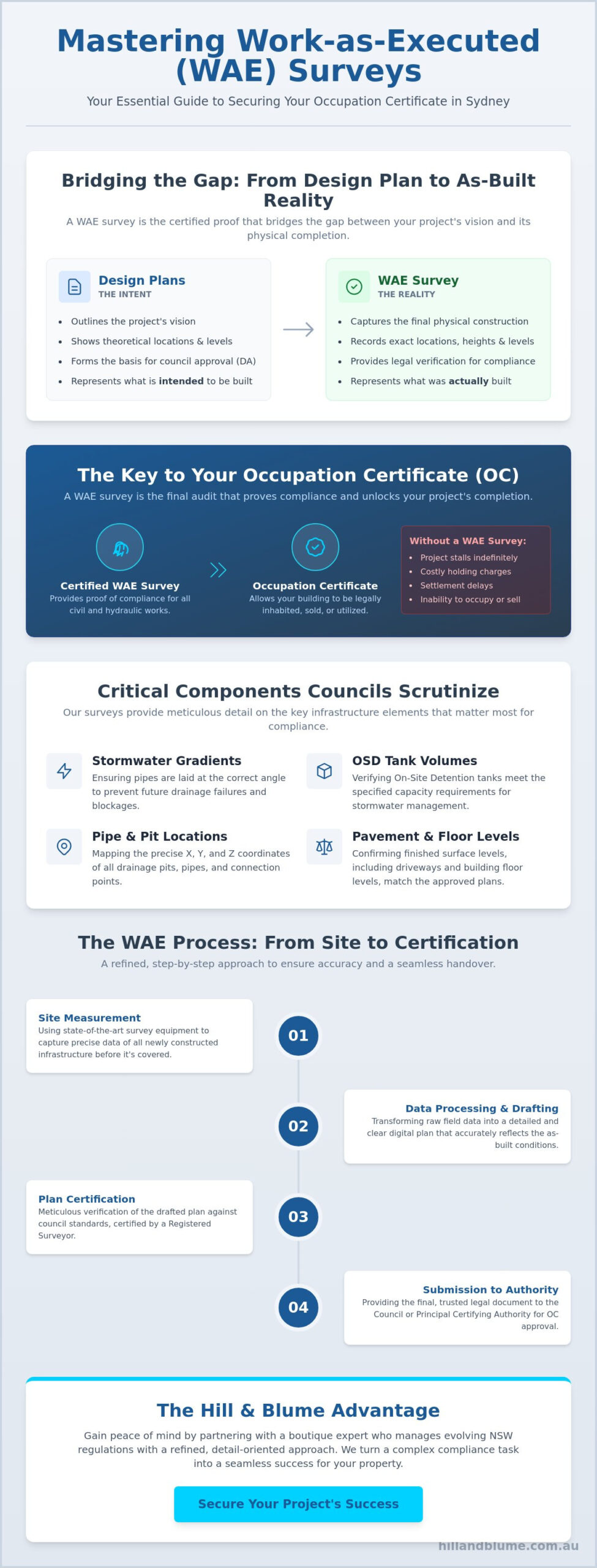
At its heart, a Work-as-Executed survey is the definitive certified plan that marks the completion of your construction journey. While your initial plans outlined a vision, the WAE captures the physical reality of what has been built on the ground. It provides a meticulous record of the exact locations, heights, and levels of all infrastructure, ensuring that every pipe, pit, and pavement matches the promised design. This document, often referred to as an As-built survey, is more than just a map; it’s a testament to the integrity of your development.
The primary purpose of these surveys is to provide peace of mind to both the developer and the governing bodies. By verifying that the construction aligns with the approved Development Application (DA) plans, you eliminate the risk of future legal or structural complications. A WAE survey serves as the formal legal verification that your project’s physical construction adheres strictly to the as-built compliance standards required by New South Wales authorities.
The Legal Significance in New South Wales
In the complex regulatory environment of Sydney, work-as-executed surveys are a non-negotiable requirement for obtaining your Occupation Certificate. Your Principal Certifying Authority (PCA) relies on these documents to ensure that the finished work won’t cause issues for the community or the environment. Without this certification, your building remains a construction site in the eyes of the law, unable to be inhabited or sold. These reports act as a vital safeguard, protecting future owners and local councils from the hidden costs of infrastructure failure by confirming that everything from drainage to floor levels was executed with precision.
WAE vs. Design Plans: Understanding the Difference
It’s helpful to think of design plans as the “intent” of a project, while WAE plans represent the “physical reality.” In a perfect world, these would be identical. However, the nature of construction means that slight deviations often occur. For Sydney’s engineering departments, “near enough” is never an acceptable standard. Small discrepancies in stormwater gradients can lead to significant drainage issues years down the line. Capturing these details, especially for underground services before they are covered by concrete or soil, is essential. Our bespoke approach ensures that these subtle differences are documented with absolute clarity, providing a seamless transition from the building phase to the final handover.
Why WAE Surveys are Essential for Your Occupation Certificate
The Occupation Certificate (OC) represents the final threshold of your development journey. It’s the “green light” that transforms a construction site into a home or a functional commercial space. Without this document, your investment sits idle, unable to be inhabited or utilized. At this high-stakes juncture, work-as-executed surveys act as the final audit of your civil and hydraulic works, proving that the physical reality of the build meets the high standards set by NSW authorities. We understand that you’ve invested significant time into your project, and we’re here to ensure it doesn’t stall at the finish line.
Without a certified WAE, your project can linger indefinitely in a state of regulatory limbo. This is where precision becomes your greatest asset. By delivering a clear, compliant plan, we help you avoid the common pitfalls that lead to rejected applications. Our goal is to make this transition feel effortless, preventing the costly holding charges and settlement delays that can erode your project’s success. It’s about more than just paperwork; it’s about securing the future of your development with confidence and grace.
Mitigating Risk and Ensuring Integrity
Identifying construction deviations before the final handover isn’t just about compliance; it’s about safeguarding your reputation. In the 2026 Sydney property market, where dwelling approvals have seen recent fluctuations, any delay in settlement can have a ripple effect on your finances. A meticulous WAE process catches errors early, such as a pipe laid at an incorrect gradient or a pit positioned slightly off-center. Addressing these details now prevents future maintenance headaches for homeowners who might otherwise face drainage failures. Accurate as-built data provides a clear record for the life of the building, ensuring long-term structural integrity and peace of mind for everyone involved.
Meeting Council and Sydney Water Standards
Navigating the specific requirements for Sydney Water assets requires a nuanced understanding of local infrastructure. Since October 2025, Sydney Water has mandated that plans be submitted electronically in georeferenced AutoCAD formats, a level of technical detail that demands professional expertise. Councils across Sydney utilize this data to update their Geographic Information Systems (GIS), ensuring the city’s digital records reflect the true state of underground services. Organizations like the Association of Public Authority Surveyors, NSW (APAS) advocate for the high standards required in these public-facing documents. Whether you’re working within the City of Sydney or a suburban municipality, we guide you through the intricate checklists unique to each region. If you’re ready to ensure your project meets these rigorous standards, you might consider connecting with our team to discuss your specific site requirements.
Critical Components of a WAE Survey: Stormwater and Civil Works
Excellence in property development is often measured by what remains unseen. While a building’s facade captures the eye, the long-term integrity of your project rests on the precision of the infrastructure hidden beneath the surface. For Sydney developers, work-as-executed surveys are the definitive record of this vital work. They provide a meticulous account of the stormwater drainage systems, capturing everything from pipe diameters and gradients to the exact invert levels where water enters and exits the system. These details ensure that the physical reality of your site matches the hydraulic intent of the original design.
Beyond the pipes, a comprehensive survey documents the essential civil elements that define the property’s relationship with its environment. This includes:
- Finished Floor Levels (FFL): Verifying these against flood planning levels to ensure the safety of future occupants.
- Retaining Walls: Confirming their height, location, and structural alignment with the approved plans.
- Driveway Gradients: Ensuring safe vehicle access and compliance with Australian Standards for steepness and transition.
- External Pavement: Recording levels to confirm that surface water flows correctly away from the building.
The Complexity of OSD Systems
On-site Detention (OSD) tanks are frequently the most scrutinized element of any Sydney WAE. Because these systems manage the flow of water into the city’s broader infrastructure, councils are incredibly meticulous about their certification. We verify the “As-Built” volume of your tank against the hydraulic engineer’s original calculations to ensure it can handle a major storm event. The orifice plate, a small but critical component that controls the discharge rate, must be measured with absolute precision. Even a discrepancy of a few millimeters can disrupt the calculated flow, potentially leading to a rejected survey and a delayed Occupation Certificate.
Civil Infrastructure and Public Domain Works
Your project’s impact extends beyond your boundary lines. Works within the council road reserve, such as new kerbs, gutters, and footpaths, must be surveyed to ensure they integrate seamlessly with existing public infrastructure. This process ensures public safety and maintains proper drainage flow-on effects for the entire street. This final verification follows the construction set-out phase, where we first established the physical boundaries of your vision. By documenting these public domain works with a bespoke, detail-oriented approach, we provide the council with the assurance they need to welcome your development into the local community fabric.
The WAE Process: From Site Measurement to Final Certification
Bringing a project to fruition requires a transition from the abstract world of design to the tangible reality of built form. For work-as-executed surveys, this journey begins with a meticulous review of your approved Development Application (DA) and hydraulic designs. We immerse ourselves in your project’s history, ensuring our team understands every nuance of the engineering intent before we even step onto the site. This initial engagement is where our partnership begins, setting a clear foundation for a successful certification.
Once the groundwork is laid, a Registered Surveyor conducts the essential fieldwork. This involves capturing precise measurements of the completed infrastructure. We then move into the data analysis phase, where your field data is layered against the original CAD design files. Our drafting team creates a detailed WAE plan that highlights any deviations for engineering review. This transparency ensures that when we finally sign off on the plan for submission to your Principal Certifying Authority (PCA) or Council, it carries the Hill & Blume seal of integrity.
Handling Deviations: What Happens When Things Don’t Match?
In construction, perfection is an aspiration, but reality often includes minor variations. We distinguish between minor “tolerances” that fall within acceptable limits and major structural deviations that require further action. When a discrepancy arises, we facilitate a collaborative conversation between the builder and the hydraulic engineer. If a deviation is significant, a “Section 4.55” modification may be necessary to update the original approval. Our role is to guide you through these complexities, ensuring that every adjustment is handled with professional care and technical precision.
Technology in Modern WAE Surveys
We believe that high-end service should be supported by the finest tools available. Our surveyors utilize Total Stations and GPS technology to achieve millimetre-perfect accuracy, providing the level of detail that modern Sydney developments demand. This digital data exchange doesn’t just improve accuracy; it significantly speeds up the certifier’s review process, moving you closer to your move-in date. This technical rigour is a core component of a broader building survey, which ensures your entire project remains compliant from the foundation to the final roofline.
If you’re ready to secure your property’s future with a bespoke approach to compliance, we invite you to reach out to our Sydney team for a tailored consultation.
The Hill & Blume Advantage: Precision with a Bespoke Touch
Choosing a surveying partner is about more than technical skill; it’s about trust and the assurance of a seamless result. At Hill & Blume, we offer more than just data. We provide a curated experience defined by over 90 years of local expertise. Our boutique approach ensures that you aren’t just another file in a high-volume system. Instead, you gain direct access to Registered Surveyors who understand the delicate nuances of NSW property law and the specific expectations of Sydney councils.
Completing work-as-executed surveys is often the final hurdle in a long and demanding construction process. We strive to make this path as smooth and sophisticated as the build itself. By fostering a partnership-oriented narrative, we ensure that every civil detail is captured with the integrity your investment demands. This calm confidence reassures you that your path to an Occupation Certificate is being managed by experts who value quality over quantity.
A Legacy of Trust in the Sydney Region
Our long-standing presence acts as a seal of quality that certifiers and councils recognize instantly. From the vibrant streets of Sydney to the growing communities from Newcastle to the Central Coast, we’ve built deep relationships based on consistent precision. This legacy allows us to provide a bespoke approach for complex developments where a standard checklist simply isn’t enough. We understand that your project represents a significant vision, and we treat it with the discerning care it deserves, ensuring every detail aligns with local expectations.
Your Next Steps Toward Completion
Early engagement is your most significant strategic advantage. Integrating survey requirements into your construction schedule well before the final brick is laid prevents the frantic rush that often leads to delays. When you involve us early, we can ensure that every measurement is taken at the optimal moment, especially for underground services that are soon to be concealed. It’s about creating a seamless flow from construction to habitation, allowing you to focus on the lifestyle your new development provides.
If you’re ready to experience a more refined path to project completion, we’re here to help. You can enquire about a bespoke WAE survey for your project and discover the difference that nearly a century of dedicated craftsmanship makes to your peace of mind.
Securing the Future of Your Sydney Development
Your property is more than just a structure; it’s a vision brought to life through meticulous planning and hard work. Navigating the final stages of construction requires a steady hand and a commitment to detail that reflects the quality of your build. By documenting every civil and hydraulic detail with absolute precision, work-as-executed surveys provide the legal certainty you need to transition from a project site to a finished home or commercial space.
At Hill & Blume, we bring over 90 years of Sydney surveying expertise to every partnership. Our Registered NSW Surveyors offer a bespoke approach that balances technical rigour with a refined aesthetic, catering specifically to high-end residential and commercial projects. We don’t just provide data; we offer the peace of mind that comes from working with trusted local experts who value your vision. Secure your Occupation Certificate with a bespoke WAE survey from Hill & Blume. We look forward to helping you cross the finish line with confidence and elegance.
Frequently Asked Questions
How long does a Work-as-Executed survey take to complete?
A standard survey typically requires five to ten business days from the initial site visit to the final certified delivery. While the physical measurement often takes just one day, our team spends significant time in the drafting room comparing field data against your original hydraulic designs. This curated analysis ensures that every detail meets the rigorous standards required for your Occupation Certificate.
Do I need a WAE survey for a small renovation or granny flat?
You’ll likely need one if your development consent includes specific conditions regarding stormwater management or civil works. Local councils often require work-as-executed surveys for granny flats to ensure that new drainage systems don’t negatively impact the existing neighborhood infrastructure. It’s always best to review your DA conditions early to avoid any last-minute surprises during your final inspection.
What happens if the WAE shows the stormwater system is not compliant?
Non-compliance usually requires either physical rectification of the works or a formal Section 4.55 modification through your council. If our survey identifies a significant deviation, we’ll work closely with your hydraulic engineer to determine the most seamless path forward. Resolving these discrepancies early is essential for maintaining the integrity of your project and securing your final sign-off without unnecessary stress.
Is a WAE survey the same as an Identification Survey?
No, these surveys serve two distinct purposes in the lifecycle of your property development. An Identification Survey focuses on the relationship between your building and the property boundaries, while work-as-executed surveys provide a detailed record of the infrastructure actually built. Think of the former as a boundary check and the latter as a final audit of your site’s civil and hydraulic performance.
Who is responsible for organizing the WAE survey; the builder or the owner?
The property owner is ultimately responsible for ensuring all DA conditions are met, though the builder often manages the scheduling of the fieldwork. We recommend a collaborative approach where both parties stay informed to ensure the site is ready for measurement. Engaging a surveyor directly ensures you have a dedicated partner who prioritizes your long-term interests and the legal standing of your asset.
Can a WAE survey be used to resolve a boundary dispute?
A WAE survey is not the appropriate tool for resolving boundary disagreements. While it records the location of built elements, it doesn’t provide the legal boundary definitions found in a formal Boundary Survey or Identification Survey. If you’re facing a dispute with a neighbor, we suggest a bespoke boundary assessment to provide the clarity and legal weight required for a resolution.
How much does a WAE survey cost in Sydney in 2026?
For a standard residential project in Sydney, you can generally expect to invest between $1,800 and $2,600 plus GST for a professional WAE survey. These costs vary based on the complexity of the site and the specific requirements of your local council or Sydney Water. Investing in a high-quality survey ensures that your path to completion is handled with the precision and care your development deserves.
What documents do I need to provide to my surveyor for a WAE report?
We require your approved Development Application plans and the final hydraulic or stormwater design files, ideally in a digital CAD format. Providing these documents allows us to perform a detailed analysis of your project, comparing the original intent with the physical reality. Having this information ready from the start helps us provide a more efficient and seamless service as you approach your project’s completion.
Disclaimer
The information provided in articles published on this website is for general informational purposes only. While we make every effort to ensure the accuracy, completeness, and timeliness of the content, the material is based on our understanding of the industry at the time of writing and may not reflect the most current developments, regulations, or standards. All opinions expressed in our articles are those of the respective authors and do not necessarily represent the official position of the website or its affiliates. The content should not be considered professional, legal or technical advice, and should not be relied upon as a substitute for consultation with qualified professionals