A single centimetre of misplaced concrete can transform your vision for a secondary dwelling into a complex legal and financial burden. When you’re looking to enhance your property’s legacy, the margin for error is non-existent. You’ve likely spent months dreaming of the perfect layout, yet the fear of council rejection or the anxiety of a boundary dispute can make the process feel overwhelming. Securing a precise land survey for granny flat sydney projects is the foundational step that balances your aspirations with the strict requirements of the 2021 Housing SEPP.
We understand that your home is your most significant asset, and moving forward with absolute confidence requires more than just a plan; it requires certainty. This guide will show you how professional surveying secures your investment, ensures seamless NSW regulatory compliance, and eliminates the hidden costs that often haunt unfinished projects. We’ll walk through the essential roadmap from Detail Surveys to final certification, ensuring you achieve maximum land utilisation while keeping your property boundaries legally protected and your approval process entirely stress-free.
Key Takeaways
- Understand why a precision land survey for granny flat sydney projects is your most critical safeguard against unforeseen excavation costs and complex drainage issues.
- Learn how identifying property easements early can unlock the fast-tracked Complying Development Certificate pathway, potentially securing your approval in as little as 20 days.
- Discover how a Detail and Level Survey serves as the master blueprint for your design, allowing you to maximize your land’s utility with absolute confidence.
- Secure your property’s legacy with a Boundary Survey and Construction Set-out that define the exact legal limits of your investment and prevent future disputes.
Navigating the Sydney Granny Flat Landscape in 2026
Sydney’s property market has evolved into a space where every square metre carries significant weight. A secondary dwelling, often referred to as a What is a Granny Flat, is no longer just a backyard addition; it’s a strategic asset that provides multi-generational living or a robust rental yield. In high-density suburbs from Paddington to Parramatta, the margin for error is razor-thin. You aren’t just building a structure; you’re curating a lifestyle within a defined boundary. Adopting a survey-first approach ensures your project begins with clarity rather than guesswork, preventing the costly stalls that occur when designs clash with reality.
Understanding the Affordable Housing SEPP
The State Environmental Planning Policy (Housing) 2021 remains the primary framework for these developments. Under this policy, your lot must typically meet a 450-square-metre minimum to qualify for fast-tracked approval. Dimensions matter just as much as area. A Registered Surveyor plays a pivotal role here, verifying that your land’s specific geometry aligns with state mandates before you commit to a design. Without this verification, you risk investing in plans that the law simply won’t allow. It’s about ensuring your land’s potential is fully realised while staying firmly within legal bounds.
Local Council vs. State Requirements
While state rules provide a baseline, local nuances in areas like the Northern Beaches or the North Shore can introduce unexpected layers of complexity. These councils often manage sensitive heritage conservation areas or stringent bushfire zones that require a more tailored approach. A standard design might look beautiful on paper, but it will fail if it doesn’t account for the unique topographical data of your specific site. Securing a professional land survey for granny flat sydney projects allows you to identify these constraints early. Whether it’s a hidden easement or a protected tree canopy, knowing these details prevents your application from being rejected by council.
Precision isn’t just a technical requirement; it’s the peace of mind that comes from knowing your investment is built on a foundation of absolute accuracy. You can explore our full range of surveying services to see how we help homeowners navigate these local intricacies. We believe that a successful build starts with a deep understanding of the land itself. By identifying property limits and contours before the first brick is laid, you protect your relationship with your neighbours and your financial future.
The Detail and Level Survey: The Foundation of Your Design
Before an architect draws a single line, they need a canvas that reflects reality. A Detail and Level Survey, often called a topographic survey, provides exactly that. It’s the essential blueprint that dictates where your structure can breathe and where it must yield. For a professional land survey for granny flat sydney builds, this data is non-negotiable. It captures every rise and fall of your terrain, ensuring that your future dwelling doesn’t just sit on the land but belongs there. This initial investment creates a seamless bridge between your vision and the physical constraints of your backyard.
Precise contour data is your first line of defence against excavation disasters. In Sydney, where sandstone and varying slopes are common, knowing your levels prevents drainage nightmares that could compromise your main home’s foundation. We also meticulously map significant trees. Since NSW regulations typically require a 3-metre clearance from any tree over 6 metres tall, missing a single trunk on your plan can stall your project for months. Following the professional standards of the Association of Consulting Surveyors NSW, this survey ensures every natural feature is accounted for before construction begins.
Why an Old Site Plan is Not Enough
Relying on a decades-old site plan is a gamble with your budget. Properties change; fences shift, and soil settles over time. Minor inaccuracies in legacy data often lead to major construction variations that blow out your timeline and your bank account. Only a fresh, precision-led survey ensures your project meets the specific 2026 compliance requirements for modern Sydney developments. It’s the difference between a project that flows effortlessly and one that is plagued by site-related surprises.
Mapping Adjoining Properties for Privacy
Your neighbours value their sanctuary as much as you do. By mapping adjoining properties, we identify their window placements, floor levels, and ridge heights. This allows your designer to place windows and balconies where they won’t intrude on a neighbour’s morning coffee or overshadow their garden. It’s a form of neighbourly diplomacy; showing your neighbours that you’ve considered their privacy often smooths the path for your project. This level of care transforms a standard build into a curated experience that respects the local community fabric.
If you’re ready to lay a flawless foundation for your project, you can reach out to our team to discuss your site’s unique needs. You might also want to explore our specific Detail and Level Survey solutions to see how we capture the nuances of your property with sophisticated accuracy.
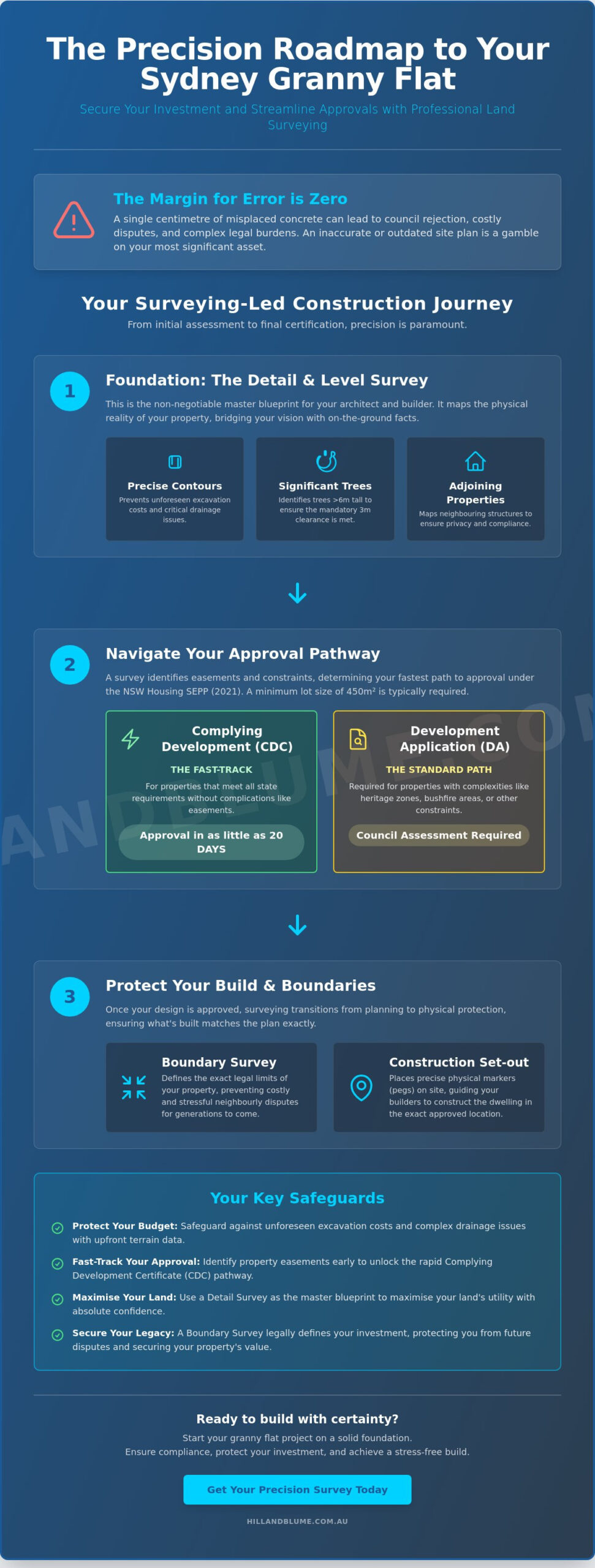
Complying Development (CDC) vs. DA: Mapping Your Path
Choosing the right approval pathway is the most consequential decision you’ll make for your secondary dwelling. For many Sydney homeowners, the Complying Development Certificate (CDC) offers a fast-track route that can see projects approved in as little as 20 days. This pathway bypasses the traditional council assessment, provided your project meets every strict standard set by the state. However, the simplicity of a CDC is only possible when your land survey for granny flat sydney is flawlessly accurate. We act as your guide through this regulatory maze, ensuring you don’t waste time on a path that your land won’t legally support.
A Private Certifier cannot issue a CDC without an Identification Survey that confirms your property’s legal standing. This survey identifies easements, such as underground sewer lines or drainage rights, which often dictate where you can and cannot build. If a proposed structure overlaps an easement, the CDC path is immediately blocked. Our role is to uncover these invisible boundaries early, giving you the clarity needed to adjust your design before it becomes an expensive problem. It is this level of foresight that distinguishes a curated project from a stressful one.
The CDC Fast-Track Requirements
To qualify for Complying Development, your property must generally meet a minimum lot size of 450 square metres and a frontage of at least 12 metres. Setbacks are equally rigid; you’ll typically need to maintain a 3-metre gap from the rear boundary and 0.9 metres from the sides. We provide the precise data required for your Section 10.7 Certificate, which outlines the specific planning rules affecting your land. You can explore our full range of Hill & Blume services to see how we provide the technical foundation for these fast-tracked approvals.
When a DA is the Only Option
Not every site fits the CDC mould. If your land features a steep slope, an unusual shape, or sits within a heritage conservation area, a traditional Development Application (DA) becomes necessary. While this process involves a more detailed assessment by your local council, a comprehensive survey remains your strongest asset. We provide the detailed contour and boundary data that supports your Statement of Environmental Effects, proving to council planners that your design is respectful of the landscape. Council planners often place higher trust in reports from established firms, as our 90-year history in the Sydney region serves as a seal of quality for your application. Whether your path is fast-tracked or more considered, we ensure it’s built on a foundation of traditional integrity.
The Construction Roadmap: From Pegs to Protection
Transitioning from a digital blueprint to a physical structure is a moment of profound transformation for your property. This phase requires a shift from conceptual planning to absolute physical precision. A professional land survey for granny flat sydney builds provides a sequence of checks that guide your project through the complexities of the Sydney landscape. It’s about certainty. From the initial placement of physical markers to the final verification of your completed dwelling, each step serves as a layer of legal and structural protection for your home.
The roadmap begins with a Boundary Survey to re-establish the legal limits of your land. This ensures that every subsequent action stays firmly within your ownership. Once boundaries are confirmed, we move into the Construction Set-out, where the building’s footprint is precisely marked on the ground. As the build nears completion, a final Identification Survey verifies that the structure aligns perfectly with the approved plans. For projects involving new plumbing or drainage, a Work-as-Executed (WAE) survey is often required by Sydney Water or local councils to confirm that the infrastructure has been installed according to the design standards.
The Critical Nature of the Construction Set-out
Many homeowners assume a builder can simply measure off an existing fence line. This is a high-risk strategy. Fences are rarely perfectly aligned with legal boundaries; relying on them can lead to the nightmare scenario of building over an easement or onto a neighbour’s property. Our Construction Set-out in Sydney ensures your builder has exact points to follow, eliminating guesswork and preventing costly structural corrections. It’s the only way to guarantee your granny flat is positioned exactly where the law allows.
Securing Your Occupation Certificate (OC)
The final hurdle in your journey is the Occupation Certificate. A Private Certifier will not grant this certificate without a final survey report that confirms the building’s height and position match the approved CDC or DA. This document is more than just a regulatory requirement; it’s a vital part of your property’s title. If you ever decide to sell your home, having a verified survey on file protects you from future disputes and proves the legality of your secondary dwelling to potential buyers. It’s a final seal of quality that preserves your investment’s value for decades to come.
Every project deserves a custom roadmap designed for its specific terrain and goals. We invite you to contact our specialist team to discuss how we can secure your construction process with precision and care.
The Hill & Blume Advantage: 90 Years of Sydney Expertise
Choosing a partner for your land survey for granny flat sydney build is about more than just technical data; it’s about choosing a legacy of trust. We operate as a boutique entity that prioritises the depth of our relationships over high-volume turnover. This approach ensures that your residential project receives the discerning, detail-oriented attention it deserves. Whether your property is nestled in the leafy North Shore, overlooking the Northern Beaches, or situated in the growing regions of Newcastle and the Central Coast, our local knowledge is woven into the very fabric of the communities we serve. We offer a curated experience that balances high-end elegance with a deeply personal touch.
Our passion for the regional lifestyle drives us to provide a service that feels both premium and inclusive. We don’t just provide markers on a map; we offer a partnership-oriented narrative that guides you through the complexities of property development. By choosing a specialist authority, you’re engaging with experts who value craftsmanship and care. This calm confidence allows you to focus on the joy of creating a new space, while we handle the intricate legalities of your property boundaries with traditional integrity.
A Legacy of Precision Since 1932
Since our inception in 1932, we’ve navigated the evolving landscape of New South Wales with a steady, deliberate hand. Decades of experience translate into faster, more accurate results because we understand the historical nuances of Sydney’s land titles better than anyone else. This long-standing presence has allowed us to establish profound trust with local councils, architects, and developers alike. When you work with us, you’re benefiting from a 90-year history of excellence. It’s essential to understand What is a Registered Surveyor in NSW? and why their legal authority is the only way to ensure absolute boundary certainty for your investment.
Your Next Steps to a Successful Granny Flat
The most seamless builds begin with early engagement. Consulting a surveyor during the initial design phase allows you to identify opportunities for maximum land utilisation before your plans are finalised. We invite you to experience a polished surveying partnership that respects your time and your intelligence. Every site is unique, which is why we provide tailored fee proposals that reflect the specific requirements of your land and your vision. When you’re ready to move forward with a sense of effortless certainty, we encourage you to Speak with a Registered Surveyor at Hill & Blume. Let’s ensure your secondary dwelling is built on a foundation of precision and local expertise.
Building Your Legacy on a Foundation of Certainty
Your vision for a secondary dwelling is a significant investment in your property’s enduring value and your family’s future lifestyle. By prioritising a professional land survey for granny flat sydney projects early in the process, you replace uncertainty with absolute clarity. We’ve explored how a precision Detail and Level survey serves as your architect’s essential blueprint, while our expertise in navigating CDC and DA requirements ensures your project remains on the fastest path to completion. Precision isn’t just a technical detail; it’s the silent safeguard of your property’s legal integrity.
With over 90 years of Sydney surveying expertise, our Registered Surveyors bring a boutique, hand-crafted approach to every residential project. We specialise in the Detail and Level surveys required for DA and CDC approvals, providing you with the calm confidence to build without compromise. Every great home begins with a deep understanding of the ground it stands upon. We invite you to begin your granny flat journey with a precision survey from Hill & Blume today. Let’s work together to create a space that’s as legally secure as it is beautifully designed.
Frequently Asked Questions
Do I really need a land survey for a granny flat in Sydney?
Yes, a professional survey is a mandatory requirement for both Complying Development Certificate (CDC) and Development Application (DA) pathways in New South Wales. A registered surveyor must provide accurate site data to ensure your project complies with strict setbacks and lot size requirements under the Housing SEPP 2021. Without this foundation, your certifier cannot legally approve your project, and you risk significant delays before construction even begins.
How much does a granny flat survey cost in NSW for 2026?
The investment for a survey varies based on the complexity of your site, its overall size, and the specific requirements of your local council or private certifier. Factors such as steep terrain, heavy vegetation, or complex historical easements will influence the final fee. We recommend requesting a tailored proposal to receive an accurate reflection of the costs associated with your specific property’s unique characteristics.
Can I use my existing house survey for a new granny flat?
It’s rarely advisable to rely on an old survey because site conditions and regulatory standards evolve over time. Most certifiers require a fresh Detail and Level Survey that reflects current ground levels, existing structures, and significant trees as they stand today. Using outdated data increases the risk of design errors and project variations, which often cost far more than a new, precision-led survey.
How long does a land survey take to complete in Sydney?
The physical site visit typically takes between a few hours and a full day, while the processing and drafting of your plans usually take one to two weeks. This timeline depends on the complexity of your site’s topography and the availability of historical title data from the land registry. Engaging your surveyor at the very start of your journey ensures these essential documents are ready when your designer begins their work.
What is the difference between a detail survey and a boundary survey?
A Detail Survey focuses on the physical features of your land, such as contours, trees, and existing buildings, to provide a blueprint for your architect. A Boundary Survey is a legal process that identifies the precise location of your property lines based on official title records. Both are vital components of a land survey for granny flat sydney projects to ensure your build is both aesthetically integrated and legally compliant.
What happens if my granny flat is built over the boundary?
Building over a boundary or easement is a significant legal issue that can lead to court-ordered demolition or expensive compensation claims from neighbours. This nightmare scenario is exactly why a Construction Set-out is so critical; it marks the exact footprint on the ground based on legal boundary data. Correcting these errors after the concrete is poured is often a complex and financially draining process that professional surveying prevents.
Do I need a survey for a “kit home” or prefabricated granny flat?
Yes, even prefabricated structures must comply with the same setback and height regulations as traditional custom builds. A survey ensures your site is properly prepared and that the kit home is positioned exactly where the approved plans dictate. Whether the home arrives in modules or as a flat-pack, its final placement on your land remains a matter of legal precision that requires professional verification.
Will a surveyor identify underground pipes and easements?
A registered surveyor will identify and map all registered easements, such as those for drainage or electricity, that appear on your property title. While we map visible evidence of services, we also utilise Dial Before You Dig data to indicate the approximate location of underground infrastructure. This foresight prevents you from accidentally designing a structure over a critical Sydney Water sewer main or other restricted zones that would block your approval.
Disclaimer
The information provided in articles published on this website is for general informational purposes only. While we make every effort to ensure the accuracy, completeness, and timeliness of the content, the material is based on our understanding of the industry at the time of writing and may not reflect the most current developments, regulations, or standards. All opinions expressed in our articles are those of the respective authors and do not necessarily represent the official position of the website or its affiliates. The content should not be considered professional, legal or technical advice, and should not be relied upon as a substitute for consultation with qualified professionals