
Imagine standing on your veranda, admiring the garden you’ve nurtured, only to discover that your boundary fence actually sits thirty centimeters inside your neighbor’s legal title. It is an unsettling realization that often surfaces at the most inconvenient moments, such as during a property settlement or a complex council DA application. When you are caught between technical jargon and the pressure of a looming deadline, understanding the distinction between an identification survey vs boundary survey nsw becomes more than just an administrative task; it is about protecting your peace of mind and your financial legacy.
We understand that the technicalities of land law can feel opaque, especially with the Surveying and Spatial Information Regulation 2024 now dictating stricter accuracy standards. You want to ensure your project is compliant and your investment is secure without the lingering fear of boundary disputes or bank loan rejection. This guide clarifies the specific purposes of each survey type, highlighting how the July 2026 digital mandate for NSW LRS Connect affects your property documentation. You will gain a clear path forward, knowing exactly which professional service aligns with your goals so you can proceed with the calm confidence your home deserves.
Key Takeaways
- Understand why choosing an identification survey vs boundary survey nsw is the first step in securing your property’s legal standing and physical integrity.
- Learn how an Identification Survey serves as a vital safeguard during property settlement by verifying that structures and easements align with the legal title.
- Discover when a physical Boundary Survey is non-negotiable for re-establishing land markers to prevent costly disputes during fencing or construction.
- Ensure your project remains compliant with the 2024 NSW Surveying Regulations and the mandatory 2026 digital lodgment requirements for council approval.
- Leverage over 90 years of local expertise to navigate complex NSW land laws with the precision and care that a boutique firm provides.
Navigating NSW Property Requirements: The Boundary vs Identification Dilemma
When you embark on a property journey, whether in New South Wales or exploring rural acreage and hunting properties with Coulee Land Company, the terminology can quickly become overwhelming. You might hear your solicitor mention an “Ident” while your architect insists on a boundary re-establishment. This common confusion often leads to unnecessary delays in property settlements or council approvals. Understanding the nuances of an identification survey vs boundary survey nsw is essential for any homeowner who values the security of their investment and the integrity of their land.
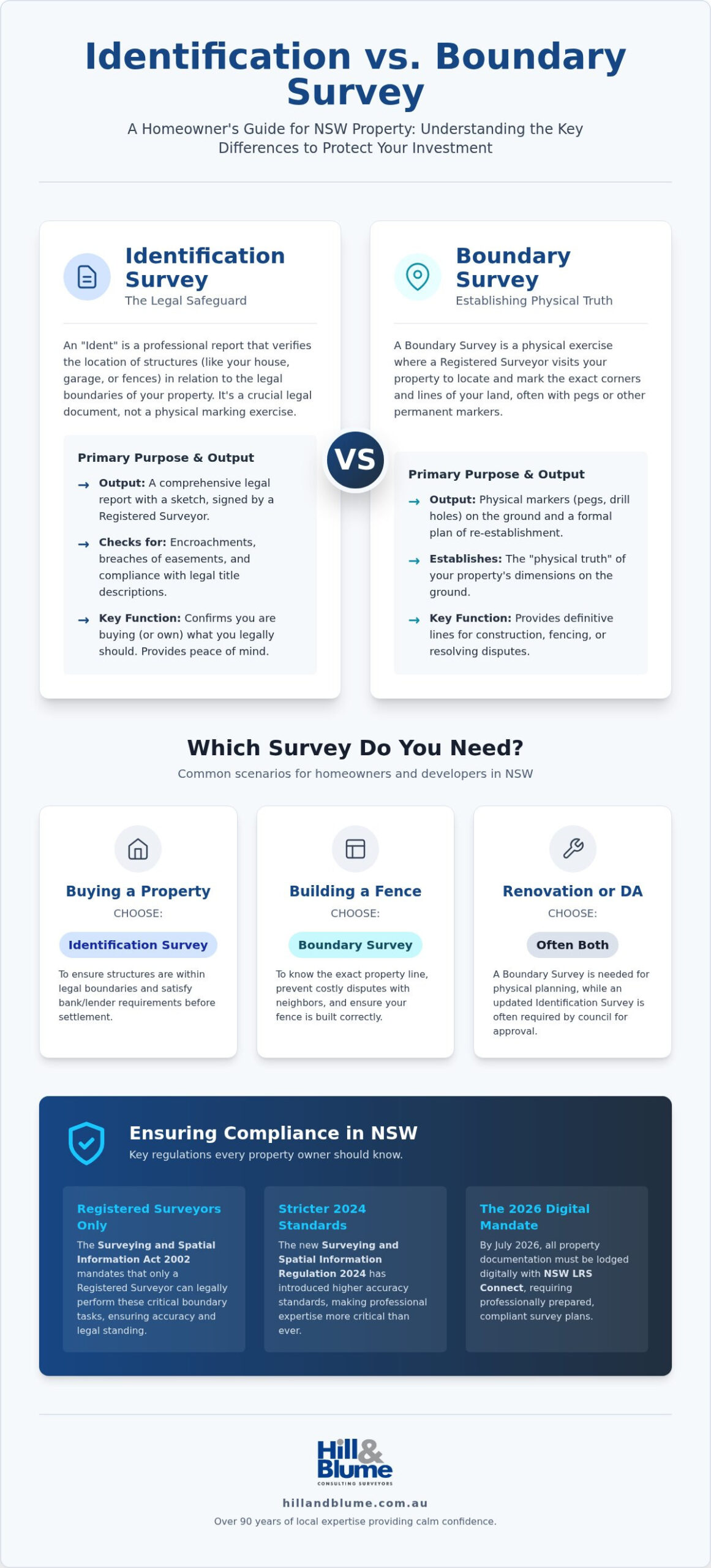
An Identification Survey is essentially a professional report. It verifies the location of structures, such as your home, garage, or fences, in relation to the legal boundaries of the land. In contrast, a Boundary Survey is a physical exercise. It involves a surveyor visiting your site to physically mark the land limits, often using pegs or drill holes. Both serve the official register of property, yet they fulfill different legal and practical needs. Whether you are buying a terrace in Paddington or planning a renovation in the Central Coast, knowing which tool to use is the first step toward a seamless project.
The Core Difference: Reports vs. Pegs
The primary distinction lies in the final output and the physical presence on your site. An Identification Survey results in a comprehensive legal document, usually required by banks or solicitors. This report confirms whether buildings encroach on neighboring land or if there are breaches of easements. You won’t always see new physical markers on your lawn after an Ident. A Boundary Survey, however, is all about those physical markers. It is the process of “pegging” the site so you know exactly where your land ends and the next begins. At Hill & Blume, we utilize our 90-year archive of survey records to navigate the intricate, often centuries-old titles found in Sydney’s historic suburbs. This deep historical context allows us to resolve discrepancies that newer, less experienced firms might overlook.
Why NSW Legislation Requires Registered Surveyors
In New South Wales, the Surveying and Spatial Information Act 2002 governs the profession to maintain the highest standards of accuracy. This legislation ensures that only a Registered Surveyor can perform these critical tasks. This isn’t just a matter of professional preference; it’s a legal safeguard. A signature from a Registered Surveyor carries the weight of law, providing the “calm confidence” you need when dealing with financial institutions or local councils. If you’re curious about the specific qualifications required, you can learn more about what is a Registered Surveyor in NSW? and why their expertise is non-negotiable for your property project.
The Identification Survey: A Legal Safeguard for NSW Property Buyers
Buying a property in New South Wales is rarely just about the architecture or the coastal view; it’s about the security of the land beneath it. When you enter into a contract of sale, you’re essentially inheriting the legal history of that site. This is where an Identification Survey, often called an “Ident,” becomes your most valuable asset. Unlike a physical pegging of the land, this survey provides a detailed report that cross-references the physical improvements on the site with the legal description on the title. It’s the professional narrative that confirms you’re actually buying what you think you’re buying.
Financial institutions in Sydney frequently demand these reports before they’ll finalize a mortgage. Banks are inherently risk-averse; they don’t want to find themselves tied to a property that has significant legal flaws. If you are currently arranging finance and need expert guidance on lender expectations, you can find out more about how The Home Loan Partners provide professional mortgage broking services. By understanding the identification survey vs boundary survey nsw distinction, you can ensure that your lender has the necessary certification to proceed. A standard Ident report from our team meticulously documents the location of fences, retaining walls, and the main dwelling, ensuring every structure respects the legal limits of the parcel.
Identifying Encroachments in Established Sydney Suburbs
In older, high-density areas like Crows Nest or the Northern Beaches, property lines are often tight and historical records can be complex. It isn’t uncommon to find that a neighbor’s garage or a decades-old stone wall has crept over the line. An encroachment is a structure crossing a legal boundary line. While ten centimeters might seem trivial in a backyard garden, it can be enough to halt a multi-million dollar settlement or trigger an expensive legal dispute. Our reports identify these issues early, giving you the leverage to negotiate or seek rectification before you’re legally committed to the purchase.
Easements and Covenants: The Hidden Constraints
Beyond the visible structures, your land may be subject to “hidden” constraints that only a professional survey can reveal. These might include drainage easements, rights of way, or restrictive covenants that dictate how you can use the property. If you’re planning a future extension or a poolside cabana, knowing these constraints is vital. You don’t want to design your dream renovation only to discover a council sewer line runs exactly where your foundations need to be. We invite you to explore the range of Hill & Blume Services to see how our identification reports provide the clarity you need. If you’re currently in the middle of a property search, you might find it helpful to speak with our team to ensure your next investment is fully protected.
The Boundary Survey: Establishing the Physical Truth of Your Land
If an Identification Survey is the legal narrative of your property, then a Boundary Survey is its physical foundation. While the former resides primarily in reports and certificates for the benefit of solicitors and lenders, the latter lives in the soil, marked by the precise placement of pegs, drill holes, or notches. For homeowners and developers, this physical redefinition is non-negotiable when the stakes involve permanent structures or boundary-line disputes. It’s the process of translating historical title dimensions into real-world coordinates, ensuring that every centimeter of your project sits exactly where it belongs.
Markers often vanish over decades due to erosion, landscaping, or previous construction. When these original pegs are missing, a Registered Surveyor must perform a redefinition. This involves a meticulous search of the surrounding area to find surviving survey marks, which are then used to mathematically re-establish your boundaries. This is where the distinction of an identification survey vs boundary survey nsw becomes clear; you aren’t just looking for a report to satisfy a bank, you’re looking for the physical truth of your land’s limits before you commit to a new fence or a significant extension.
When to Request a Peg-Out Survey
A peg-out is the essential first step for any physical works. Builders rarely move a shovel until they have a professional set-out to guide them. Whether you’re pouring a concrete slab for a new studio or erecting a high-end boundary fence, these physical markers provide the blueprint for your contractors. They remove the guesswork, protecting you from the risk of building on a neighbor’s land. For those moving into the build phase, our guide on Construction Set-out in Sydney details how this precision prevents costly structural errors and ensures council compliance from day one.
The Technical Precision of Cadastral Surveying
Modern cadastral surveying is a marriage of high-tech instrumentation and deep historical research. We utilize advanced GPS and total station technology to achieve sub-centimeter accuracy, yet technology alone is insufficient in Sydney’s older corridors. At Hill & Blume, we balance these modern tools with our 90-year archive of local survey records. This allows us to cross-reference digital readings with historical field notes, providing a level of certainty that protects your property from future challenges. It’s a boutique approach that values the depth of history as much as the precision of the present, ensuring your land’s physical truth is established with calm confidence.
Choosing the Correct Survey: Scenarios for Homeowners and Developers
Deciding between an identification survey vs boundary survey nsw depends entirely on the stage of your property journey. While the technical differences are distinct, the practical application often overlaps based on who requires the information. Whether you are a first-time buyer in the Inner West or a seasoned developer on the Central Coast, selecting the right tool ensures your project remains legally compliant and financially sound. We see four common scenarios where the choice becomes critical for your property’s future.
- Scenario A: Buying an existing house. Your solicitor or lender will typically request an Identification Survey. This report confirms that the home you are purchasing sits within its legal boundaries and doesn’t violate any local easements.
- Scenario B: Building a new fence or retaining wall. You need a Boundary Survey. This provides physical markers on the ground, allowing your contractors to build with precision and avoiding future disputes with neighbors.
- Scenario C: Submitting a DA to Council. This usually requires a hybrid approach. You’ll likely need both a Detail Survey for topography and a Boundary Survey to define the site’s limits.
- Scenario D: Resolving a dispute with a neighbor. An Identification Survey accompanied by a formal report is your best course of action. It provides a professional, unbiased assessment of any encroachments.
The “Renovators Hybrid”: Detail and Boundary Surveys
For those embarking on a significant renovation or new build, a single survey type rarely suffices. Most Sydney councils require a combination of topographic data and legal boundary re-establishment for a Development Application (DA). This hybrid approach captures the lay of the land, including slope and existing features, while anchoring those details to the legal title. Utilizing a Contour and Detail Survey Guide can help you understand how this dual-layered data saves time during the design phase and prevents costly revisions during council review. It is a strategic investment that streamlines the approval process for sophisticated property developments.
Property Disputes: Why the Report is Your Best Defence
In the unfortunate event of a boundary disagreement, a professional Identification Report serves as critical expert evidence. NSW courts and tribunals rely on these documents to settle claims regarding encroachments or unauthorized works. The value of engaging a boutique firm lies in the depth of the investigation and the clarity of the resulting narrative. Only a Registered Surveyor can provide a legally binding report that carries the necessary authority in a legal setting. When the stakes are high, you need a partner who understands the nuances of land law and can articulate them with calm confidence. If you find yourself facing a complex boundary issue, we encourage you to book a consultation with our experts to secure your property’s future.
Ensuring Compliance with Hill & Blume’s Registered Surveyors
Navigating the complexities of land law requires more than just modern equipment; it demands an intimate understanding of the legal landscape that only a Registered Surveyor can provide. In New South Wales, the choice between an identification survey vs boundary survey nsw is governed by strict legislative frameworks that prioritize accuracy and public record integrity. Choosing a partner who respects these nuances ensures your property documentation is not just a piece of paper. It becomes a robust legal shield for your investment, protecting your boundaries for decades to come.
Hill & Blume stands apart as a specialized local authority. We prioritize the depth of our relationship with you over high-volume turnover, ensuring every detail is considered with a refined aesthetic. This boutique approach provides the calm confidence needed to navigate council compliance and property settlements in an increasingly digital landscape. By engaging experts who value quality over quantity, you’re not just booking a service; you’re securing a partnership grounded in traditional integrity and forward-thinking precision.
A Legacy of Precision in Sydney Property
Founded in 1932, our firm has been an integral part of the local fabric for over 90 years. We’ve watched Sydney grow from its traditional roots into the modern metropolis it is today. This history isn’t just a number; it’s a vast archive of field notes and historical data that we use to solve the most complex boundary puzzles. Whether your project is in the heart of Sydney, the coastal stretches of Newcastle, or the tranquil suburbs of the Central Coast, our Registered Surveyors bring a legacy of precision to every task. We view every project as a partnership, ensuring that our professional narrative aligns perfectly with your aspirations for your home or development.
Request Your Personalised Survey Strategy
Every property has a unique story, and every project requires a tailored solution. We don’t believe in one-size-fits-all surveying. Instead, we work closely with you to determine whether your specific goals require an identification survey vs boundary survey nsw, or perhaps a more comprehensive hybrid approach to satisfy a complex DA. Our professional consulting process is designed to be effortless and polished, reflecting the high-end lifestyle and seamless service our clients expect. By choosing a firm that values craftsmanship and care, you ensure that your property settlement proceeds without the anxiety of technical errors or boundary disputes. We invite you to contact Hill & Blume today for a professional survey quote and experience a service crafted with integrity and a personal touch.
Defining Your Property’s Future with Confidence
Your property is more than just a parcel of land; it is a legacy that deserves the highest level of protection. Whether you are finalizing a high-stakes purchase or breaking ground on a new architectural vision, understanding the identification survey vs boundary survey nsw distinction ensures your project remains legally sound and physically precise. An identification survey provides the documented peace of mind required for property settlements, while a boundary survey re-establishes the physical markers that define your land’s true limits.
With over 90 years of industry experience across Sydney, Newcastle, and the Central Coast, our Registered Surveyors offer a sophisticated, boutique service that larger corporate firms often lack. We blend traditional integrity with a partnership-oriented approach to guide you through every regulatory nuance of the 2024 and 2026 standards. Don’t leave your investment to chance when you can proceed with the calm confidence that comes from expert craftsmanship and local authority. Secure your property boundaries with Hill & Blume’s expert surveyors and take the first step toward a seamless development journey that respects both your time and your intelligence.
Frequently Asked Questions
Do I need an identification survey or a boundary survey for a new fence?
You need a boundary survey for a new fence because it provides physical markers, or pegs, on the ground for your contractor to follow. While an identification report confirms boundary locations on paper, it doesn’t usually include the physical site marking required for construction. Physical pegging ensures your new fence sits exactly on the legal line, preventing costly disputes with your neighbors.
Is an identification survey mandatory when buying a house in NSW?
An identification survey isn’t strictly mandatory by state law, but it’s a standard requirement for most mortgage lenders and a critical recommendation from solicitors. Without one, you’re essentially buying the property’s legal history blind. This report is the only way to guarantee that the home and its structures don’t encroach on neighboring land or violate any existing easements before you settle.
How long does an identification survey report remain valid in Sydney?
There is no fixed legal expiry for a survey report, though most financial institutions require a document that is less than two or three years old. With the Surveying and Spatial Information Regulation 2024 now in effect, older reports may not meet the current digital and accuracy standards required for new applications. We suggest a fresh identification survey vs boundary survey nsw if there has been significant local development since the last report.
What happens if a boundary survey reveals an encroachment?
If a survey reveals an encroachment, you should consult your solicitor to discuss a resolution under the Encroachment of Buildings Act 1922. The professional survey report serves as your primary expert evidence in these negotiations. Common resolutions include the creation of a formal easement, the removal of the offending structure, or a compensatory payment to the affected land owner, all of which require factual certainty to resolve.
Can any surveyor perform an identification survey in NSW?
No, only a Registered Surveyor is legally authorized to perform and sign off on an identification or boundary survey in New South Wales. This registration, governed by the Surveying and Spatial Information Act 2002, ensures the surveyor has the necessary expertise and professional indemnity insurance. Documents prepared by unregistered individuals aren’t recognized by local councils, NSW Land Registry Services, or financial institutions.
What is the cost difference between a boundary and identification survey?
An identification survey is generally more cost-effective because the primary output is a professional report and certification rather than physical site marking. A boundary survey involves more intensive labor on-site to locate or re-establish original survey marks, which often requires significant research and field work. The choice depends on whether your goal is legal verification for a property transfer or physical guidance for a builder.
How long does it take to get a survey report back from Hill & Blume?
The delivery timeframe depends on the complexity of your property’s title and the availability of historical survey marks in your area. As a boutique firm, we prioritize a considered and meticulous analysis of our 90-year archive to ensure absolute precision. Most clients receive their polished reports within a few weeks, allowing you to proceed with your project or settlement with total confidence in the data.
Do I need a survey if the property already has existing fence lines?
You definitely need a survey because existing fence lines are frequently not aligned with the true legal boundary. Fences are often placed for convenience, to avoid trees, or based on historical guesswork rather than precise measurements. A professional identification survey vs boundary survey nsw is the only way to verify the physical truth of your land and ensure you aren’t unknowingly losing space or inheriting a legal liability.
Disclaimer
The information provided in articles published on this website is for general informational purposes only. While we make every effort to ensure the accuracy, completeness, and timeliness of the content, the material is based on our understanding of the industry at the time of writing and may not reflect the most current developments, regulations, or standards. All opinions expressed in our articles are those of the respective authors and do not necessarily represent the official position of the website or its affiliates. The content should not be considered professional, legal or technical advice, and should not be relied upon as a substitute for consultation with qualified professionals