

Could a few centimetres of timber be the difference between a peaceful sanctuary and a costly legal battle? For many homeowners, the process of arranging a boundary survey for new fence nsw projects begins with a desire for clarity and a quiet fear of the unknown. You might worry about encroaching on a neighbour’s land or wonder if your understanding of the property line matches the official records. It’s a common concern, especially when the stakes involve both your financial investment and your relationship with those living next door.
At Hill & Blume, we’ve spent over 90 years acting as the calm authority in property matters, ensuring every project begins on a foundation of precision. This guide explores how to navigate the Dividing Fences Act, avoid the pitfalls of historical errors, and ensure your construction process is as seamless as the lifestyle you’re building. We’ll walk you through the essential steps to protect your assets and maintain harmony in your local community. By the end of this article, you’ll understand how a professional survey ensures legal compliance and preserves your property’s value for years to come.
Key Takeaways
- Discover why securing a professional boundary survey for new fence nsw projects is the most effective way to protect your investment and avoid costly disputes.
- Gain clarity on the Dividing Fences Act 1991 to ensure your project remains fully compliant with current NSW regulations.
- Learn to distinguish between a physical boundary peg out for construction and an identification survey for your long-term legal records.
- Explore how historical land registry research and modern precision technology work together to define your property’s exact limits.
- Understand how partnering with a boutique firm brings a calm authority and 90 years of local heritage to your residential project.
Planning Your New Fence in NSW: Why a Boundary Survey is Your First Step
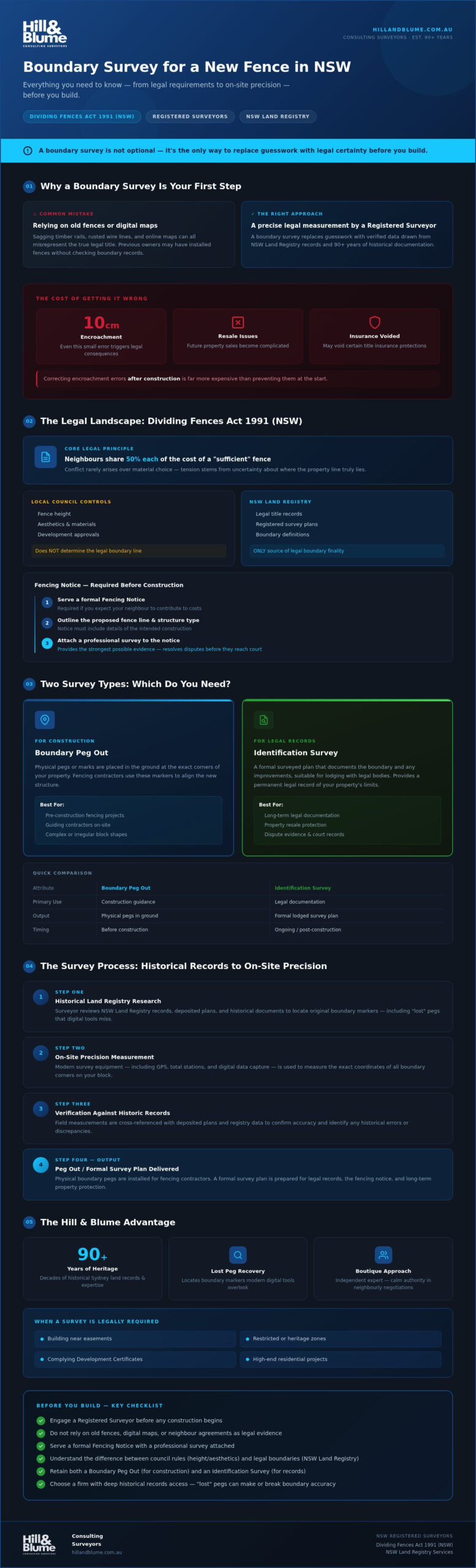
Choosing to build a new fence is an act of curation. It defines your private sanctuary and frames your property’s unique character. However, many homeowners mistakenly rely on the position of a sagging timber rail or a rusted wire line to determine where their property ends. This is a high-risk strategy. A boundary survey for new fence nsw projects provides the absolute certainty required to build with confidence.
A boundary survey is not merely a map; it is a precise legal measurement performed by a Registered Surveyor. This professional verification replaces guesswork with data. Relying on old fences or digital maps can be deceptive because land often shifts, and previous owners may have installed barriers without checking the legal title. By engaging an expert, you ensure your new structure sits exactly where it should.
The Risk of Encroachment
Small errors can lead to significant consequences. If your new fence is discovered to be just 10cm over the line, you face more than just an awkward conversation with a neighbour. This discrepancy can complicate future property resales and may even void certain title insurance protections. Encroachment is a legal liability for homeowners that occurs when a structure or improvement extends beyond the property boundary and onto an adjoining title. Correcting these mistakes after construction is finished is far more expensive than preventing them at the start.
Setting the Design Foundation
Precision is the silent partner of high-end design. Whether you are installing custom wrought iron or contemporary slats, the fence must align perfectly with your home’s architectural intent. At Hill & Blume, we draw upon over 90 years of historical records to locate “lost” boundary markers that modern digital tools might overlook. This deep research allows us to provide a level of accuracy that supports complex landscaping and architectural projects. You can explore our full range of specialised surveying services to see how we provide the clarity your project deserves. Our boutique approach ensures that every measurement respects the integrity of your land and the legacy of your investment.
Understanding the Legal Landscape: The Dividing Fences Act and NSW Regulations
The Dividing Fences Act 1991 (NSW) remains the primary legislation governing how neighbours share the cost and location of a boundary barrier. Even in 2026, the core principle remains that owners are generally responsible for half the cost of a “sufficient” fence. However, conflict rarely arises over the choice of timber or colorbond. Instead, tension usually stems from uncertainty about where the property line truly lies. A boundary survey for new fence nsw transforms these subjective debates into a factual, data-driven conversation.
Before any construction begins, you’re required to serve a formal Fencing Notice if you expect a neighbour to contribute to the costs. This document must outline the proposed fence line and the type of structure intended. Attaching a professional survey to this notice provides the strongest possible evidence of your property’s legal limits. It’s vital to distinguish between council requirements and legal title boundaries. While your local council regulates the height and aesthetics of a fence, they don’t determine the legal boundary line. Only the NSW Land Registry records, interpreted by a Registered Surveyor, provide that finality.
Navigating Neighbourly Negotiations
Conversations regarding shared boundaries require a delicate balance of transparency and expertise. Bringing a professional survey to the table allows you to act with a sense of calm authority. Rather than guessing where a line might be, you’re presenting a curated, impartial report that both parties can respect. A Registered Surveyor serves as an independent expert, ensuring the narrative remains focused on property integrity rather than personal opinion. For a deeper look at protecting your land, you can explore our Boundary Surveys in Sydney: A Homeowner’s Guide. This level of detail often resolves potential disputes before they ever reach a local court or tribunal.
When is a Survey Legally Required?
In many high-end residential projects, a survey is a mandatory requirement rather than a choice. If you’re building near easements, restricted zones, or seeking a Complying Development Certificate (CDC), a survey is often a prerequisite for legal approval. Precision also acts as a safeguard against “Adverse Possession” claims. This legal concept allows a person to claim ownership of land they’ve occupied for a long period, often because a fence was misplaced decades ago. Maintaining an accurate boundary ensures your title remains secure for the next generation. If you’re navigating a complex site, you can speak with our team to understand the specific regulations affecting your property.
Identification Surveys vs. Boundary Peg Outs: Which Do You Need?
Once you’ve committed to securing a boundary survey for new fence nsw, you must decide which level of professional insight your project requires. Not all surveying services are identical. Some focus on the physical act of construction, while others provide the legal documentation necessary to protect your title for decades. At Hill & Blume, we often find that homeowners benefit most from a bespoke combination of both, ensuring that the fence built today doesn’t become a legal liability tomorrow.
Choosing between these services depends on the complexity of your site and your long-term goals for the property. If you’re simply replacing a standard timber fence on a clear lot, a physical marking may suffice. However, for high-end architectural projects or properties with complex easements, a formal report is indispensable. Our role is to provide the calm authority you need to make this choice with confidence, drawing on our 90 years of experience in the Sydney and Newcastle regions.
The Practical Peg Out
A boundary peg out is the physical translation of historical land records onto your actual soil. When our surveyors arrive on-site, they use high-precision GPS and total stations to locate the exact corners of your land. You can expect to see wooden pegs driven into the ground, often accompanied by paint marks or offset lines if the true boundary is currently obstructed. These markers are the primary tools your fencer will use to ensure the new structure is perfectly straight and legally compliant. Only a Registered Surveyor can legally place boundary pegs in New South Wales. This ensures that the markers carry the weight of legal authority, preventing future disputes with neighbours over the fence’s location.
The Identification Survey Report
While pegs provide the guide for construction, an Identification Survey provides the permanent record for your files. This comprehensive report is a signed legal document that describes the property, its boundaries, and any improvements located on or near those lines. It details vital information such as encroachments, easements, and whether the proposed fence aligns with the legal title. This document is particularly valuable during future property sales, as it gives prospective buyers and insurers total certainty about the land’s integrity. You can explore our full range of surveying services to see how an Identification Survey fits into your broader property strategy. It’s a sophisticated “insurance policy” that preserves the harmony of your neighbourhood and the value of your architectural investment.
The Boundary Survey Process: From Historical Records to On-Site Precision
The journey toward a perfectly placed fence doesn’t begin on your lawn. It starts in the quiet, digital archives of the NSW Land Registry Services. When you commission a boundary survey for new fence nsw projects, you’re initiating a multi-stage process of verification and discovery. This rigorous workflow ensures that every centimetre of your property is accounted for before the first post is driven into the earth, providing the calm confidence you need to proceed with your construction.
Our process typically follows five distinct, purposeful stages:
- Step 1: Deep-dive research into historical plans and original land grants to establish the legal framework of your title.
- Step 2: Precise on-site measurement using high-precision GPS and total stations to map the current state of your land.
- Step 3: Analysing occupational evidence, such as aged sandstone walls, original timber fences, and adjacent structures that hint at historical boundaries.
- Step 4: Final mathematical calculation to reconcile historical data with current physical markers, ensuring a seamless fit.
- Step 5: Delivery of your signed survey plan or formal Identification Report, providing a permanent legal record of your property integrity.
The Art of Historical Research
Property boundaries in Sydney’s older suburbs can be incredibly complex, often layered with decades of minor adjustments and subdivisions. Our surveyors track these property changes through generations of records to ensure no detail is overlooked. This cadastral expertise is essential for navigating the unique land conditions of the Newcastle and Central Coast regions. Hill & Blume’s 90-year archive, dating back to our founding in 1930, provides a unique advantage in this field. We often hold historical records that provide the missing piece of a boundary puzzle, allowing us to resolve discrepancies that might baffle less established firms.
Modern Technology Meets Traditional Integrity
While we deeply respect our heritage, we actively embrace the future of surveying technology. In 2026, we utilise advanced laser scanning and drone technology to capture data on tight urban sites where traditional methods might face physical obstacles. This high-tech approach allows us to ensure accuracy to within millimetres, which is vital for high-end residential projects where space is at a premium. It’s this blend of traditional integrity and modern innovation that defines our boutique service. If you’re ready to secure your property’s future with precision, you can enquire about a boundary survey for your project today. We take the time to understand your vision, ensuring your new fence sits exactly where it belongs.
Securing Your Property’s Future with Hill & Blume’s Expertise
Selecting the right surveyor is the final, most critical step in your fencing journey. It’s a choice that moves beyond simple measurements and into the realm of long-term property protection. A boundary survey for new fence nsw is an investment in your home’s integrity, ensuring that every dollar spent on construction is anchored by legal certainty. By choosing a firm that values precision over volume, you’re opting for a partnership that respects the unique character of your land and the lifestyle you’ve cultivated within its borders.
Our boutique approach means you’re never just another file in a high-turnover system. Instead, you receive the dedicated attention of Registered Surveyors who understand that a fence is more than a barrier; it’s a defining feature of your sanctuary. This meticulous care prevents the hidden costs of future boundary disputes and the stress of potential legal challenges. We act as your calm authority, providing the clarity required to move from planning to construction with total peace of mind.
A Legacy of Trust in NSW
Heritage is a powerful indicator of reliability in the surveying industry. Since 1930, Hill & Blume has served homeowners across Sydney, Newcastle, and the Central Coast with unwavering accuracy. Our 90-year history allows us to navigate local land conditions with a level of insight that only comes from decades of regional experience. We maintain high-end professional standards that reflect our commitment to the local community and the architectural heritage of the area. Understanding why hiring a Registered Surveyor is non-negotiable is essential for any property owner who values quality and legal compliance. It’s the difference between a temporary fix and a permanent solution for your property’s boundaries.
Ready to Start Your Fencing Project?
Preparing for your surveyor’s visit is a straightforward process that sets the stage for a seamless project. We recommend clearing any heavy debris or overgrown vegetation along the suspected boundary line to allow our team clear sightlines for their precision instruments. Once you make an initial enquiry, the timeline to receive your final report typically spans a few weeks, depending on the complexity of the historical research required. This small window of time provides a lifetime of certainty. If you’re ready to define your property with confidence, you can contact Hill & Blume today for a tailored quote. We look forward to helping you secure your property’s future with the same care and craftsmanship you bring to your home.
Building Your Boundary with Absolute Confidence
Building a fence is about more than just timber and nails; it’s about defining the space where your life unfolds. By securing a boundary survey for new fence nsw, you’ve moved past the uncertainty of old maps and into a place of total property integrity. You now understand that a professional survey is the only way to satisfy the Dividing Fences Act and ensure your architectural vision aligns perfectly with your legal title.
Whether you need physical markers for your fencer or a comprehensive identification report for your records, the right preparation preserves your investment. Hill & Blume brings over 90 years of continuous practice since 1930 to every project. Our Registered NSW Surveyors specialise in the unique land conditions of Sydney, Newcastle, and the Central Coast, offering a boutique service that prioritises depth of relationship over volume. Ready to take the first step toward a seamless construction process? Secure your property boundaries with a professional survey from Hill & Blume today. We’re here to ensure your project begins with the clarity and care it deserves.
Frequently Asked Questions
Do I need a survey if there is already an old fence in place?
You shouldn’t assume an existing fence sits on the legal boundary. Over time, fences can shift due to soil movement or may have been installed incorrectly by previous owners. A professional boundary survey for new fence nsw ensures your new structure is built with legal precision. This prevents future disputes and ensures your property title remains accurate, which is vital for maintaining your investment’s long-term value and your peace of mind.
How much does a boundary survey for a fence cost in NSW in 2026?
Professional fees for a boundary survey are determined by the specific complexity of your property. Factors include the terrain, the age of the original land grants, and the amount of historical research required in the NSW Land Registry. Because every site in Sydney, Newcastle, or the Central Coast is unique, we provide tailored quotes rather than flat rates. This ensures you receive a curated service that reflects the actual requirements of your high-end residential project.
Can a fencer determine the property boundary themselves?
Fencers are experts in construction, but they lack the legal authority to determine property lines. In New South Wales, only a Registered Surveyor is qualified to interpret cadastral records and physically mark a boundary. Relying on a fencer’s guess can lead to encroachment issues and costly legal liability. Engaging a specialist firm like Hill & Blume provides the calm authority needed to ensure your project remains fully compliant with state regulations and local council requirements.
How long does a boundary survey take to complete?
The timeline for a comprehensive survey usually spans several weeks. This period allows our team to conduct deep-dive research into historical plans before performing on-site measurements with precision technology. While the physical visit might only take a few hours, the analysis of occupational evidence and final calculations requires careful attention. We prioritise accuracy over speed to ensure your final report is a robust legal document that protects your property integrity for years to come.
What is the difference between a Registered Surveyor and a regular land surveyor?
A Registered Surveyor in NSW has met rigorous professional standards and is legally authorised to perform boundary identification. While many people work in the broader surveying industry, only those registered with the Board of Surveying and Spatial Information can sign off on plans that define land titles. This distinction is critical for fencing projects, as it ensures your markers carry the weight of legal authority in the event of a dispute or property sale.
Will my neighbour have to pay for half the survey cost?
The Dividing Fences Act 1991 (NSW) focuses on the shared costs of a sufficient fence. While neighbours usually split the cost of the physical barrier, the expense of a boundary survey for new fence nsw is typically covered by the party initiating the work. However, if there is a legitimate dispute about the line, costs may be shared by mutual agreement. It’s best to discuss these details with your neighbour during the early planning stages to maintain harmony.
What happens if the survey shows the current fence is in the wrong place?
If a survey reveals a misplaced fence, it identifies a legal encroachment. This discovery allows you to rectify the issue before investing in a new structure. You might choose to move the fence to the correct line or enter into a formal agreement with your neighbour regarding the land’s use. Having a signed report from a Registered Surveyor provides the factual foundation needed for a calm, professional resolution to these sensitive and often complex property matters.
How long is a boundary survey report valid in NSW?
A boundary survey report is a permanent record of the property’s state at the date of the survey. While the legal data doesn’t expire, physical markers like pegs can be disturbed or lost over time due to weather or landscaping. If significant time has passed or if markers are missing, we recommend a peg out to re-establish the lines before construction. This ensures your fencer has the most accurate guide possible for your project.
Disclaimer
The information provided in articles published on this website is for general informational purposes only. While we make every effort to ensure the accuracy, completeness, and timeliness of the content, the material is based on our understanding of the industry at the time of writing and may not reflect the most current developments, regulations, or standards. All opinions expressed in our articles are those of the respective authors and do not necessarily represent the official position of the website or its affiliates. The content should not be considered professional, legal or technical advice, and should not be relied upon as a substitute for consultation with qualified professionals