

Last Tuesday, a homeowner in the leafy suburbs of Sydney discovered that a simple garden renovation had sparked a heated disagreement over a three-inch strip of land. What began as a project to enhance their sanctuary quickly dissolved into anxiety over lost property value and the looming shadow of legal fees. You’ve worked hard to curate your home as a legacy, and the thought of needing a boundary dispute survey nsw feels like a sudden disruption to the tranquility you’ve built. It’s deeply unsettling when decades-old plans don’t seem to align with the reality of the ground beneath your feet.
We understand that your property is more than just an asset; it’s a piece of local history you’re entrusted to protect. This guide will provide the expert surveying insights you need to navigate the complexities of NSW land laws with grace and absolute certainty. We’ll preview the mandatory shift to digital survey plans that arrived in July 2026 and explain how a Registered Surveyor provides the only legally binding validation of your rights. By the end, you’ll have a clear path toward a peaceful resolution that restores both your boundaries and your neighborly relationships.
Key Takeaways
- Navigate the shifting 2026 NSW property landscape by understanding how new digital mandates and the Conveyancing Regulation impact your land’s measurement.
- Discover how a precise boundary dispute survey nsw acts as a definitive legal anchor, providing the clarity needed to resolve encroachments with certainty.
- Learn to distinguish between an Identification Survey for private negotiation and the formal path of a Boundary Determination through the Registrar General.
- Master a step-by-step approach to resolving conflicts that prioritizes both the protection of your land value and the preservation of neighborly relationships.
- Understand why leveraging nearly a century of archival knowledge is essential for uncovering the historical truth behind complex Sydney property lines.
Understanding Boundary Disputes in the 2026 NSW Property Landscape
Sydney’s skyline is changing. As our suburbs grow denser and infill development accelerates, every square inch of land becomes a precious asset. This proximity often leads to friction between neighbors, especially when older property lines don’t seem to match modern expectations. You might feel a sense of unease when a neighbor mentions a new fence or an extension, wondering if your own space is being slowly eroded. It’s a common anxiety, yet one that can be resolved with the right expertise and a calm, methodical approach.
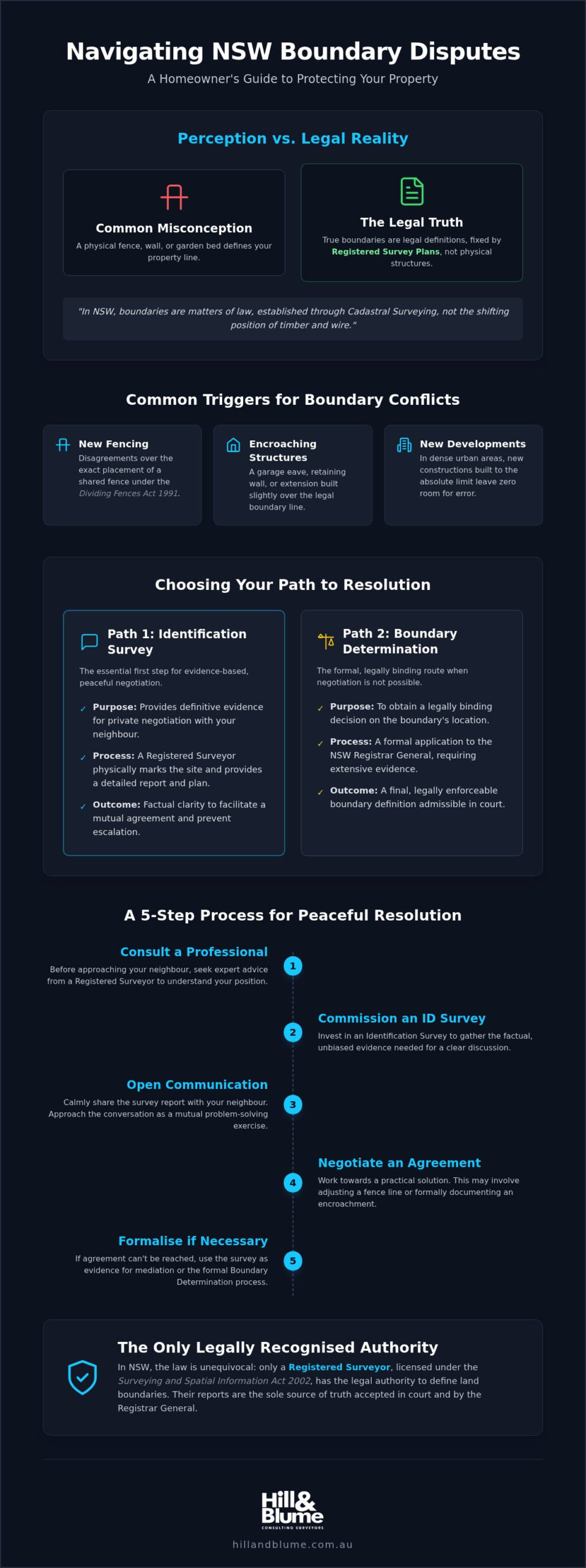
The legal framework governing these spaces is also evolving. On September 1, 2026, the Conveyancing (General) Regulation 2026 took effect, introducing refined standards for how land is measured and described in NSW. This isn’t just bureaucratic red tape; it’s a fundamental shift in how your property rights are documented and protected in a digital-first era. A common misconception we see is the belief that a physical fence line defines a boundary. In reality, a fence is often just a historical convenience or a marker of past agreement. True boundaries are established through Cadastral surveying, a specialized discipline that marries historical data with modern precision to define the legal extent of your ownership. Boundaries are matters of law, fixed by registered plans rather than the shifting position of timber and wire.
Common Triggers for NSW Boundary Conflicts
Disputes rarely happen in a vacuum. They often arise from mundane events that suddenly carry high stakes. Under the Dividing Fences Act 1991, neighbors share the cost of a “sufficient” fence, but disagreements over the exact placement of that fence can halt progress and sour relationships. We also frequently encounter issues with encroaching structures. A garage eave overhanging a line or a retaining wall built slightly out of place can create significant legal headaches when it’s time to sell. In Sydney’s tight residential lots, where new developments are built to the very edge of the permissible area, there’s no room for error. A professional boundary dispute survey nsw becomes the essential tool to prevent these minor overlaps from becoming major liabilities that diminish your property’s value.
The Legal Weight of the Registered Surveyor
In NSW, the law is clear: only a Registered Surveyor, licensed under the Surveying and Spatial Information Act 2002, has the legal authority to define land boundaries. Their reports are the only ones admissible in court or accepted by the Registrar-General should a dispute escalate. At Hill & Blume, we draw upon over 90 years of archival records to find the historical “truth” of a boundary. This process involves more than just modern GPS equipment; it requires a deep dive into historical title searches and old survey plans to ensure the result is beyond reproach. By choosing a specialized boutique firm, you’re investing in a partnership that values the legacy of your property as much as you do, ensuring your rights are validated with absolute certainty.
The Role of an Identification Survey in Resolving Encroachments
When you’re faced with conflicting opinions about where your land ends and your neighbor’s begins, clarity is the only remedy. An Identification Survey, commonly known as an ID Survey, is a precise professional assessment that identifies the exact relationship between physical buildings and legal boundaries. An Identification Survey is the gold standard for dispute resolution in the NSW property market. Unlike a simple visual check, this process involves a Registered Surveyor physically marking the site with Survey Pegs or identifying permanent marks that anchor your property to the state’s official grid. These markers provide a tangible sense of site certainty that verbal agreements or old fence lines simply cannot match.
A professional ID Survey report for NSW properties is a comprehensive legal document. It includes a plan showing the land’s dimensions, the position of structures relative to the boundaries, and a written report detailing any discrepancies. This level of detail ensures that your property’s integrity is documented with the care and craftsmanship it deserves, providing a shield against future claims or confusion.
Detecting Encroachments and Easements
The primary value of a boundary dispute survey nsw lies in its ability to reveal what’s often invisible to the naked eye. Encroachments, such as a neighbor’s garage eave overhanging your yard or a retaining wall built slightly across the line, are identified with millimeter precision. Beyond physical structures, we also examine the role of easements. These legal rights, such as a right of way or drainage access, are significant sources of conflict if they aren’t clearly understood. As outlined by the NSW Registrar General, understanding these interests is vital before any formal determination is sought. Our professional plans translate these complex legal descriptions into clear, real-world boundaries you can see and defend.
The Value of Professional Documentation
In a heated disagreement, a written report carries a weight that a verbal opinion never will. A professional ID Survey report provides a detailed narrative of your property’s standing, serving as a powerful tool for negotiation or mediation. It moves the conversation away from emotion and toward objective fact. You can explore our more detailed breakdown on What is an Identification Survey Report in Sydney? to see how these documents protect your interests. Having this data on hand often facilitates a peaceful resolution between neighbors, as it provides a shared truth that both parties can respect. If you find yourself in a position where clarity is needed, you might consider speaking with our team to discuss how we can help secure your property’s legacy.
Boundary Determination vs. Identification Survey: Which Do You Need?
Deciding how to resolve a property line disagreement often comes down to the level of finality you require and the state of your relationship with your neighbour. Most Sydney property owners find themselves choosing between a private Identification Survey and a formal Boundary Determination under Part 14A of the Real Property Act. While both involve a boundary dispute survey nsw, they serve different masters. One is an expert opinion designed to facilitate a private resolution; the other is a formal administrative process that results in a binding decision by the state. Choosing the right path requires a balance of legal strategy and a desire for a peaceful outcome.
When to Opt for a Private Boundary Survey
A private survey is almost always the preferred first step for those planning renovations, installing new fencing, or seeking to resolve a misunderstanding before it escalates. Working with a boutique firm like Hill & Blume offers a level of speed and personal attention that larger agencies often lack. We provide you with the precise data needed to have a considered conversation with your neighbour, allowing you to maintain neighbourly grace while protecting your land’s value. This path is less adversarial and significantly more cost effective than formal litigation. By presenting a professional report early, you often find that the truth of the boundary, backed by our 90 years of archival records, is enough to settle the matter without further conflict.
The Administrative Review Path (Part 14A)
There are times when communication breaks down entirely and a shared resolution feels impossible. In these rare instances, a formal application for Boundary Determination to the Registrar General may be necessary. This is an official NSW Land Registry Services (LRS) process where the state acts as the final arbiter. While the Registrar General makes the ultimate binding decision, they don’t conduct the fieldwork themselves. You still require a Registered Surveyor to conduct a boundary dispute survey nsw and provide the rigorous evidence and digital survey plans mandated by the July 2026 regulations to support your application. This path offers absolute finality, but it’s a more rigid and time consuming process that should generally be viewed as a last resort. For most, the tailored insights found in our specialised surveying services provide a swifter, more elegant resolution.
Step-by-Step: Navigating a Boundary Dispute in NSW
When a disagreement over land arises, the first instinct is often defensive. However, a measured and methodical response is your greatest asset in protecting your property’s legacy. Start by quietly reviewing your current property title and any historical survey plans you possess. While these documents might feel like relics of the past, they provide the essential baseline for your property’s identity. It’s about grounding yourself in the known facts before addressing the unknown.
Once you’ve gathered your records, the next critical move is to engage a Registered Surveyor. A fresh, precise Identification Survey is essential to verify the current state of your land against the legal record. This boundary dispute survey nsw provides the objective, admissible data required to move past guesswork and emotional assumptions. By grounding the dispute in technical precision, you transform a personal conflict into a professional matter that can be solved with logic.
Communicating the survey findings to your neighbour requires a delicate, sophisticated touch. Approach the conversation with a focus on collaborative resolution rather than confrontation. If the data shows a minor encroachment, many neighbours are willing to adjust their plans once the legal facts are clear. However, if a neighbour remains hostile or the encroachment is significant, seeking legal counsel becomes the next prudent step. You’ll enter those discussions with the confidence that your position is backed by a Registered Surveyor’s authority.
The Importance of Early Engagement
Waiting until construction begins to address a boundary concern is a recipe for a costly injunction and a fractured relationship. By engaging an expert early, you use a professional survey to de-escalate emotional arguments with objective facts. It’s a proactive way to replace tension with clarity. For a deeper look at how to manage these site complexities, see our Homeowner’s Guide to Boundary Surveys in Sydney.
Resolving Encroachments Permanently
Minor overlaps don’t always require the removal of a structure. You might explore nuanced options like financial compensation or the creation of a formal easement to grant access while maintaining your ownership. If a more permanent change is needed, such as a boundary realignment, your surveyor will prepare the documentation for a new Plan of Subdivision. The final step involves lodging these updated digital plans with the NSW Land Registry Services to ensure your property rights are corrected for future generations. If you’re ready to secure your boundaries with professional precision, we invite you to reach out to our team for a considered, expert consultation.
Precision and Legacy: The Hill & Blume Approach to NSW Surveys
Your home is an extension of your lifestyle, a curated space that reflects your journey within the unique fabric of New South Wales. When that sanctuary is challenged by a boundary disagreement, you need more than just a measurement; you need a partner who understands the deep-rooted history of our region. At Hill & Blume, we view every boundary dispute survey nsw as an opportunity to restore peace through precision. We blend the rhythmic traditions of craftsmanship with the digital mandates of 2026 to ensure your property’s legacy remains untarnished and your rights are beyond question.
We believe in a partnership-oriented narrative that prioritizes the depth of our relationship with you over high-volume turnover. Our approach is sophisticated yet approachable, offering a calm confidence that reassures you during times of uncertainty. By choosing a boutique firm, you’re engaging with experts who value quality and detail, ensuring that every survey we conduct is a polished reflection of our commitment to excellence. We’ve remained a steady presence in the Sydney, Newcastle, and Central Coast property communities, anchoring our modern, forward-thinking agency with traditional integrity.
Why 90 Years of Experience Matters
Founded in 1932, our firm possesses a rare depth of archival knowledge that’s essential for navigating Sydney’s complex land titles. Many properties in our established suburbs still lean on “old system” land records that require a discerning eye and historical records to interpret correctly. This perspective allows us to uncover the truth behind a boundary when others might only see conflicting plans. Our name carries a weight of trust with local councils and the courts, providing you with a seal of quality that simplifies the resolution process. We’ve supported Sydney homeowners for nearly a century, and that commitment to quality remains our signature promise.
Your Next Steps for Property Peace
Resolving a dispute doesn’t have to be a clinical or stressful experience. When you reach out to us, we begin with a considered conversation to understand your specific concerns and the unique charm of your area. We’ll provide a tailored quote for your boundary dispute survey nsw that reflects the specific requirements of your site. During our visit, our Registered Surveyors utilize the latest 2026 digital technologies to capture data with absolute certainty, ensuring your plans meet the new LandXML mandates.
Following the fieldwork, you’ll receive a detailed report that serves as your definitive proof of ownership. This document is your shield, validating your rights and providing a clear path to a peaceful resolution. To understand more about the legal necessity of our role, you can explore our guide on Why You Must Hire a Registered Surveyor in Sydney. We invite you to experience a service where your property’s integrity is our primary passion.
Securing Your Property’s Future with Absolute Certainty
Your home is a legacy that deserves protection with the highest level of care. We’ve seen how the 2026 NSW property landscape requires more than just a passing glance at old fences; it demands the technical precision of a registered professional. Whether you’re navigating a minor encroachment through a private Identification Survey or considering the formal path of a Boundary Determination, your next steps should be grounded in objective fact. A specialized boundary dispute survey nsw provides the definitive evidence needed to resolve conflicts while preserving the neighborly grace that defines your local community.
Hill & Blume brings over 90 years of Sydney surveying expertise to your site, a legacy trusted by the city’s leading architects and developers. Our team of Registered Surveyors is dedicated to providing the clarity and site certainty you need to move forward. Protect your property legacy—request a boundary survey from Hill & Blume today. You can rest easy knowing your boundaries are validated by a name synonymous with traditional integrity and modern precision.
Frequently Asked Questions
What is a boundary dispute survey in NSW?
A boundary dispute survey nsw is a specialized professional assessment conducted by a Registered Surveyor to define the exact legal limits of your land. This process involves a meticulous analysis of historical title records and physical site measurements. The result is a precise report that identifies the relationship between buildings, fences, and the true property lines. It provides the technical clarity needed to resolve disagreements with certainty and protect your property’s long-term value.
Can a fence be used as a legal property boundary in Sydney?
Physical markers like fences or retaining walls aren’t legal boundaries in Sydney. While they often serve as practical dividers, the true legal boundary is defined by the registered survey plan held by NSW Land Registry Services. Over many decades, fences can shift or be replaced in the wrong position. Only a Registered Surveyor can verify the actual location of your property lines, ensuring your rights are based on law rather than physical convenience.
How much does a boundary dispute survey cost in NSW?
The investment for a survey depends on the complexity of your site, the terrain, and the age of the existing archival records. Because every property in Sydney and the Central Coast is unique, fees are structured on a per-project basis. This considered approach ensures you receive a high-quality, precise result tailored to your specific situation. Requesting a professional quote is the best way to understand the requirements for your particular boundary concern.
What happens if my neighbour’s house is encroaching on my land?
If an encroachment is suspected, your first step is to commission a boundary dispute survey nsw to document the overlap with precision. This report provides the objective evidence needed for a calm, collaborative conversation with your neighbor. Depending on the structure’s size, you might negotiate its removal, seek financial compensation, or formalize a legal easement. Having a professional report early prevents minor overlaps from becoming expensive and emotionally draining legal battles.
Is a surveyor’s report legally binding in a boundary dispute?
A report from a Registered Surveyor is the gold standard of evidence in NSW. While the report itself is an expert opinion, it’s the only documentation admissible in court or accepted by the Registrar-General to define boundaries. If neighbors can’t reach an agreement privately, this report becomes the foundation for a formal, legally binding decision. It provides the professional validation required to settle disputes with absolute finality and professional grace.
Do I need a lawyer or a surveyor first for a boundary issue?
It’s almost always best to engage a Registered Surveyor before speaking with a lawyer. Legal counsel requires technical facts to build a case, and they can’t determine the physical location of a boundary themselves. By obtaining a survey first, you provide your legal team with the precise data they need to offer accurate advice. Often, the clarity provided by a professional survey report is enough to resolve the issue without needing expensive legal intervention.
What is the difference between a licensed surveyor and a registered surveyor?
In New South Wales, a Registered Surveyor is the only professional legally authorized to undertake land boundary surveys under the Surveying and Spatial Information Act 2002. While ‘licensed’ is a term used in other jurisdictions, ‘registered’ is the specific title that denotes a surveyor’s authority to define property lines in our state. This registration ensures they possess the specialized expertise and historical knowledge required to protect your property’s integrity and legal standing.
How long does a boundary survey take to complete in NSW?
Most residential boundary surveys are completed within one to two weeks. This timeframe allows our team to conduct a thorough site visit and a deep dive into nearly a century of archival records. We prioritize quality over speed to ensure every measurement is beyond reproach. Once the fieldwork and historical research are finished, we deliver a polished, professional report that provides the certainty you need to resolve any property concerns with confidence.
Disclaimer
The information provided in articles published on this website is for general informational purposes only. While we make every effort to ensure the accuracy, completeness, and timeliness of the content, the material is based on our understanding of the industry at the time of writing and may not reflect the most current developments, regulations, or standards. All opinions expressed in our articles are those of the respective authors and do not necessarily represent the official position of the website or its affiliates. The content should not be considered professional, legal or technical advice, and should not be relied upon as a substitute for consultation with qualified professionals