

The timber fence line you see every morning is often nothing more than a historical approximation, not a legal reality. It’s natural to feel a surge of anxiety when you suspect your property’s boundaries have been quietly compromised. You’ve invested deeply in your home’s legacy, and with 32% of people reporting neighbourly disagreements in the past year, the thought of a confrontation can feel overwhelming. If you are wondering what to do if neighbours fence is on my property sydney, you’re seeking more than just a quick fix; you’re looking for the certainty that only professional stewardship can provide.
We are here to replace that confusion with a clear, rhythmic path toward resolution. This guide promises to demystify the technical and legal steps required to address encroachments under the Dividing Fences Act 1991 and the Encroachment of Buildings Act 1922. You’ll learn how a Registered Surveyor provides the definitive evidence needed to protect your property value, from serving a formal Fencing Notice to securing a precise identification survey. We will explore the roadmap to a peaceful, documented outcome that respects both your land and your local community values.
Key Takeaways
- Learn the precise technical steps and legal rights required to understand what to do if neighbours fence is on my property sydney, replacing doubt with professional certainty.
- Navigate the nuances of the Dividing Fences Act 1991 to ensure any repairs or replacements are handled with legal compliance and fair cost-sharing.
- Identify why engaging a Registered Surveyor is the only way to obtain the authoritative, legally binding documentation needed to resolve boundary disputes.
- Follow a refined roadmap that moves from calm, informal discussions to formal identification surveys, protecting both your property value and your neighbourly relationships.
- Discover how 90 years of surveying heritage provides a sophisticated, detail-oriented perspective that secures the long-term integrity of your Sydney home.
Understanding Fence Encroachment on Sydney Properties
In the quiet, leafy streets of Sydney, a fence is rarely just a fence. It’s a statement of privacy, a container for your garden, and often, a source of quiet confusion. When you begin to suspect that your physical boundary doesn’t align with your title, you’ve encountered what we call an encroachment. This occurs when a structure, such as a timber fence or a brick wall, physically crosses the legal line that separates your land from your neighbour’s. If you’re currently researching what to do if neighbours fence is on my property sydney, it’s vital to start with a clear understanding of what that fence actually represents in the eyes of the law.
A fence is technically defined as a dividing structure. It serves a practical purpose, but it isn’t a definitive legal boundary. In New South Wales, the physical occupation of land doesn’t automatically grant ownership of that soil. While the legal principle of Adverse Possession exists, claiming land through long-term use is a complex legal hurdle that rarely applies to simple fencing misalignments in modern Sydney suburbs. For most homeowners, the fence is simply a suggestion that requires professional verification to become a fact. To understand the full scope of your land, exploring professional surveying services is the most elegant solution to restore your peace of mind.
The Difference Between a Fence Line and a Boundary Line
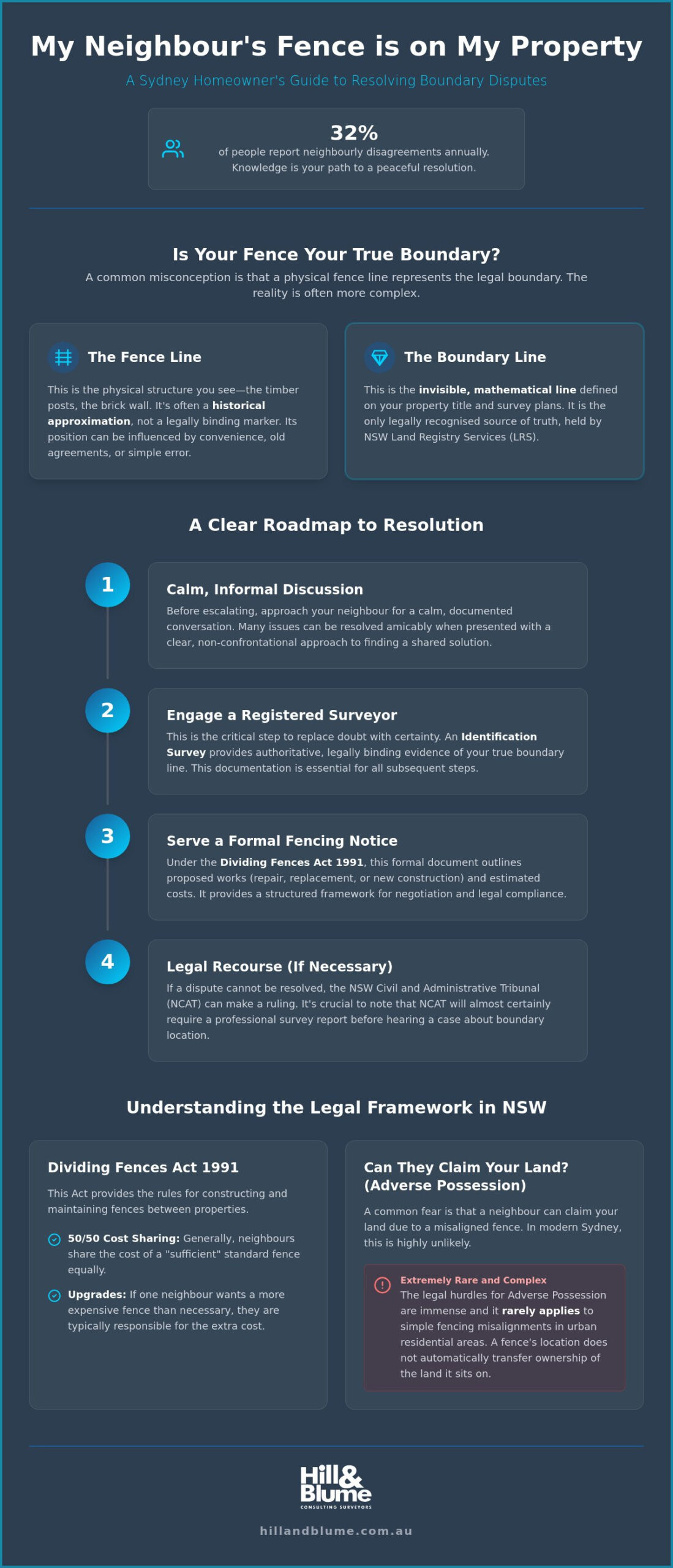
Your property is defined by a cadastral boundary. This is an invisible, mathematical line recorded within legal titles and survey plans held by the NSW Land Registry Services (LRS). It’s a common mistake to rely on aged timber posts or rusted metal pegs found in the garden as proof of your land’s edge. These markers can shift over time or may have been placed inaccurately by previous owners. The only source of truth is the registered survey plan, which acts as the DNA of your property’s footprint. Relying on anything less leaves your most valuable asset vulnerable to error.
Common Reasons for Misaligned Fences in Sydney
Sydney’s diverse landscape and rich history often contribute to these discrepancies. In established areas like Crows Nest or the Northern Beaches, legacy issues are frequent. Many fences were erected decades ago using rudimentary tools, long before the precision of modern GPS and laser technology. If you’re worried about what to do if neighbours fence is on my property sydney, remember that natural shifts in sandstone terrain or the accidental removal of original survey markers often lead to “best guess” fencing. These historical errors are precisely why a professional eye is required to restore order to your property’s integrity and ensure your boundaries are respected for the next generation.
The Legal Framework: NSW Dividing Fences Act 1991
Resolving a boundary dispute requires a shift from emotional reaction to legal stewardship. In New South Wales, the primary instrument for this transition is the Dividing Fences Act 1991. This legislation provides the essential rulebook for how neighbours contribute to the cost and construction of what the law terms a “sufficient” dividing fence. Generally, the law expects costs to be shared equally between adjoining owners. However, this 50/50 split applies only to a standard, functional fence; if a neighbour desires a premium design that exceeds the local norm, they are typically responsible for the additional investment.
If you are navigating what to do if neighbours fence is on my property sydney, it’s vital to understand that this Act is a tool for maintenance and construction, not a means of title transfer. A fence is a physical partition, and its presence on your land does not legally strip you of your ownership. Before any physical work begins or legal orders are sought, serving a formal Fencing Notice is the first professional step. This document outlines the proposed work and estimated costs, creating a structured environment for a calm, documented conversation. If the boundary location itself is the source of the disagreement, the NSW Civil and Administrative Tribunal (NCAT) will almost certainly require a professional survey before they will hear the case. You may wish to speak with our specialists to ensure your evidence is beyond reproach before you initiate this formal process.
Adverse Possession in NSW: Can They Claim Your Land?
A frequent source of anxiety for Sydney homeowners is the concept of adverse possession, often whispered about as the “12-year rule.” While this principle allows a person to claim ownership of land they have occupied for over a decade, its application in suburban Sydney is exceptionally rare. Most residential land in our region is registered under Torrens Title, a system designed to offer robust protection against land theft through minor fencing discrepancies. Squatter’s rights rarely apply to simple fence misplacements in a modern residential context.
When the Encroachment of Buildings Act 1922 Applies
The law draws a sharp distinction between a removable timber fence and a permanent structure. If a neighbour’s garage wall or house extension crosses your boundary, the Encroachment of Buildings Act 1922 becomes the relevant authority. The court treats these “substantial” encroachments with far more weight than a misaligned fence. It is essential to act with deliberate speed when you discover such an issue. Waiting too long can lead to “acquiescence,” where your silence is interpreted by the court as implied consent to the structure’s position, potentially complicating your future property integrity.
While property disputes in Sydney require local expertise, managing legal complexities across international lines—such as business or investment interests between the US and Israel—requires its own specialized approach. To understand how these cross-border matters are handled, you can learn more about Israel Cross Border Law Firm for expert guidance on international legal stewardship.
Verifying the Boundary: Identification vs. Boundary Surveys
To move from suspicion to certainty, you must look beyond the physical timber and wire of the fence. A professional Boundary Survey provides the clarity you need to protect your land’s legacy. It’s the essential first step in resolving any dispute, replacing guesswork with a precise, mathematical re-establishment of your property’s corners. When you are deciding what to do if neighbours fence is on my property sydney, this technical verification acts as your foundation. It isn’t just a measurement; it’s a legal confirmation of your property’s footprint.
During the survey process, a specialist will physically re-mark your boundaries. They place new survey pegs at the exact coordinates defined in your property’s title, offering a visual and undeniable truth. This isn’t a mere estimation. It’s a sophisticated process that involves tracing historical survey records and using high-precision technology to ensure every millimetre is accounted for. The resulting survey plan is a curated document that provides the visual evidence required to demonstrate exactly where the fence has strayed. It provides a sense of calm confidence that you’re operating from a position of factual truth.
The Identification Survey Report
While a boundary survey marks the land, an Identification Survey Report is the specific narrative document required by legal professionals and financial institutions. It identifies any encroachments by or upon the land, detailing exactly how far a structure has crossed the line. This report is the gold standard for solicitors and banks. If your matter progresses to the NSW Civil and Administrative Tribunal, this document serves as your primary evidence. It transforms a neighbourly disagreement into a factual discussion, providing a clear roadmap for resolution that courts and tribunals can easily interpret.
Why a Registered Surveyor is Essential
The integrity of your property title rests on the authority of the person who measures it. In New South Wales, only a Registered Surveyor is legally authorised to define and mark property boundaries. Their signature carries significant legal weight, backed by years of rigorous training and professional accountability. Relying on unlicensed measurers or modern DIY apps is a risk that can lead to costly errors and rejected claims. When choosing a surveyor in Sydney, you are investing in a boutique experience that prioritises precision and traditional integrity over high-volume shortcuts. This partnership ensures your property rights are defended with the highest level of craftsmanship.
Steps to Resolve a Fence Dispute with Your Neighbour
Finding the right approach for what to do if neighbours fence is on my property sydney requires a blend of diplomacy and technical precision. Most disputes are born from a lack of information rather than genuine malice. By following a structured, professional roadmap, you can protect your land while maintaining the harmony of your local community. Resolving an encroachment is a process of restoration, moving from uncertainty toward a documented, shared reality.
- Step 1: Informal Discussion: Begin with a sophisticated, calm conversation. Sharing your concerns early can often prevent a minor misalignment from becoming a lasting conflict.
- Step 2: Professional Verification: Engaging a specialist to provide an identification survey establishes the factual truth of your boundary, removing emotion from the equation.
- Step 3: Formal Notice: If discussions stall, you must serve a “Fencing Notice.” Under NSW law, this must be done at least one month before applying for a tribunal order.
- Step 4: Mediation: Community Justice Centres (CJC) offer a graceful, low-cost way to reach an agreement through professional mediation without the heat of a courtroom.
- Step 5: NCAT Resolution: If all else fails, the NSW Civil and Administrative Tribunal (NCAT) can issue a legally binding order to define the fence’s position and cost-sharing.
Approaching Your Neighbour with Survey Evidence
When you present a survey plan, you aren’t offering an opinion; you’re sharing a certified fact. This objective “third party” evidence is powerful in de-escalating the natural emotions that arise when property lines are questioned. We recommend offering a “without prejudice” discussion. This allows both parties to explore practical solutions without those words being used against them later in court. With over 90 years of industry experience, Hill & Blume provides the kind of undisputable data that neighbours and legal professionals instinctively trust. It’s about providing a seal of quality that settles the matter once and for all.
What Happens if the Neighbour Refuses to Move the Fence?
If your neighbour remains uncooperative, the path leads toward the NSW Civil and Administrative Tribunal (NCAT). As of July 2026, application fees are structured by claim amount, with a standard fee of $64 for claims up to $10,000 and $133 for those up to $30,000. A surveyor’s report is the single most important document in this process. It streamlines the tribunal’s decision-making by providing the technical proof they need to issue an “Order for Fencing Work.” These orders are legally enforceable, ensuring the fence is moved to its correct cadastral position. To ensure your case is built on a foundation of professional integrity, contact our registered surveyors to secure the documentation you need.
Protecting Your Property Integrity with Hill & Blume
Your home is a sanctuary, and the land it rests upon is its most fundamental asset. When you find yourself questioning what to do if neighbours fence is on my property sydney, you aren’t just looking for a measurement; you’re seeking the peace of mind that comes from unwavering technical authority. Hill & Blume provides that certainty. Our boutique approach ensures that every detail of your boundary is meticulously checked, providing a seal of quality that protects your investment for decades. We treat every property with the care it deserves, ensuring your documentation is as polished as the home it defines.
Beyond boundary verification, maintaining the total integrity of your home is a vital part of property stewardship. For those who require professional property inspection services to ensure precision and peace of mind for their real estate investments, Lin Inspects offers expert guidance.
Engaging a specialized local authority transforms a stressful confrontation into a managed, professional process. We pride ourselves on a partnership-oriented narrative, moving away from clinical industry jargon toward a considered conversation that respects your time and intelligence. By choosing a firm that values quality over high-volume turnover, you ensure that your property rights are defended by experts who are deeply rooted in the local culture. This isn’t just a technical service; it’s a curated experience designed to restore order and harmony to your property’s legacy.
Expert Boundary Identification Since 1932
Since 1932, we’ve navigated the unique complexities of Sydney’s evolving land titles. We leverage a vast archive of historical records alongside modern laser precision to resolve even the most intricate disputes in older suburbs. We understand that survey data can feel cold, so we focus on providing clear, evocative passages of information that translate complex cadastral lines into a narrative you can trust. By exploring Our Professional Surveying Services, you gain access to a heritage of excellence that larger corporate agencies simply cannot match. We combine the craftsmanship of traditional surveying with the efficiency of modern technology to provide the final word in boundary disputes.
Start Your Resolution Today
Don’t let a misaligned fence or a lingering doubt diminish your property’s value or your daily peace of mind. Whether you require a formal Identification Survey for an NCAT hearing or a simple boundary re-marking to guide a new construction, we are here to provide the roadmap. Professional surveying is the only investment that guarantees boundary certainty. We invite you to contact Hill & Blume for a confidential discussion about your specific boundary concerns. Let us help you secure your property’s future with the same passion and precision we’ve brought to Sydney homes for over 90 years.
Restoring Your Property’s Legacy
Your property is more than just land; it’s a legacy that deserves protection with absolute precision. We’ve explored how a simple fence line can often diverge from the true cadastral boundary and how the legal framework in New South Wales supports your right to clarity. Finding the definitive answer for what to do if neighbours fence is on my property sydney doesn’t have to be a source of ongoing anxiety. By moving through the structured steps of informal discussion, formal notice, and expert surveying, you restore both the integrity of your title and the harmony of your local community.
Hill & Blume brings over 90 years of Sydney surveying heritage to every partnership, ensuring your boundaries are defined by expert Registered Surveyors who are deeply specialized in NSW boundary law. We provide more than just technical data; we offer a seal of quality that settles disputes with calm confidence. It’s time to replace doubt with documented truth and protect your home’s footprint for the future. Secure your property boundaries with a professional Identification Survey from Hill & Blume. We look forward to helping you achieve total certainty for your home.
Frequently Asked Questions
Is a fence always the legal boundary in NSW?
A fence is rarely a definitive legal boundary in New South Wales. Under the law, it’s considered a dividing structure designed for privacy and containment rather than a certified marker of land ownership. The true boundary is an invisible line defined by the cadastral records held at the Land Registry Services. To find the truth, you must rely on a registered survey rather than the physical position of timber or wire.
How much does a boundary survey cost in Sydney for a fence dispute?
The cost of a professional survey in Sydney varies depending on the complexity of your land and the age of the original title. While general industry ranges exist, factors such as steep terrain, heavy foliage, or missing historical markers will influence the final investment. We recommend requesting a tailored quote to ensure you receive a precise, boutique service that reflects the specific needs of your property’s footprint.
Can I pull down a fence if it is on my property?
You shouldn’t remove a fence unilaterally, even if you are certain it encroaches on your land. Doing so can lead to legal complications or claims of property damage under the Dividing Fences Act 1991. The most elegant path is to establish the facts with a survey and then follow the formal resolution process. This ensures your actions are backed by legal documentation rather than just a personal conviction.
What is a Fencing Notice and how do I serve one?
A Fencing Notice is a formal invitation to your neighbour to discuss the repair or replacement of a boundary structure. It outlines the proposed work, the estimated costs, and the suggested position of the fence. You must serve this notice at least one month before you can seek an order from a tribunal. It’s a vital step for anyone wondering what to do if neighbours fence is on my property sydney, as it sets the stage for a documented resolution.
How long does a boundary dispute take to resolve in Sydney?
The timeline for resolution depends entirely on the level of cooperation between you and your neighbour. An informal agreement backed by a survey can be reached in a matter of days, while matters that proceed to the NSW Civil and Administrative Tribunal often take several months to conclude. Engaging a professional early often accelerates this pace. A clear, undisputed survey plan acts as a catalyst for a much faster agreement.
Do I need a surveyor if I have a clear title deed?
A title deed is a legal description, but it doesn’t physically mark the earth. While your deed provides the mathematical framework of your ownership, a surveyor is the only professional who can translate those legal coordinates into physical pegs on your lawn. Without this technical translation, your title remains a theoretical concept rather than a tangible reality. It’s the difference between owning a map and actually standing on the ground it depicts.
What happens if my neighbour’s garage is on my land, not just a fence?
If a permanent structure like a garage crosses your boundary, the Encroachment of Buildings Act 1922 takes precedence over standard fencing laws. These substantial encroachments are viewed with greater weight by the courts and often require a specialized identification survey to detail the exact overlap. Resolving these issues involves a more formal legal process, which might include compensation or the removal of the structure to restore your property’s integrity.
Can NCAT force my neighbour to pay for moving the fence?
NCAT has the authority to issue legally binding orders that dictate how a fence is moved and who pays for the work. If a survey proves the fence is misplaced, the tribunal can order that it be relocated to the correct boundary line. They also determine the fair distribution of costs, ensuring that you aren’t left carrying the financial burden for a neighbour’s historical error. This provides a clear, enforceable roadmap for what to do if neighbours fence is on my property sydney.
Disclaimer
The information provided in articles published on this website is for general informational purposes only. While we make every effort to ensure the accuracy, completeness, and timeliness of the content, the material is based on our understanding of the industry at the time of writing and may not reflect the most current developments, regulations, or standards. All opinions expressed in our articles are those of the respective authors and do not necessarily represent the official position of the website or its affiliates. The content should not be considered professional, legal or technical advice, and should not be relied upon as a substitute for consultation with qualified professionals