
What if the most valuable asset you own is built on a foundation of invisible, yet potentially catastrophic, legal uncertainty? It’s a question many Sydney homeowners overlook until a boundary dispute or a renovation project brings the need for an identification survey into sharp focus. You’ve likely spent years curating your property to reflect your lifestyle, and you deserve the peace of mind that comes with knowing exactly where your sanctuary begins and ends.
Securing this professional assessment is the definitive step toward achieving that clarity. It’s not merely a technical drawing; it’s a curated legal narrative that safeguards your investment against hidden encroachments and ensures total compliance with the latest NSW Land Registry requirements. This article explores how this essential service resolves boundary confusion and aligns your property with the SSIR 2024 standards. You’ll discover how we help you maintain your property’s legal integrity while staying ahead of the transition to fully digital survey plan mandates and the mandatory 2026 Edition Contract for Sale.
Key Takeaways
- Understand the vital distinction between your physical fence line and the legal title boundaries defined by a Registered Surveyor.
- Learn how a professional identification survey documents every structure and encroachment to provide a clear, legal narrative of your land.
- Discover the critical moments in the NSW property cycle, like the cooling-off period, where professional verification acts as your ultimate safeguard.
- Gain insight into the meticulous research and high-precision field work required to meet the most recent NSW Land Registry standards.
- See why a consultant-led approach with a 90-year legacy offers the deep local expertise your property investment deserves.
The Strategic Role of an Identification Survey in Sydney Property
Owning property in Sydney is more than a financial transaction; it’s a commitment to a specific lifestyle and a long-term investment in one of the world’s most vibrant landscapes. Whether you’re acquiring a heritage terrace in Paddington or a contemporary waterfront home in Mosman, the legal integrity of your land is paramount. An identification survey serves as the definitive legal document, meticulously prepared by a Registered Surveyor, to confirm that what you see on the ground aligns perfectly with what’s recorded on your title. It acts as a professional seal of quality for your property assets.
In the complex environment of property law, this report is a specialized form of cadastral survey. It focuses specifically on the relationship between your land’s boundaries and the structures built upon it. Sydney’s unique topography and its rich, often layered history of land grants mean that historical titles can be notoriously difficult to interpret without expert eyes. Expert identification transforms these abstract legal descriptions into certainties, protecting you from the high-stakes risks inherent in the city’s premium real estate market. It’s a strategic tool for risk mitigation that offers a sense of calm confidence during high-value transactions.
Why ‘Near Enough’ is Never Enough in NSW Land Titles
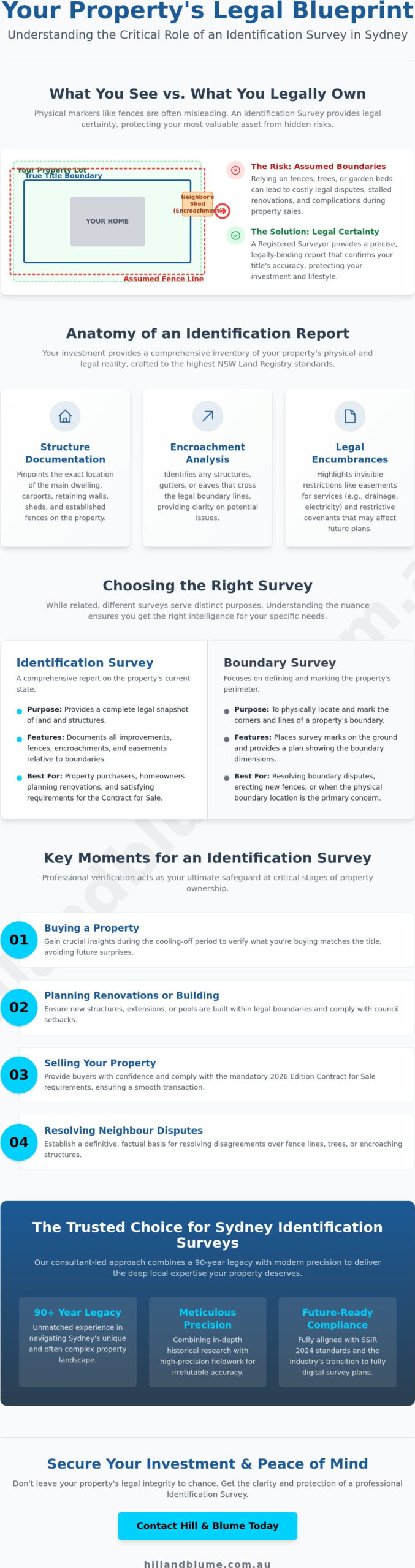
Many homeowners mistakenly believe that an existing fence line or a row of established trees accurately represents their property’s edge. In our experience, these visual markers are frequently misleading. Relying on “near enough” can invite significant legal complications, especially during a sale or a major renovation. A small encroachment of just a few centimeters can trigger costly disputes or stall a transaction entirely. By engaging a Registered Surveyor, you secure a precise verification that confirms your title’s accuracy. This level of detail is essential for maintaining the lifestyle you’ve built without the threat of boundary-related anxiety.
Identification Surveys vs. Boundary Surveys: Understanding the Nuance
While they share common ground, it’s vital to distinguish between different survey types to ensure you’re getting the specific data you need. A standard boundary survey focuses primarily on the location of the land’s edges and marking them on-site. In contrast, an identification survey provides a comprehensive snapshot of the property’s current state, including all improvements, fences, and buildings. It details how these structures relate to the legal boundaries. For a deeper look at the technical specifications of land marking, you may wish to explore our Boundary Surveys in Sydney guide. This distinction ensures you have the right intelligence for your specific property goals, allowing for a seamless and polished experience from start to finish.
The Anatomy of an Identification Report: What You Are Investing In
When you receive your completed identification survey, you’re holding a meticulously crafted blueprint of your property’s legal standing. It’s far more than a simple map; it’s a comprehensive inventory of your land’s physical and legal reality. Every permanent structure on your property, including the main dwelling, carports, retaining walls, and even established fences, is documented with surgical precision. By measuring the exact distances from these structures to the boundary lines, a surveyor provides the clarity you need to enjoy your home without the lingering doubt of boundary uncertainty.
The report also performs a vital comparative analysis. It identifies the current land area and weighs it against the dimensions recorded in the original historical title. This process ensures that the space you believe you own is legally supported by the Board of Surveying and Spatial Information (BOSSI) standards. Beyond the physical buildings, the report highlights the invisible threads that bind your property, such as easements for services or restrictive covenants that might influence your future plans. If you’re ready to secure this level of detail for your home, you can reach out to our boutique team for a tailored discussion.
Identifying Encroachments and Overhangs
In the densely settled suburbs of Sydney, even a few centimeters can carry significant legal weight. An encroachment occurs when a structure, or even a part of it like gutters or eaves, crosses the boundary line onto an adjoining property. Your report will clearly identify if a neighbor’s garage is resting on your land or if your own roofline overshoots the title limit. Identifying these issues early is vital to prevent claims of adverse possession, where a neighbor might eventually seek legal rights over a portion of your land due to long-term, undisputed use. Precise identification protects your property’s value and your long-term peace of mind.
Easements, Covenants, and Restrictions on Use
Easements and covenants are often hidden in the fine print of a title, yet they dictate how you can actually use your land. A surveyor doesn’t just read these documents; they locate physical evidence on-site, such as sewer manholes or shared access ways, to show exactly where these restrictions lie. This data is essential if you’re planning a renovation or an extension, as building over a registered easement can lead to forced demolition. Our professional land surveying services translate these complex legal layers into clear, actionable data, ensuring your vision for your property remains within the bounds of legal compliance and architectural possibility.
Navigating Property Risks: When is an Identification Survey Essential?
Identifying the exact moment to commission an identification survey is as vital as the survey itself. In the high-stakes world of Sydney real estate, timing is often the difference between a seamless transition and a protracted legal challenge. Lenders and financial institutions frequently require these reports to confirm that the security for their mortgage is physically and legally sound. For those undertaking new builds or significant developments, the survey is a non-negotiable step in the compliance chain. You simply cannot obtain an Occupation Certificate from your local Council without verifying that the finished structure adheres to all boundary setbacks and title requirements. It is the final, essential bridge between the vision of construction and the reality of legal occupancy.
Protecting Your Purchase: The Pre-Settlement Check
The cooling-off period offers a precious window of opportunity to verify your investment. We believe that completing your survey before a sale goes unconditional is the most effective way to ensure you aren’t “buying into” a pre-existing boundary dispute or a hidden encroachment. It is a recurring scenario in Sydney’s established suburbs: a new owner discovers a neighbor’s carport or shed is partially on their land only after settlement has occurred. By engaging a specialist land surveyor in Sydney, you gain a partner who understands the intricate local fabric. This professional verification, overseen by the Board of Surveying and Spatial Information (BOSSI), provides the legal certainty you need to proceed with peace of mind.
Renovations and New Fencing: Ensuring Precision
Precision is the cornerstone of maintaining a harmonious lifestyle when you decide to alter your property’s perimeter. A new fence should be an elegant addition to your home, not a source of neighborhood tension. Under the Dividing Fences Act, an identification survey serves as the definitive evidence required for fair cost-sharing and exact boundary placement. This level of precision is even more critical when you are investing in permanent structures such as swimming pools, retaining walls, or architectural extensions. Without a formal survey, you risk the heartbreaking possibility of building over a boundary or a registered easement. Such errors often lead to council-ordered removals or expensive legal settlements. Protecting your assets means ensuring every brick and beam is placed with absolute, verified accuracy.
The Surveying Process: From Deposited Plans to Registered Sign-off
The journey to legal certainty begins long before our team sets foot on your land. It’s a meticulous process of discovery that starts deep within the digital archives of the NSW Land Registry Services. We investigate the historical narrative of your property, analyzing the original Crown Grants and Deposited Plans that define its very existence. This preparation ensures that when we arrive on-site, we aren’t just measuring space; we’re validating a legacy. Every identification survey we produce is a culmination of this rigorous research and high-precision field work.
Once the research phase is complete, our surveyors utilize high-precision electronic distance measurement (EDM) technology on-site. This equipment allows us to capture data with a level of accuracy that meets the stringent SSIR 2024 standards, which recently introduced updated requirements for measurement equipment and accuracy tolerances. We then move into the calculation and drafting phase, where your property’s physical reality is harmonized with its legal title records. The final step is the most critical: the verification and signing by a Registered Surveyor. In New South Wales, a Registered Surveyor is the only individual legally authorized to sign an identification survey, providing you with a document that holds true legal weight. If you require this level of precision for your next property transaction, contact our specialist team today to begin the process.
Researching Sydney’s Historical Land Records
Retrieving and analyzing historical Deposited Plans (DPs) is an art form in itself. Many older Sydney suburbs still rely on descriptions of ‘metes and bounds’ that date back over a century, often referencing landmarks that no longer exist. Resolving the discrepancies between these archaic descriptions and modern, laser-precise measurements requires a deep understanding of local history and surveying evolution. This is why engaging a boundary surveyor with specific expertise in the NSW landscape is essential for protecting your investment. We bridge the gap between historical intent and modern legal reality, ensuring your title is as robust as the home built upon it.
The Final Report: Your Seal of Property Integrity
Your final report is a polished, professional document, now typically delivered as a digital file in accordance with the NSW transition to a fully digital survey plan process via LRS Connect. It features a clear, detailed plan showing your boundaries, all permanent structures, and any identified encroachments or overhangs. The legal weight of the report rests on the Registered Surveyor’s signature and seal, which acts as a guarantee of accuracy and compliance. A Registered Surveyor status is a mandatory requirement for any professional providing NSW identification reports, ensuring that your property’s legal integrity is upheld by a qualified local authority.
Why Hill & Blume is the Trusted Choice for Sydney Identification Surveys
Choosing a partner to verify your property’s boundaries is a decision that resonates through the entire life of your investment. It’s about more than just a technical report; it’s about securing a legacy of legal certainty. At Hill & Blume, we’ve positioned ourselves as a specialized local authority, offering a boutique experience that prioritizes the depth of our relationships over high-volume turnover. When you commission an identification survey with us, you’re engaging with a team that values craftsmanship and care, ensuring your property remains an asset of total integrity. We don’t just provide data. We provide a curated experience that respects your time and your intelligence.
Our firm presents as a forward-thinking agency that remains anchored by traditional integrity and a personal touch. We understand that architects, developers, and discerning homeowners require more than a standard checklist. They need a specialist who understands the human element of real estate. By blending nearly a century of historical wisdom with the latest digital measurement technologies, we provide a level of certainty that larger, more clinical agencies simply cannot replicate. We believe in quality over quantity, ensuring every project receives our full, detail-oriented attention.
A Legacy of Precision Since 1932
Hill & Blume’s roots are deeply embedded in the local fabric of New South Wales. Since 1932, we’ve maintained a steady, deliberate presence across the Sydney, Newcastle, and Central Coast regions. This longevity isn’t just a number; it represents a vast, curated archive of historical land data that we draw upon to resolve even the most complex title discrepancies. Our firm has played a vital role in major infrastructure and residential projects, providing the foundational precision that industry leaders rely on. This deep-rooted knowledge allows us to navigate the unique challenges of Sydney’s historical suburbs with a sense of calm confidence that only decades of experience can provide.
Tailored Solutions for Your Property Aspirations
We believe that every property tells a story, and our role is to ensure that story is protected by legal fact. Our consultant-led approach means you aren’t just a file number; you’re a partner in a considered conversation about your property’s future. Whether you’re a homeowner protecting a private sanctuary or a developer seeking subdivision plans, we provide a seamless service that mirrors the high-end lifestyle you aim to achieve. We combine traditional integrity with modern precision, ensuring our identification survey reports meet the highest contemporary standards. We invite you to explore our full range of surveying services or contact our team for a tailored quote to begin your journey toward property certainty.
Securing Your Property Legacy with Confidence
Your Sydney property is more than just land and structures; it’s a sanctuary and a vital part of your lifestyle. Ensuring its legal integrity requires a level of precision that only an identification survey can provide. You’ve discovered how this essential document resolves boundary uncertainties, protects you from hidden encroachments, and ensures total compliance with evolving NSW Land Registry standards. By prioritizing this professional verification, you’re choosing to safeguard your investment against the complexities of historical titles and modern regulatory shifts.
At Hill & Blume, we bring over 90 years of Sydney surveying expertise to every consultation. Our Registered Surveyors offer a boutique, personalized service designed to navigate even the most intricate property boundaries with calm confidence. We believe that a home should be a source of pride, not a catalyst for legal anxiety. You deserve a partner who values craftsmanship and traditional integrity as much as you do. When you’re ready to achieve total boundary certainty, we’re here to guide you through a considered conversation about your land’s future.
Secure your property’s future with a Hill & Blume Identification Survey. We look forward to helping you protect the unique charm and value of your Sydney home.
Frequently Asked Questions
What is the difference between an identification survey and a boundary survey?
A boundary survey focuses primarily on marking the physical edges of your land on-site, whereas an identification survey provides a comprehensive legal report on the relationship between your boundaries and any structures. It documents every permanent improvement, including dwellings, fences, and carports, to ensure they sit within the legal title limits. This report is a vital tool for property transactions and asset protection.
Is an identification survey mandatory when buying a house in Sydney?
While not strictly mandatory for every private sale in NSW, an identification survey is a standard requirement for most financial institutions before they approve a mortgage. Even when buying with cash, we recommend commissioning a report during the cooling-off period. It’s the only way to verify that you are truly purchasing the land and structures described in the contract for sale.
How long does it take to complete an identification survey in NSW?
The typical turnaround time for a professional assessment in Sydney is approximately two to three weeks. This duration allows our team to conduct deep research into historical land records and perform high-precision field work. If your property is located in an older heritage area or on a complex site, the process may take longer to ensure absolute accuracy and legal integrity.
Can a standard builder or tradesperson perform an identification survey?
No, only a Registered Surveyor is legally authorized to perform and sign an identification report in New South Wales. Builders and other tradespeople do not have the specialized training, high-precision equipment, or the legal standing required by the NSW Land Registry. Relying on an unqualified individual for boundary verification can lead to significant legal and financial risks.
What happens if an identification survey reveals an encroachment?
If the report reveals that a structure crosses a boundary line, it provides the definitive evidence you need to address the issue. You can use this data to negotiate with neighbors, seek legal advice regarding an easement, or arrange for the physical rectification of the structure. Early identification is the key to resolving these complexities before they escalate into costly court disputes.
How much does an identification survey typically cost in Sydney?
The investment required for your survey is influenced by several variables, including the age of the suburb and the complexity of the property’s topography. Older areas often require more extensive historical research, while properties on busy main roads may present access challenges. We provide tailored quotes that reflect the specific requirements and craftsmanship needed for your unique land title.
How long is an identification survey report valid for in NSW?
An identification report is a snapshot of your property’s status at a specific moment in time. While the legal boundaries remain constant, the report’s relevance depends on whether any new structures or fences have been built since the survey date. Most lenders and legal professionals prefer a report prepared within the last two years to ensure total accuracy for a transaction.
Do I need an identification survey for a simple fence replacement?
We highly recommend a survey before replacing any boundary fencing to ensure the new structure is placed exactly on the legal line. This precision is essential for complying with the Dividing Fences Act and ensures that any cost-sharing arrangements with neighbors are based on verified data. It’s a simple step that prevents long-term neighborhood tension and potential legal challenges.
Disclaimer
The information provided in articles published on this website is for general informational purposes only. While we make every effort to ensure the accuracy, completeness, and timeliness of the content, the material is based on our understanding of the industry at the time of writing and may not reflect the most current developments, regulations, or standards. All opinions expressed in our articles are those of the respective authors and do not necessarily represent the official position of the website or its affiliates. The content should not be considered professional, legal or technical advice, and should not be relied upon as a substitute for consultation with qualified professionals